Bridging the Gap: How ‘Prop For That’ is Revolutionizing CSS-JavaScript Interactivity
For years, the divide between the declarative nature of Cascading Style Sheets (CSS) and the imperative power of JavaScript has been a fundamental reality of web development. CSS is the language of presentation—static, predictable, and performant—while JavaScript is the language of logic, capable of sniffing out complex browser states and user interactions.
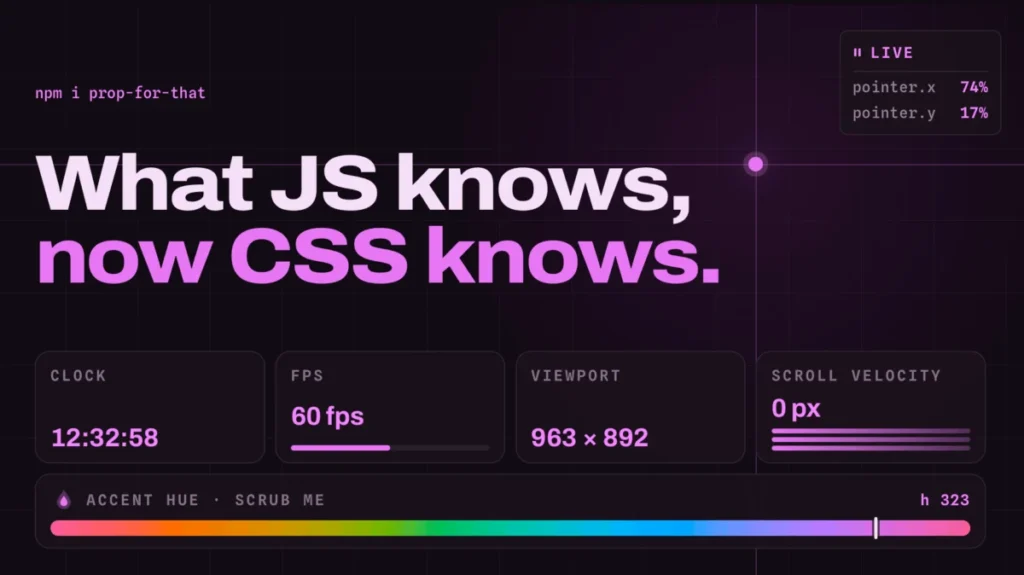
However, Adam Argyle—a prominent figure in the CSS ecosystem and the creator behind the widely adopted Open Props—has just shifted the paradigm once again. His latest project, Prop For That, serves as a bridge, bringing high-level browser metadata directly into the CSS layer without requiring developers to write boilerplate JavaScript for every interaction. By leveraging data attributes and custom properties, Prop For That promises to make the "impossible" in CSS—like tracking real-time cursor velocity, scroll progress, and form states—not only possible but trivial.
The Main Facts: What is Prop For That?
At its core, Prop For That is a utility library designed to expose live browser state to CSS variables. Historically, if a developer wanted to change a CSS value based on a user’s scroll velocity or mouse position, they were required to manually write an event listener in JavaScript, calculate the values, and then update a CSS variable via element.style.setProperty().
Prop For That abstracts this entirely. By importing the library and assigning a specific data-props-for attribute to an HTML element, the library automatically attaches the necessary "observer" logic. These observers feed live data into CSS custom properties (variables) that are scoped to that element.
The library handles:
- Pointer Tracking: Real-time X and Y coordinates.
- Scroll Dynamics: Scroll position, percentage, and velocity.
- Temporal Data: Real-time clock and date values.
- Form States: Validity, focus, and input interactions.
- Browser Metrics: Viewport dimensions and visibility states.
This transformation allows developers to keep their logic and presentation tightly coupled without the "spaghetti code" that often results from manual DOM manipulation.
A Chronology of CSS Evolution
To understand the magnitude of this release, one must look at the evolution of CSS over the last decade.
1. The Era of Static Styling (Pre-2015)
In the early days, CSS was strictly for static visual styling. If an element needed to move in response to a mouse hover, developers relied on :hover pseudo-classes. Anything more complex required heavy JavaScript libraries like jQuery to perform direct style manipulation.
2. The Rise of Custom Properties (2016–2020)
The introduction of CSS Variables (Custom Properties) was a turning point. It allowed developers to create "themeable" components. However, these variables were still essentially static; they didn’t "know" about the browser environment unless a developer manually injected values into them.
3. The "Open Props" Revolution (2021)
Adam Argyle’s Open Props provided a massive set of preconfigured variables for color palettes, shadows, and spacing. It was a utility-first approach that proved developers were hungry for standardized design tokens. Prop For That is effectively the functional successor to Open Props; while the former provided the aesthetic variables, the latter provides the dynamic variables.
4. The Arrival of Prop For That (2024)
With the launch of Prop For That, the web development community has reached a new stage: Reactive CSS. By enabling CSS to observe its own environment, Argyle has effectively offloaded the "glue code" of web development into a standardized, lightweight library.
Supporting Data: Implementation Mechanics
The technical elegance of Prop For That lies in its simplicity. Instead of forcing developers to manage complex event loops, the library uses a declarative syntax.
Consider the task of tracking a pointer’s location. Previously, one would need to write a script like this:
window.addEventListener('mousemove', (e) =>
  document.documentElement.style.setProperty('--x', e.clientX);
  document.documentElement.style.setProperty('--y', e.clientY);
);
With Prop For That, the JavaScript is entirely abstracted. The developer simply adds the attribute:
<div class="pointer-follower" data-props-for="pointer"></div>The CSS then consumes the variable directly:
.pointer-follower
  position: absolute;
  left: calc(var(--live-pointer-x, 0) * 1px);
  top: calc(var(--live-pointer-y, 0) * 1px);
The library injects these variables into the scope of the element, meaning that if you have multiple elements, they can each track their own interaction states independently without global variable conflicts.
Official Responses and Developer Sentiment
The reception within the frontend engineering community has been overwhelmingly positive. Early testers have noted that the library’s greatest strength is its performance. By utilizing requestAnimationFrame and IntersectionObserver under the hood, the library minimizes layout thrashing—a common pitfall when developers manually update DOM styles in high-frequency loops.
Adam Argyle, in his documentation, emphasizes the "classy" nature of these demos. By removing the friction of JavaScript, he argues, developers are more likely to experiment with complex visual interactions. "When the barrier to entry for dynamic design is lowered, the entire web becomes more interactive and intuitive," Argyle noted in his release announcement.
Critics, however, have raised questions regarding the performance cost of attaching too many observers to a single page. If a developer were to apply data-props-for to hundreds of elements simultaneously, the memory overhead could theoretically impact performance on low-end devices. However, the library is architected to be "tree-shakable" and modular, allowing developers to import only the plugins they need, such as pointer-local.ts or scroll-velocity.ts.
Implications for the Future of Web Development
The release of Prop For That has profound implications for how we define the boundary between CSS and JavaScript.
1. The Decline of "Boilerplate Glue"
For years, a significant percentage of frontend code has been dedicated to the "glue" that connects data to view. Libraries like Prop For That suggest a future where the browser’s own state is natively observable via CSS. It is possible that in the coming years, much of the functionality provided by this library will be baked into the CSS specification itself (such as the burgeoning scroll-timeline and anchor-positioning APIs).
2. Democratizing Complex UI
Interactive web design has historically been reserved for developers with a strong grasp of JavaScript event loops and coordinate mathematics. By abstracting this logic into data attributes, Prop For That democratizes the ability to build high-end, responsive, and interactive interfaces. A junior developer can now create a mouse-following effect or a complex scroll-triggered animation in minutes rather than hours.
3. A Shift Toward Declarative Design
Web development is clearly trending toward declarative patterns. Whether it is the rise of React Server Components or the maturation of CSS, the industry is signaling a move away from imperative DOM manipulation. Prop For That aligns perfectly with this trend, encouraging developers to describe what they want the UI to look like based on state, rather than how to calculate and apply those states manually.
Conclusion
The impact of Adam Argyle’s work on the modern web cannot be overstated. With Open Props, he standardized the "look" of the web. With Prop For That, he is now standardizing the "behavior" of the web.
While seasoned engineers might prefer writing custom hooks or performance-optimized logic for mission-critical applications, the accessibility and ease-of-use offered by Prop For That are unparalleled. It serves as a bridge for developers who want to push the boundaries of visual design without getting bogged down in the intricacies of browser events.
As we look toward the future, it is likely that the line between CSS and JavaScript will continue to blur. For now, Prop For That stands as a powerful tool in the arsenal of any developer looking to build a more dynamic, engaging, and responsive web. Whether you are building a personal portfolio or a sophisticated landing page, the ability to effortlessly bind live browser data to your stylesheets is a game-changer that is set to define the next generation of web interactivity.