The New Era of Dalal Street: India’s Startup IPO Landscape in 2026
The year 2025 marked a watershed moment for the Indian startup ecosystem, as Dalal Street effectively transformed into a "founder’s paradise." A staggering 18 Indian startups successfully navigated the complexities of public markets, collectively raising a record-breaking INR 41,248 Cr. This wave of listings wasn’t merely a byproduct of market liquidity; it was a result of fundamental shifts in macroeconomic tailwinds and a deliberate, supportive regulatory framework.
As we progress through the first half of 2026, the fervor has transitioned into a phase of "calculated maturation." While the pipeline remains robust, the appetite of public market investors has shifted from aggressive headline growth to a disciplined focus on sustainable unit economics, profitability, and transparent corporate governance.
The 2025 Foundation: A Regulatory and Economic Pivot
The 2025 surge was powered by a convergence of forces. Robust GDP growth projections bolstered investor confidence, but it was the Securities and Exchange Board of India (SEBI) that acted as the primary catalyst. By simplifying Draft Red Herring Prospectus (DRHP) filings and modernizing ESOP rules, SEBI enabled founders to retain meaningful equity ownership while streamlining the transition from private to public.
The emergence of retail participation was equally instrumental, with demat account registrations crossing the 20 Cr milestone. This influx of domestic liquidity allowed tech companies to rely less on volatile Foreign Institutional Investors (FIIs) and more on a steady base of domestic retail and institutional support. However, the dominance of Offer for Sale (OFS) components in these IPOs served a specific purpose: providing the necessary exit liquidity for the early-stage venture capital backers who had supported these firms through their hyper-growth years.
2026: The Year of Recalibration
If 2025 was defined by the sheer volume of listings, 2026 is defined by "recalibration." While seven new-age tech companies have already made their D-Street debut, the market response has been mixed. Barring successful outliers like SEDEMAC and Kissht, many listings have seen flat or lacklustre performance.
This cooling sentiment is a direct response to the market’s demand for value. Investors are no longer enamored by the "growth-at-all-costs" narrative. Instead, they are prioritizing predictable cash flows and operational efficiency.
"IPO-bound startups in 2026 will be increasingly defined by their ability to demonstrate predictable cash flows, sustainable unit economics, and operational discipline," noted Rehan Yar Khan, managing partner at Orios Venture Partners. "Public market investors are placing greater emphasis on governance, capital efficiency, and long-term value creation, favouring companies that balance scale with financial prudence."
A Snapshot of Recent Debuts
The performance of 2026 debutants offers a clear window into investor sentiment:
- Amagi: Despite being a cloud-based SaaS powerhouse, its debut was lacklustre, with shares listing at a 12.2% discount to the issue price. The market reaction reflected a cautious view on the broader SaaS sector’s valuation multiples.
- Kissht: In a stark contrast, the lending tech platform saw a stellar debut with an 11.7% premium, signalling that fintechs with clear AI-driven credit assessment models still command high trust.
- SEDEMAC: The deeptech firm’s 13.5% premium at listing underscored the market’s hunger for industrial-grade technology and defensible manufacturing moats.
- Shadowfax: The logistics major faced a muted debut, with shares listing at a discount, reflecting the intense competition and margin pressures inherent in the logistics sector.
The Robust Pipeline: The Road Ahead
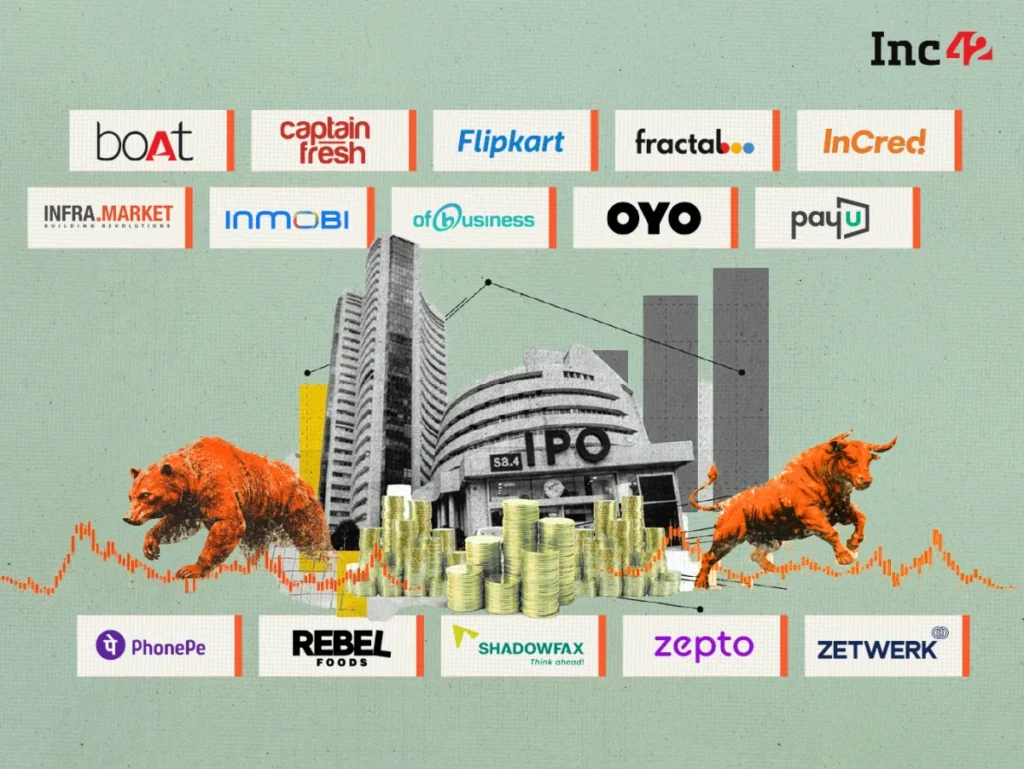
Despite the volatility, the IPO pipeline for the remainder of 2026 and early 2027 remains one of the strongest in India’s history. Over 28 startups have already filed their DRHPs, with an additional 24 in the final stages of planning. Giants like Zepto, OYO (rebranded as PRISM), InMobi, and Zetwerk are potential heavyweights that could collectively raise upwards of INR 45,000 Cr.
Key Companies in the Wings
- Zepto: After a strategic pause to optimize unit economics, the quick-commerce unicorn has filed an updated DRHP for a massive INR 8,010 Cr fresh issue. Its ability to scale while narrowing losses will be the key metric for investors.
- OYO (PRISM): After multiple attempts, the hospitality giant has finally secured SEBI’s nod for a INR 6,650 Cr IPO. The market will be watching whether PRISM’s shift from a pure-play aggregator to a diverse travel-tech suite justifies its $7-8 Bn valuation target.
- InCred Holdings: Having received SEBI’s approval in February 2026, the firm is preparing for a INR 1,250 Cr fresh issue. Their steady performance in 9M FY26 suggests a well-managed transition.
- Razorpay: As a backbone of the Indian payments infrastructure, Razorpay’s decision to file via the confidential route for a $500-700 Mn IPO is highly anticipated. Their ability to turn a profit after accounting for ESOP expenses will be a major point of analysis for public market analysts.
Challenges and Market Sentiment
The current landscape is not without its hurdles. FIIs have been pulling back in response to geopolitical tensions—most notably the ongoing conflict in West Asia—and muted performance in the secondary markets. Retail subscription levels, while still healthy compared to global standards, have begun to moderate as investors become more selective.
However, Ashish Kumar, co-founder of Fundamentum Partnership, remains bullish. "Besides the readiness that startups showed in their unit economics, there is also an increase in the founders committing to their businesses for the next couple of decades… something that the public markets reward handsomely."
Strategic Implications
For founders, the lesson of 2026 is clear: the IPO is not the finish line; it is the starting point of a new level of scrutiny. The companies that will succeed are those that have successfully pivoted from the venture-capital-funded growth model to the public-market-funded profit model.
Governance, which was previously a secondary concern for many high-growth startups, is now a prerequisite. The transition from private boardrooms to public shareholder meetings requires a level of transparency and capital efficiency that many are currently working to institutionalize.
Conclusion: The Maturation of an Ecosystem
India’s startup IPO journey is entering its most critical phase. The initial "hype" phase has passed, replaced by a rigorous, valuation-conscious environment. This is a positive evolution. As the market forces startups to prioritize long-term value over short-term vanity metrics, the quality of companies listing on Dalal Street will naturally improve.
While short-term market volatility and global geopolitical tensions remain, the underlying fundamentals of the Indian economy and the maturing business models of its tech giants suggest that India will continue to solidify its position as a global leader in the startup-to-public-market pipeline. Investors who can look past the current market noise and identify companies with strong moats, operational discipline, and clear paths to profitability will likely be the primary beneficiaries of this transformative era.
Summary Table of Upcoming Major IPOs (Indicative)
| Company | Sector | IPO Size (Approx) | Status |
|---|---|---|---|
| Zepto | Quick Commerce | INR 11,682 Cr | Filed |
| OYO (PRISM) | Travel Tech | INR 6,650 Cr | Filed |
| PhonePe | Fintech | INR 10,700-13,400 Cr | Filed |
| Razorpay | Fintech | INR 4,500 Cr | Conf. Filed |
| Infra.Market | Ecommerce | INR 5,000 Cr | Filed |
| Zetwerk | Ecommerce | INR 3,456-4,320 Cr | DRHP Pending |
Note: Data is sourced from DRHP filings, MCA records, and media reports. IPO sizes and valuation numbers are subject to change based on final market conditions and regulatory approval.