Supercharging Infrastructure: AWS Launches CloudFormation Express Mode to Slash Deployment Times
In the rapidly evolving landscape of cloud-native development, speed is the ultimate currency. Developers and engineers, increasingly reliant on Infrastructure-as-Code (IaC) to manage complex, distributed systems, have long sought a balance between robust validation and rapid iteration. Today, Amazon Web Services (AWS) addressed this demand head-on by announcing the general availability of AWS CloudFormation Express mode, a transformative deployment configuration designed to accelerate infrastructure provisioning by up to four times.
This development marks a significant shift in how CloudFormation—the backbone of AWS resource management—handles the lifecycle of stacks. By decoupling resource configuration from the traditional, time-intensive "stabilization" phase, AWS is empowering developers to iterate faster, test more frequently, and integrate AI-assisted coding tools with unprecedented efficiency.
Main Facts: Redefining the Deployment Loop
At its core, CloudFormation Express mode is an optimization engine. Historically, every CloudFormation deployment followed a rigid sequence: resource configuration followed by a comprehensive stabilization check. These checks verify that every resource in a stack—be it an Amazon SQS queue, a Lambda function, or a complex VPC setup—is fully operational and ready to serve traffic before the deployment is marked as "complete."
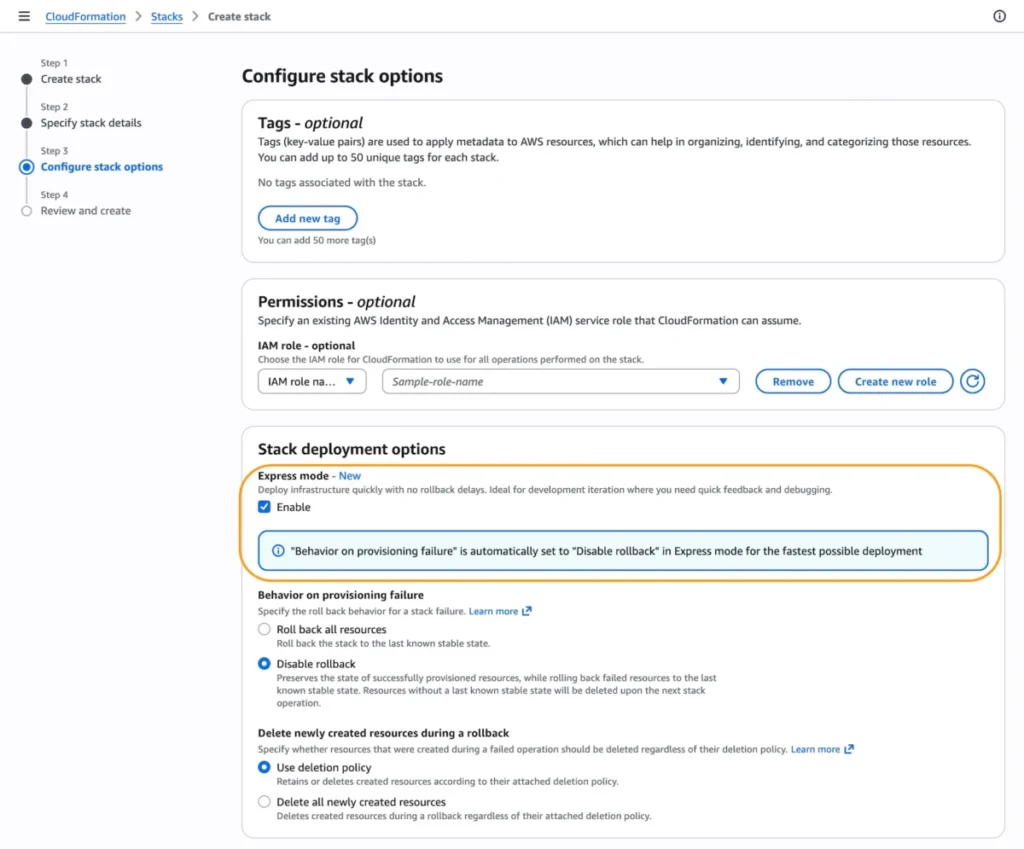
While essential for production environments where service availability is paramount, these checks can become a bottleneck during the development and testing phases. Express mode fundamentally alters this behavior. When enabled, CloudFormation confirms that the requested resource configuration has been applied and immediately signals completion, allowing the underlying resources to stabilize asynchronously in the background.
Key Technical Pillars:
- Asynchronous Stabilization: Resources continue to reach their operational state without holding up the deployment process.
- Built-in Resilience: CloudFormation automatically manages transient failures. If a dependency encounters a temporary issue during provisioning, the system retries the operation within the stack automatically, removing the need for manual developer intervention.
- Zero-Template Friction: Express mode requires no changes to existing YAML or JSON templates. It is an operational setting that can be toggled via the AWS Management Console, AWS CLI, or SDKs.
- Speed Metrics: Internal benchmarks provided by AWS highlight staggering performance improvements. For instance, creating an SQS queue with a dead-letter queue (DLQ) sees deployment times drop from 64 seconds to a mere 10 seconds. Even more dramatic are the improvements in resource deletion; removing a Lambda function with complex network interface attachments—a process that typically takes 20 to 30 minutes—can now be completed in under 10 seconds.
Chronology: The Evolution of Cloud Automation
The introduction of Express mode is the latest chapter in a long history of AWS’s commitment to developer productivity. To understand the significance of this launch, one must look at the progression of infrastructure management:
- The Manual Era: In the early years of cloud computing, infrastructure was largely provisioned via manual console clicks, leading to "configuration drift" and inconsistent environments.
- The Advent of CloudFormation: AWS introduced CloudFormation to provide a declarative way to model and set up AWS resources. This brought consistency but introduced the "stabilization tax," where deployment speed was sacrificed for safety.
- The IaC Explosion: The rise of tools like the AWS Cloud Development Kit (CDK) and Terraform pushed the industry toward programmatic infrastructure. However, as stacks grew in complexity, the time required to "wait for stacks to complete" became a common pain point for DevOps teams.
- The AI-Assisted Present: With the rise of AI-powered coding assistants—such as those integrated into the AWS ecosystem—the feedback loop between writing code and seeing infrastructure provisioned has become the new frontier of efficiency. Express mode was built specifically to accommodate the sub-minute feedback loops required by modern AI development workflows.
Supporting Data: When Speed Meets Stability
The necessity for Express mode is backed by clear usage patterns. Not all infrastructure changes are created equal. When a developer is prototyping a microservice or iterating on a testing environment, they often do not need the guarantee of "full service readiness" that a production-grade stabilization check provides.
Performance Gains at a Glance
| Operation | Standard Mode | Express Mode | Improvement |
|---|---|---|---|
| Create SQS + DLQ | 64 Seconds | 10 Seconds | ~6.4x faster |
| Delete Lambda w/ ENI | 20-30 Minutes | 10 Seconds | ~120x+ faster |
These numbers underscore the primary benefit of Express mode: the reduction of "wait time." In a typical development cycle involving dozens of small adjustments per day, these cumulative time savings represent a massive boost to developer velocity. By disabling mandatory rollback by default in Express mode, AWS further optimizes the process for rapid iteration, allowing developers to push forward with their configurations without being blocked by minor, non-critical initialization errors.
Official Responses: Architecting for the Developer
Channy Yun, a Principal Developer Advocate at AWS, emphasized that Express mode is not a replacement for standard deployments, but a new tool in the architect’s arsenal. "Express mode changes when the deployment completes, not how resources are provisioned," Yun explained. "It allows for a more fluid interaction between the developer and their infrastructure, particularly when utilizing AI tools that require rapid feedback."
AWS has made it clear that this feature is designed to be highly interoperable. Whether using the AWS CLI, SDKs, or the AWS CDK, the implementation is consistent. By setting the --deployment-config parameter to EXPRESS, users can immediately begin utilizing this mode across their existing CI/CD pipelines.
For those concerned about safety, AWS has provided a clear path to customization. While rollback is disabled by default to maximize speed, users can easily re-enable it for production-ready stacks by setting disableRollback to false. This flexibility ensures that while Express mode is a "speed-first" feature, it remains a "safety-aware" platform.
Implications: The Future of Cloud-Native Workflows
The launch of CloudFormation Express mode carries significant implications for the broader industry.
1. The AI-Driven Development Loop
The integration with AI tools is perhaps the most forward-looking aspect of this announcement. AI assistants, which can generate infrastructure code in seconds, were previously hampered by the "wait time" of traditional CloudFormation deployments. With Express mode, the "Write-Deploy-Test" cycle for AI-generated code is now near-instantaneous, effectively creating a real-time collaborative environment between human developers and machine intelligence.

2. Microservices and Modular Infrastructure
As companies continue to decompose monolithic applications into microservices, the number of stacks managed by a single organization is skyrocketing. Express mode is uniquely suited for this modular architecture, where individual microservices are updated frequently. The ability to update a Lambda function or a queue mapping in seconds rather than minutes allows teams to deploy more frequently, supporting true Continuous Delivery (CD).
3. Cost and Operational Efficiency
While Express mode does not directly change the cost of AWS resources, it significantly reduces the "cost of time." Engineering hours spent waiting for deployments to stabilize are non-billable overhead. By eliminating this waiting, organizations can redirect developer focus toward building features rather than managing deployment logistics.
4. A Paradigm Shift in DevOps
We are witnessing a shift in the DevOps philosophy. For years, the mantra has been "stability above all." While stability remains the foundation, the industry is now moving toward "resilient agility." Express mode assumes that transient failures are a natural part of the cloud and that infrastructure can be self-healing. By automating the retry logic and moving stabilization to the background, AWS is signaling a move toward more autonomous, self-managing cloud infrastructure.
Conclusion: Getting Started
CloudFormation Express mode is available today in all commercial AWS regions at no additional cost. Developers are encouraged to begin by testing the mode on development or staging environments to gauge the performance improvements for their specific stack architectures.
As the ecosystem continues to embrace AI-assisted development and modular, microservice-based architectures, tools like Express mode will be essential for maintaining competitive velocity. By bridging the gap between rapid iteration and managed infrastructure, AWS has once again set a new standard for what it means to build in the cloud. As of now, the documentation is live, and the community on AWS re:Post is already actively discussing the best ways to incorporate this new speed-first paradigm into their existing pipelines. The message from AWS is clear: the wait is over.