Revolutionizing Agility: AWS Dramatically Accelerates Amazon ECS Service Auto Scaling
In the high-stakes world of cloud-native infrastructure, the difference between a seamless user experience and a service outage is often measured in seconds. For organizations relying on containerized workloads, the ability to react to traffic spikes is paramount. Today, Amazon Web Services (AWS) has announced a significant evolution in its container orchestration capabilities: the introduction of high-resolution, 20-second metrics for Amazon Elastic Container Service (ECS) Service Auto Scaling. This enhancement marks a paradigm shift in how applications respond to fluctuating demand, slashing scale-out times by more than 70% and providing a more granular, responsive architecture for modern microservices.
The Core Innovation: Closing the Latency Gap
At its foundation, Amazon ECS has long offered a robust suite of auto-scaling features, including predictive scaling for cyclical traffic, scheduled scaling for known events, and target tracking for reactive adjustments. However, these mechanisms have historically relied on standard 60-second metric resolution via Amazon CloudWatch. While sufficient for many workloads, this one-minute interval can create a "lag" in highly dynamic environments where traffic surges occur rapidly.
The latest update effectively triples the resolution of these monitoring signals. By moving to a 20-second reporting cadence, ECS services can now detect load imbalances and trigger provisioning workflows with unprecedented speed. This is not merely a minor optimization; it is a fundamental reduction in the time-to-value for scaling operations.
Chronology of the Update
The journey toward this release reflects AWS’s ongoing commitment to performance optimization across its stack.
- Pre-Launch Era: Historically, Amazon ECS relied on the standard CloudWatch metric cycle. For years, engineers were forced to over-provision resources to buffer against the 60-second reaction window, leading to increased costs and inefficient resource utilization.
- The Development Phase: AWS engineering teams identified that the bottleneck was not in the orchestration logic itself, but in the granularity of the feedback loop. By integrating high-resolution data streams directly into the Application Auto Scaling engine, the team aimed to minimize the interval between a metric spike and a scale-out event.
- Benchmarking Period: Throughout internal stress testing, AWS focused on two key performance indicators: the time to trigger a scale-out event and the total time required to provision new tasks. The results confirmed that high-resolution data allowed for a much tighter coupling between real-time metrics and infrastructure response.
- Official Rollout: The feature is now generally available across all ECS compute options, including AWS Fargate, Amazon EC2, and ECS Managed Instances.
Supporting Data: Quantifying the Performance Gains
The impact of this upgrade is most clearly demonstrated through the data provided by AWS’s internal benchmarking. In competitive and high-traffic environments, these seconds are not just metrics—they are the difference between maintaining service level objectives (SLOs) and triggering customer-facing errors.

The Scale-Out Trigger
Previously, the time taken to register a metric breach and trigger a scaling action averaged 363 seconds. With the new 20-second high-resolution metrics, this time has been slashed to 86 seconds. This represents a 4.2x improvement in responsiveness, or a 76% reduction in latency.
Total Provisioning Throughput
Equally impressive is the improvement in the "time to ready" metric. The total duration required to move from the initial load spike to the point where new tasks are fully provisioned and handling traffic has dropped from 386 seconds to 109 seconds. This 72% improvement (3.5x faster) ensures that applications are "battle-ready" significantly faster than before, effectively insulating the user experience from sudden traffic spikes.
Technical Implementation and Operational Workflow
For DevOps teams and system architects, adopting this new capability is designed to be a streamlined process. The configuration is integrated directly into the existing ECS console and API structures, minimizing the overhead of refactoring infrastructure-as-code (IaC).
Enabling High-Resolution Metrics
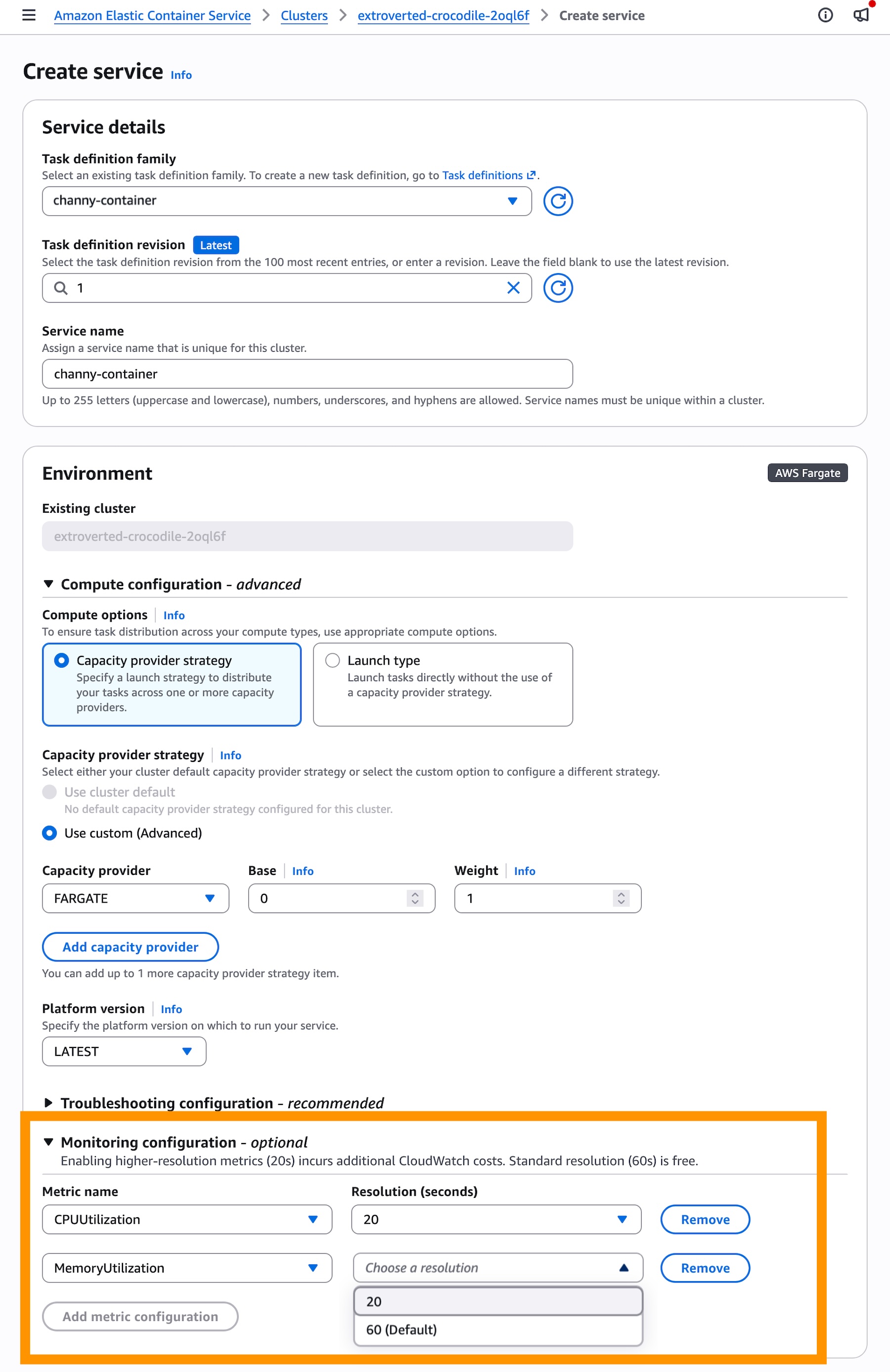
The process begins at the service level. When creating or updating an ECS service, users can now specify the "Monitoring configuration." By selecting the 20-second resolution option, the service begins emitting metrics at the higher frequency.
Target Tracking Integration
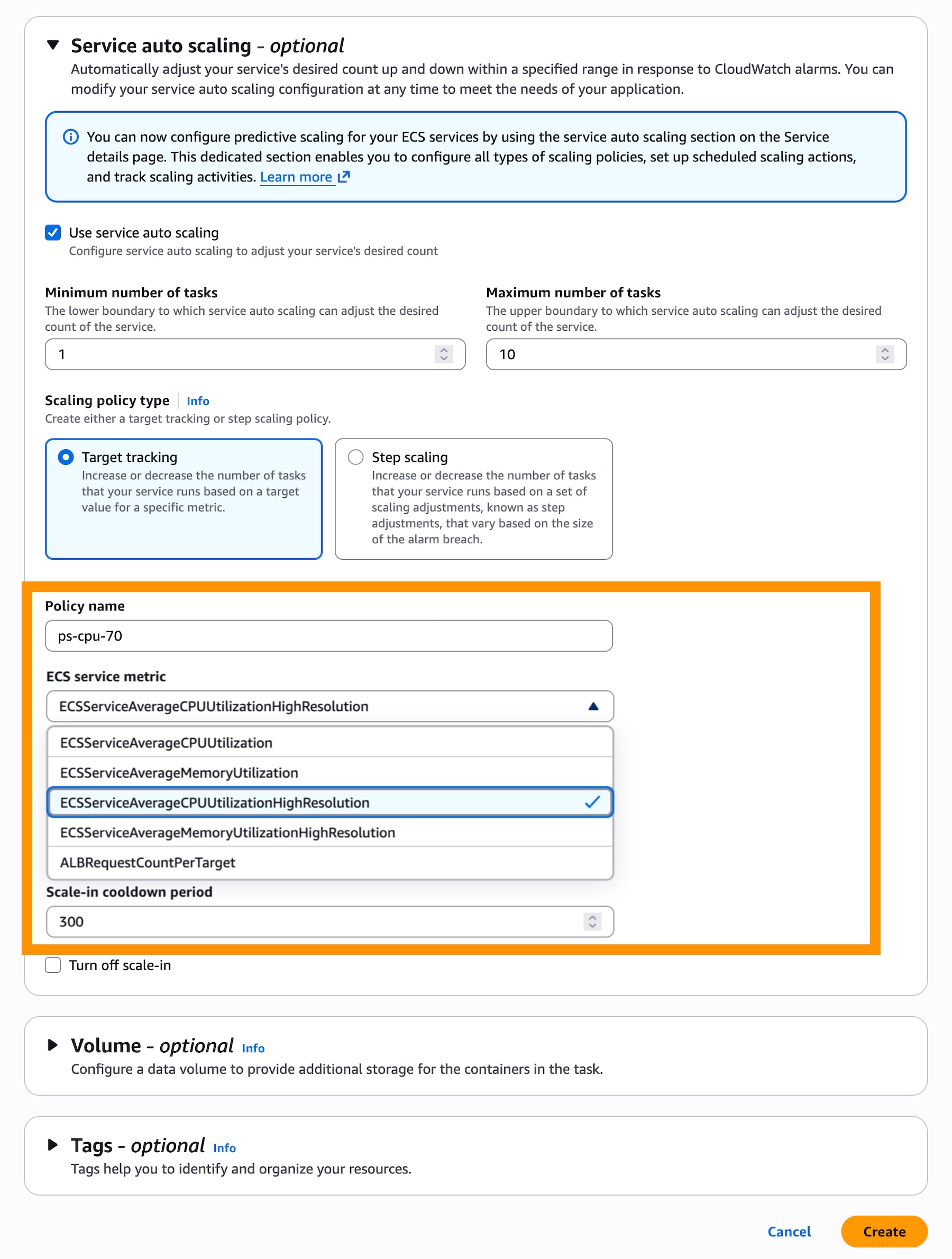
Once the high-resolution metrics are active, users must define a target tracking scaling policy. AWS has introduced specific high-resolution metrics—ECSServiceAverageCPUUtilizationHighResolution and ECSServiceAverageMemoryUtilizationHighResolution—to facilitate this. By selecting these as the basis for the target tracking policy, the auto-scaler is automatically updated to poll the data every 20 seconds rather than every 60 seconds.

Compatibility Across Compute Options
A standout aspect of this release is its ubiquity. Whether an organization is running serverless workloads on AWS Fargate or managing their own clusters via Amazon EC2 instances, the feature is fully supported. This consistency ensures that architectural teams do not need to choose between infrastructure flexibility and performance responsiveness.
Implications for Modern Cloud Architecture
The implications of this update extend far beyond simple efficiency metrics. The availability of 20-second auto-scaling has profound impacts on cost management, architectural design, and service reliability.
Cost Optimization via Precision
For years, the "over-provisioning tax" has been a standard part of cloud accounting. To handle a 60-second lag, companies would often maintain a higher "baseline" of tasks than strictly necessary, just to ensure that the initial seconds of a traffic spike didn’t overwhelm the system. By reducing the scale-out time to 109 seconds, businesses can adopt a "leaner" baseline, reducing waste and optimizing their monthly AWS bill.
Resilience and Elasticity
In the microservices model, services are highly interdependent. A latency spike in a downstream service can quickly propagate through a system, causing a cascading failure. By shortening the reaction time, ECS helps maintain the integrity of these chains. Organizations can now handle "flash sales" or viral traffic events with greater confidence, knowing their infrastructure is elastic enough to match the velocity of their users.
The Role of CloudWatch Pricing
While the ECS feature itself carries no additional charge, it is critical for architects to understand the economic model of high-resolution metrics. High-resolution CloudWatch metrics are billed differently than standard metrics. As users transition their services to the 20-second model, they should review their CloudWatch pricing documentation to ensure the budget forecast reflects the increased granularity of the data streams. This is a classic "performance-for-cost" trade-off that remains highly favorable for mission-critical applications.
Expert Perspective: Why This Matters
"This launch represents a maturation of the container orchestration layer," notes one industry observer. "We are moving away from the era where we had to guess the load based on a minute-by-minute heartbeat. Now, we are seeing the infrastructure act as a real-time extension of the application code itself."
The move to 20-second metrics is part of a broader trend in AWS to empower developers with more granular control over their environment. As containerization continues to dominate the software development landscape, the infrastructure underneath must become increasingly invisible—a goal that is only achievable when the scaling logic is as fast as the application it supports.
Getting Started: A Call to Action
AWS has provided comprehensive documentation for teams ready to integrate these features. The documentation covers everything from CLI commands for automated deployments to detailed walkthroughs of the console interface.
For teams currently struggling with "scaling lag" or those who have historically over-provisioned to manage bursty traffic, this update is a mandatory evaluation. Whether by updating existing services via the AWS SDK or configuring new services via CloudFormation, the pathway to 20-second resolution is well-documented and ready for production use.
As the industry continues to push toward more dynamic and highly available architectures, the ability to respond to change is the ultimate competitive advantage. With this update, Amazon ECS has once again set a high bar for what container orchestration can achieve, providing developers with the tools to build systems that are not just fast, but intelligently and dynamically resilient.
For those seeking further guidance or wanting to share their experiences, the AWS re:Post for ECS remains the primary community hub, where users can engage with AWS experts and peers to refine their scaling strategies.