The digital marketing industry is suffering from a massive case of shiny object syndrome. As generative artificial intelligence reshapes the contours of the internet, an entire sub-industry has emerged around Generative Engine Optimization (GEO)—charging top dollar to track and manipulate brand mentions in standalone large language models (LLMs) like ChatGPT, Claude, and Anthropic tools.
Yet, according to a sweeping new empirical study, this frantic race for LLM visibility is a dangerous distraction. While digital strategists pour resources into optimizing for conversational AI chat windows, they are missing the actual return on investment unfolding on the mainstream search engines that continue to dominate web traffic.
The web is no longer merely a directory of blue links designed for human browsing; it is rapidly transforming into the "agentic web." However, the data reveals that the current pipeline for traffic and conversions looks vastly different than conventional industry panic suggests.
Main Facts: The Reality of LLM Referral Traffic
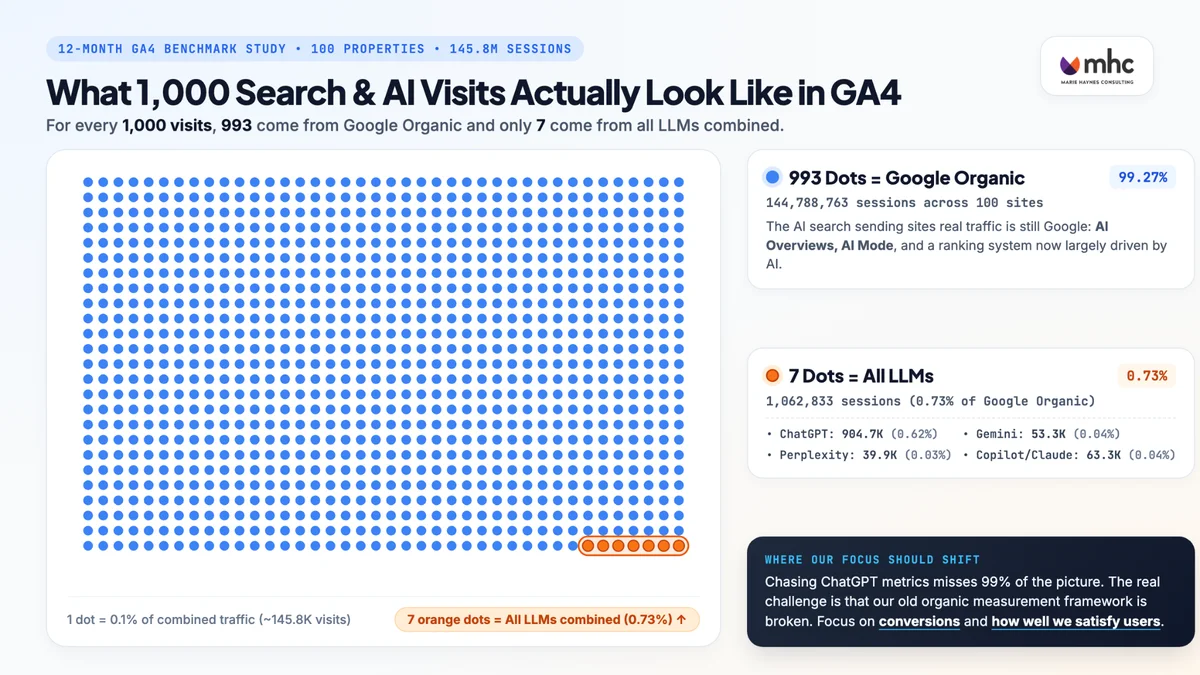
To understand where web traffic is actually originating in the age of generative AI, SEO expert and researcher Marie Haynes conducted a comprehensive 12-month analysis of Google Analytics 4 (GA4) data. The dataset spanned 100 websites of varying sizes and niches, collectively accounting for more than 145 million sessions.
The findings upend prevailing industry narratives about the decline of traditional search and the immediate dominance of standalone AI chatbots:
The ChatGPT Fraction: Across the 100 analyzed properties, referral sessions originating directly from ChatGPT accounted for a paltry 0.62% of the volume driven by Google Organic search.
The Aggregate AI Share: When all other independent LLMs were factored into the equation alongside ChatGPT, the total AI referral share inched up to just 0.73%.
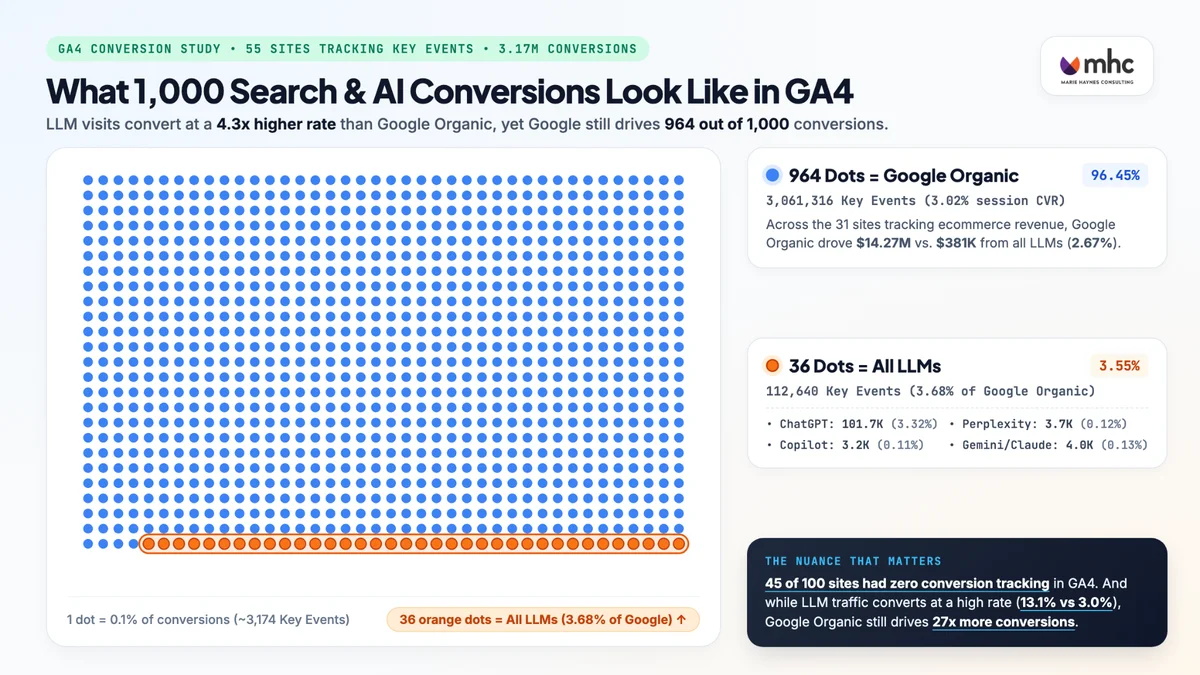
The Conversion Paradox: While it is true that users arriving via ChatGPT exhibited a higher conversion rate—visiting and purchasing or inquiring at a rate more than 4.5 times that of standard Google organic visitors—the sheer scale of traffic disparity neutralized the advantage. Google Organic still accounted for 96.5% of total conversions across the analyzed channels.
The Multiplier Effect: In practical terms, Google Organic drove roughly 27 times more conversions than all LLMs combined within the dataset.
Rather than an expanding tidal wave, data tracking the collective trajectory of ChatGPT referral visits across these 100 properties revealed that exponential growth abruptly plateaued around August 2025—coinciding with the rollout of GPT-5. Since that milestone, ChatGPT has actually begun sending fewer referral visitors back to publisher websites, signaling a structural shift toward zero-click information retrieval.
Chronology: From Exponential Hype to the Post-Growth Plateau
Understanding how the SEO community arrived at its current obsession with AI visibility requires looking back at the timeline of generative search adoption.
Late 2022 – 2024: The Birth of the LLM Traffic Illusion
When OpenAI launched ChatGPT to the public, early adopters noticed a sudden, sharp upward trajectory in referral traffic clicks appearing in analytics tools. Assuming an exponential curve, forecasters predicted that standalone LLMs would soon eclipse traditional search engines like Google, sending unprecedented floods of targeted visitors directly to content creators and e-commerce platforms. This sparked the birth of GEO, prompting agencies to build sophisticated tracking suites focused exclusively on brand citations in chatbot responses.
August 2025: The Inflection Point and GPT-5
The projected exponential growth hit a hard ceiling. Following the release of GPT-5 in mid-2025, referral traffic from ChatGPT stopped climbing across mainstream publisher sites. Instead of sending users outward to read full articles or browse product catalogs, AI interfaces increasingly synthesized answers natively within the chat UI, keeping users enclosed within the conversational ecosystem.
2026 and Beyond: The Rise of the Agentic Web
As standalone chat referrals flatlined, the actual locus of AI-driven discovery consolidated back into legacy search ecosystems—most notably Google. Through the aggressive integration of AI Overviews, dedicated AI conversational modes, and deeply embedded machine learning ranking systems, Google retained its dominance as the primary gateway for users looking to engage with commercial businesses. Concurrently, tech giants began laying the groundwork for true agentic commerce—shifting search from a passive tool that finds links into an active coordinator of tasks and transactions.
Supporting Data: GA4 Comparative Metrics
To visualize the staggering scale disparity between traditional organic search and independent LLM traffic, data visualization tools processing Haynes’s GA4 sample produced stark comparative metrics:
Traffic Volume Share: Google Organic commands an overwhelming 99.27% of the baseline traffic volume in the study, contrasted against the combined 0.73% generated by all external LLMs.
Conversion Impact: Out of the 100 properties evaluated, 55 actively tracked key conversion events in GA4. Within those sites, Google Organic secured 964 total conversions, whereas AI LLMs collectively drove a mere 36 conversions.
Analytics Blind Spots: A surprising administrative finding of the study was that 45 out of the 100 randomly sampled websites were not tracking any key events or conversions whatsoever. This highlights a foundational industry weakness: businesses are stressing over advanced optimization tactics for emerging channels while failing to measure basic user conversion metrics on their own properties.
Official Responses and Industry Perspectives from Search Leaders
As the paradigm shifts from passive browsing to active agentic execution, industry pioneers and tech executives acknowledge that the future of the web is fundamentally unpredictable, yet undeniably automated.
During Google I/O, when tech visionary Sergey Brin was asked what the internet ecosystem would look like in a decade, he admitted candidly: “I don’t think we really know what the world looks like in 10 years.”
Demis Hassabis elaborated on the structural transformation of the digital landscape, noting:
"The web is going to change quite a lot if you think about an agent-first web, like it doesn’t necessarily need to see renders and things like we do as humans using the web. So I think things will be pretty different in a few years."
Google CEO Sundar Pichai echoed this sentiment in interviews addressing the evolution of query mechanics, stating that “Search will become an agent manager.”
Rather than viewing search engines as digital libraries where users manually hunt for information, industry architects envision automated software agents navigating the web on behalf of human users—comparing prices, managing carts, and executing complex workflows behind the scenes.
Implications: Preparing for the Agentic Web and Universal Commerce
The takeaway for digital marketers is clear: chasing ChatGPT citations is a distraction from where commercial value actually lives. While informational content clicks may be drying up due to AI summaries, users looking to interact with or purchase from a business are still routing through Google’s intelligent surfaces.
To remain competitive in this next era, brands must look beyond standard blue links and prepare their technical infrastructure for the agentic web. Key technological pillars defining this transition include:
1. Google’s Universal Cart and Merchant Optimization
Google’s Universal Cart aggregates products from multiple retailers into a unified checkout experience managed directly within Google Wallet. It monitors real-time price fluctuations, promotions, and inventory levels, allowing users to bundle items from competing vendors without visiting their individual storefronts.
The Opportunity: Brands must master the Google Merchant Center, utilizing its built-in AI assistants to ensure feed data, stock status, and promotional markups are flawless so automated systems can seamlessly recommend their products at the exact point of intent.
2. The Universal Commerce Protocol (UCP)
Co-developed across major technology and retail platforms including Google, Shopify, and Stripe, UCP provides an open discovery layer that enables autonomous AI agents to compare inventory and complete purchases natively.
The Opportunity: Technical SEO must expand to encompass agentic discovery endpoints. Understanding protocols like /.well-known/ucp and structuring product catalogs to be machine-readable will dictate which brands win conversions when automated agents make purchasing decisions on behalf of consumers.
3. WebMCP (Model Context Protocol)
WebMCP allows websites to expose their interactive functions—such as custom calculators, dynamic booking schedulers, and multi-step forms—directly to AI agents through declarative markup and imperative APIs.
The Opportunity: While still in its infancy, forward-thinking businesses should begin experimenting with custom tools designed specifically for autonomous AI agents to interact with on a customer’s behalf.
4. Intelligent Eyewear and Ambient Multimodal Search
Moving beyond traditional screens, upcoming hardware developments—such as Android XR-powered audio frames and micro-LED smart glasses backed by multimodal models like Gemini—will allow users to search the physical world around them in real time ("Hey Gemini, find me that jacket in my size and buy it").
The Opportunity: Brands will need to think beyond flat web pages and prepare for ambient search scenarios where consumers discover, evaluate, and purchase services natively through augmented reality and wearable computing.
Conclusion
The golden rule of digital marketing remains unchanged: optimize for user satisfaction and commercial utility rather than trying to game automated machines. Deep learning algorithms within modern search systems are increasingly sophisticated at predicting what a searcher finds genuinely helpful.
By abandoning the illusion that standalone LLM chat referrals will replace search engines, businesses can refocus their energy on what actually matters—tracking true conversion metrics, mastering structured data protocols like UCP and WebMCP, and building exceptional products that both humans and autonomous agents want to engage with.