AWS Revolutionizes Serverless Architectures with Enhanced Custom Event Buses in Amazon EventBridge
Main Facts
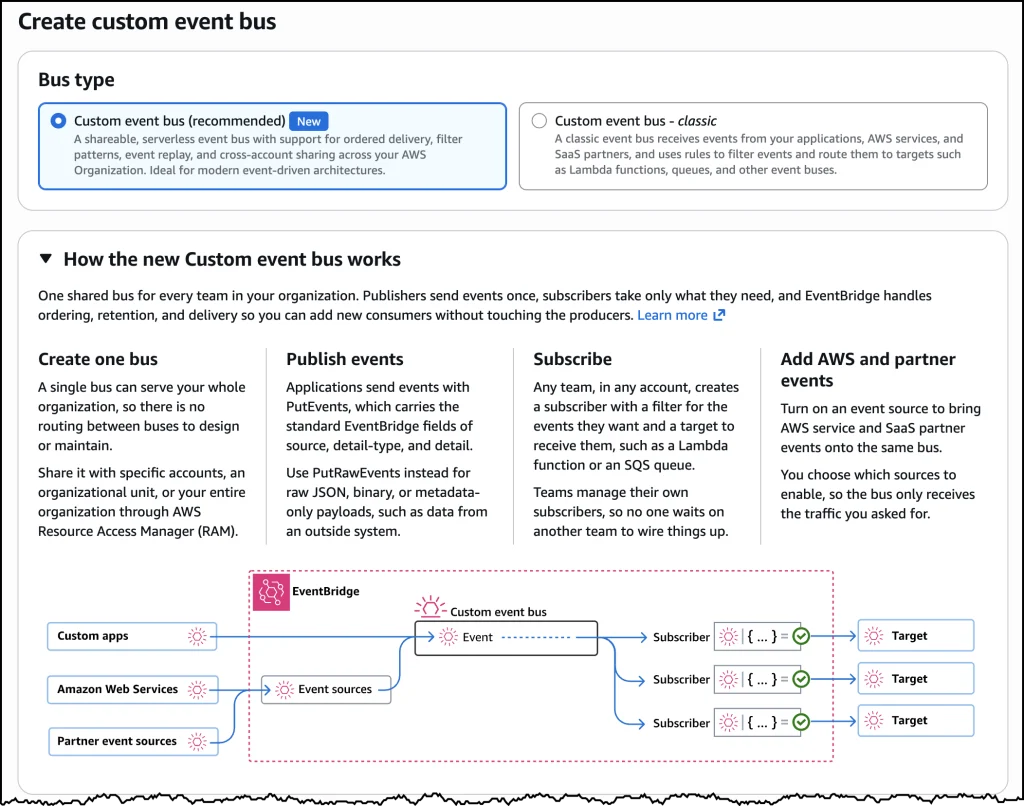
Amazon Web Services (AWS) has officially announced the rollout of a powerful new capability within Amazon EventBridge: the enhanced custom event bus. Purpose-built to address the operational friction of scaling serverless architectures across complex enterprise environments, this new offering allows organizations to deploy a single, centralized event bus shared seamlessly across all AWS accounts.
For years, enterprises building event-driven applications on AWS have faced a architectural dilemma. While standard best practices recommend multi-account setups to isolate workloads and teams, doing so with traditional EventBridge infrastructure meant constructing webs of cross-account rules and bus-to-bus configurations. This workaround inadvertently reintroduced the operational complexity that serverless frameworks were designed to eliminate. Platform teams lost clear visibility into event subscriptions, routing costs compounded quickly, and teams requiring strict event ordering were forced to engineer elaborate workarounds or pivot to external technologies entirely.
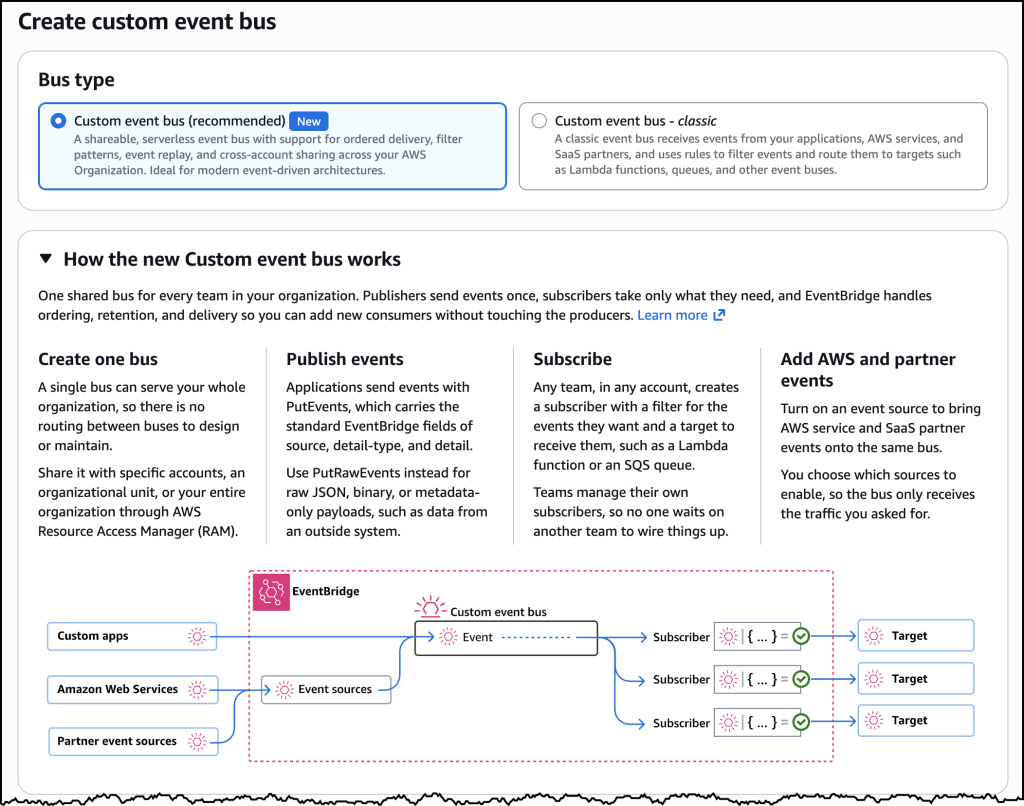
The enhanced custom event bus directly resolves these pain points. By introducing native organization-wide sharing via AWS Resource Access Manager (AWS RAM), built-in event ordering guarantees via EventGroupId, a consolidated "Subscriber" resource model, and a modernized ingress-egress pricing structure, AWS is fundamentally reshaping how modern enterprise distributed systems handle real-time data flow.
Crucially, AWS has ensured backward compatibility. Existing workloads will not be disrupted; classic event buses remain fully supported, allowing organizations to adopt the new enhanced custom event bus at their own pace.
Chronology of Evolution: From Single-Account Silos to Unified Enterprise Backbones
To understand the significance of the enhanced custom event bus, it is necessary to examine how enterprise event-driven architectures have evolved on the AWS cloud platform.
Phase 1: The Single-Account Paradigm
In the early days of serverless adoption, organizations typically began their journey with a single custom event bus housed inside one AWS account. This architecture was nimble, easy to manage, and ideal for single-team development units. Publishers could broadcast events instantly, and local consumers could evaluate payloads without traversing account boundaries.

Phase 2: The Multi-Account Complication
As cloud adoption accelerated, organizations scaled their engineering organizations into dozens—or even hundreds—of independent teams. Security and governance mandates dictated a multi-account strategy, where each domain or team operated within its own securely isolated AWS account.
To maintain event-driven communication across these borders, architects had to bridge the gaps. They engineered complex cross-account resource policies, set up event bus-to-event bus forwarding rules, and managed intricate IAM permissions. What began as a lightweight, decoupled serverless model began to resemble the very integration bottlenecks it was meant to replace. Platform teams lost centralized visibility, and tracking who subscribed to what became a compliance and operational headache.
Phase 3: The Unified Enterprise Architecture (Present Day)
With the launch of the enhanced custom event bus, AWS has entered a new era of enterprise serverless design. Organizations can now provision one central event backbone that spans entire AWS Organizations. By leveraging native AWS RAM integrations, subsidiary accounts can publish and subscribe to the central bus instantly, completely bypassing the need for manual cross-account routing configurations.
Supporting Data and Technical Architecture
The technical innovations powering the enhanced custom event bus address several long-standing architectural trade-offs in cloud computing.
1. Organization-Wide Sharing and Scale
The new event bus introduces a default quota of 10,000 Subscribers per bus, with higher limits available upon request. This massive capacity prevents the previous fragmentation where organizations were forced to spin up multiple auxiliary buses simply to stay under subscriber ceilings. Through AWS RAM, administrators can scope access precisely—limiting sharing to specific AWS accounts, entire organizational units (OUs), or specific IAM principals.
2. Native Event Ordering
Traditionally, event-driven architectures rely heavily on asynchronous, decoupled patterns where message order is irrelevant. However, domain-specific workloads—such as IoT tracking, financial ledger updates, or logistics routing—frequently demand strict sequence execution.

The enhanced custom event bus introduces the EventGroupId parameter for publishers. EventBridge guarantees that events sharing the same EventGroupId are delivered sequentially to subscribers utilizing ordered delivery configurations. Crucially, this does not affect other consumers on the same bus; non-ordered subscribers can continue processing asynchronously in parallel. To support this cleanly, the system introduces synchronous target invocations (for example, directly invoking AWS Lambda), eliminating the historical necessity of placing an Amazon SQS queue between the event bus and the function to preserve order.
3. Consolidated Subscriber Resources
Previously, achieving secure and filtered delivery required orchestrating multiple disparate components: individual rules, target configurations, retry policies, and dead-letter queues (DLQs). The enhanced custom event bus consolidates these elements into a single Subscriber resource. This unified object defines event filtering, retry behavior, delivery destinations, and variable start times (ideal for replaying historical events or hydrating newly deployed microservices).
4. Advanced Event Evaluation and Transformation
Data hygiene is a critical challenge at scale. The new bus introduces:
- Content-Based Deduplication: EventBridge can automatically hash meaningful payload attributes to identify and drop duplicate retries occurring within a five-minute window, achieving "exactly-once" delivery semantics for flaky event sources.
- JSONata Transformations: Subscribers can apply native JSONata expressions to reshape event payloads on the fly before they hit downstream targets—renaming fields, filtering arrays, or computing new values without writing custom translation code.
- Schema Deserialization: Native support for deserializing Apache Avro and Protocol Buffers directly into JSON, enabling granular filtering without forcing consumers to handle heavy parsing overhead themselves.
5. A Modernized Pricing Model
To align costs with actual architectural usage, the enhanced custom event bus replaces the legacy per-event model with an ingress and egress throughput pricing structure. Publishers pay strictly for the events they ingest, while subscribers pay for the events delivered. This cleanly eliminates the compounding financial penalties associated with legacy multi-bus, cross-account forwarding setups.
Official Responses and Industry Context
While AWS has long dominated the serverless landscape with products like Lambda, SQS, and EventBridge, enterprise customers have increasingly demanded native architectural primitives that support large-scale governance without sacrificing developer velocity.
Industry analysts note that as enterprises move deeper into cloud-native maturity, operational overhead—rather than raw infrastructure cost—is the primary bottleneck to productivity. By shifting the burden of cross-account routing, event deduplication, and ordered delivery directly into the managed service layer, AWS is alleviating significant engineering toil.
"Platform teams have spent years building custom administrative tooling just to manage how events flow across internal AWS boundaries," notes enterprise architecture consultant Sarah Jenkins. "By baking organization-wide sharing, native ordering, and unified subscriber modeling directly into EventBridge, AWS is giving platform engineers their time back while drastically simplifying distributed system topologies."
Implications for Developers, Platform Teams, and Enterprises
The release of the enhanced custom event bus has far-reaching implications across the software development lifecycle:
For Platform Engineering Teams
- Total Visibility: Centralized event buses restore overarching governance, allowing platform teams to audit event flows, monitor security postures, and oversee publishing permissions across all enterprise accounts from a single pane of glass.
- Reduced Maintenance Overhead: Eliminating the need to manually script cross-account RAM policies, bus targets, and complex IAM trust relationships dramatically shrinks infrastructure-as-code (IaC) footprints.
For Application Developers
- Accelerated Onboarding: Developers can instantly hook into organizational event backbones without waiting for infrastructure provisioning cycles.
- Simplified Error Handling and Replay: With native JSONata transformations, content-based deduplication, and unified subscriber configurations, writing boilerplate data-cleaning and retry logic becomes a thing of the past.
For Enterprise CFOs and FinOps
- Predictable Economics: The new ingress/egress cost model provides clear cost allocation visibility. Publishers and consumers bear financial responsibility proportional to their actual data consumption, ensuring fairer chargeback models across business units.
Availability and Getting Started
The enhanced custom event bus is generally available today across a broad footprint of global AWS Regions, including:
- Americas: US East (N. Virginia, Ohio), US West (Oregon)
- Europe: Europe (Ireland, Frankfurt, Stockholm, Spain)
- Asia Pacific: Asia Pacific (Hong Kong, Malaysia, Mumbai, Singapore, Sydney, Thailand, Tokyo)
Organizations can begin provisioning and experimenting with enhanced custom event buses immediately through the AWS Management Console, the AWS Command Line Interface (CLI), or standard EventBridge APIs. Existing classic event buses remain fully operational, ensuring a smooth, friction-free migration path for enterprises ready to scale their serverless infrastructure to the next level.