Beyond Static Styles: How ‘Prop For That’ Is Bridging the Gap Between JavaScript and CSS
For years, the division of labor in web development has been clear: JavaScript handles the logic, the state, and the complex interactions, while CSS handles the presentation and layout. But as modern user interfaces demand increasingly fluid, reactive animations—like tracking a cursor’s exact coordinate or calculating scroll velocity—the bridge between the two languages has often felt clunky, requiring verbose addEventListener blocks and repetitive style.setProperty calls.
Adam Argyle, a luminary in the CSS ecosystem and the mind behind the popular utility library Open Props, has unveiled his latest project: Prop For That. This library promises to fundamentally alter how developers bridge the gap between browser state and CSS variables. By abstracting the heavy lifting of JavaScript listeners into declarative HTML attributes, Prop For That enables a new paradigm of "live" CSS, where browser metadata flows directly into the stylesheet with minimal overhead.
The Main Facts: What is Prop For That?
At its core, Prop For That is a lightweight library designed to expose "invisible" browser data—information that CSS cannot natively perceive—as accessible CSS custom properties.
Historically, if a developer wanted an element to follow the user’s mouse cursor, they would need to write a JavaScript function that tracks mousemove events, calculates coordinates, and then manually updates a CSS variable on a target element. Prop For That eliminates this boilerplate. By simply adding a data attribute to an HTML element—such as data-props-for="pointer"—the library automatically hooks into the necessary browser APIs and injects the live data into CSS variables like --live-pointer-x and --live-pointer-y.
This creates a declarative workflow. Developers no longer need to write custom logic to pipe browser data into the styling layer. Instead, the data is treated as an ambient environment variable, ready to be consumed by calc(), transition, or animation properties in pure CSS.
A Chronology: From Open Props to Live State
To understand the significance of Prop For That, one must look at the evolution of Adam Argyle’s work in the CSS space.
The Era of Preconfiguration (Open Props)
Several years ago, Argyle released Open Props, a library of high-quality, pre-configured CSS variables. It provided a robust design system for colors, shadows, and spacing. It was a massive success because it solved the "decision fatigue" developers often face, offering a standardized, performant foundation for styling. However, Open Props was fundamentally static; it provided the palette, but it didn’t provide the motion or the interactivity.
The JavaScript-CSS Gap
Throughout the early 2020s, the developer community struggled with the limitations of the CSS Houdini API and the lack of native support for browser-state tracking. Projects like Chris Coyier’s famous demonstrations on updating CSS variables via JavaScript highlighted the friction: developers were writing dozens of lines of code just to perform basic tasks like tracking scroll position or time-of-day.
The Birth of Prop For That
Prop For That represents the next logical step. Having mastered the static utility space with Open Props, Argyle shifted his focus to the "reactive" space. By combining the simplicity of declarative HTML attributes with the power of modern browser APIs, Prop For That addresses the missing link in the web’s styling engine, transforming the browser into a real-time data provider for CSS.
Supporting Data: How It Works Under the Hood
The architecture of Prop For That is remarkably lean. It relies on a plugin-based system that allows for modular expansion. When a developer adds an attribute like data-props-for="pointer", the library registers a listener for the corresponding event.
The Workflow
- Declaration: The developer tags an element in the HTML.
- Observation: The script initiates a "watcher," tapping into browser APIs (such as
PointerEvent,IntersectionObserver, orrequestAnimationFrame). - Injection: The script updates the custom properties on the host element at the native frame rate of the browser.
- Application: The developer uses the variables in CSS:
.follower
  transform: translate(calc(var(--live-pointer-x, 0) * 1px), calc(var(--live-pointer-y, 0) * 1px));
Efficiency Metrics
Unlike older solutions that might trigger layout thrashing or heavy reflows, Prop For That is engineered to be highly performant. By updating CSS variables directly at the element level, it minimizes the work the browser has to do to recalculate styles. Because it uses custom properties, it also keeps the styling engine "live," meaning that changes to these variables can be transitioned or animated using standard CSS transition or animation properties—a feat that is traditionally difficult when working solely with JavaScript-driven logic.
Official Responses and Industry Context
While this is a personal project from Argyle, the community reception has been overwhelmingly positive. Lead developers and UI designers have praised the library for its "classy" implementation.
In a recent technical brief, Argyle noted that the primary objective of Prop For That was to "democratize access to browser state." He argues that modern browsers are essentially "data-rich" environments, yet we have historically treated them as "data-poor" because getting that data into CSS was a developer experience nightmare.
Industry analysts suggest that this library could set a new standard for how we build interactive websites. If Prop For That becomes a de facto standard, we may see fewer heavy framework dependencies for simple interactions. Instead of importing massive libraries just to create a scroll-linked animation, developers can use a handful of declarative attributes, keeping the "DOM weight" significantly lower.
Implications: The Future of Reactive Design
The introduction of Prop For That signals a shift in the philosophy of front-end development.
1. The Decline of "Logic-Heavy" Styling
Historically, developers have had to choose between writing heavy JavaScript-driven UI components or settling for static designs. Prop For That provides a "third way": a middle ground where the intelligence of JavaScript is used to power the aesthetic flexibility of CSS. By delegating the state-tracking to the library, developers can focus on the look and feel of their animations rather than the underlying state-management math.
2. Standardizing Browser Interactivity
By creating a unified way to access things like scroll velocity, current time, and form states, Prop For That helps standardize how developers interact with the browser environment. If the industry adopts this pattern, we could see a future where CSS is consistently aware of the user’s context, leading to more responsive and personalized UI experiences.
3. Performance Benefits
One of the most significant, yet understated, implications is performance. JavaScript-based animation libraries often struggle with performance bottlenecks because they fight the browser’s main thread. By funneling data into CSS variables, Prop For That allows the browser’s internal rendering engine to handle the heavy lifting of interpolation and composition. This is a massive win for mobile users, who are most impacted by heavy JavaScript execution.
Conclusion: A New Frontier for CSS
Prop For That is more than just a utility library; it is a conceptual shift. By treating the browser’s internal states as first-class citizens in the styling process, Adam Argyle has provided a glimpse into a future where web interfaces are more fluid, responsive, and easier to build.
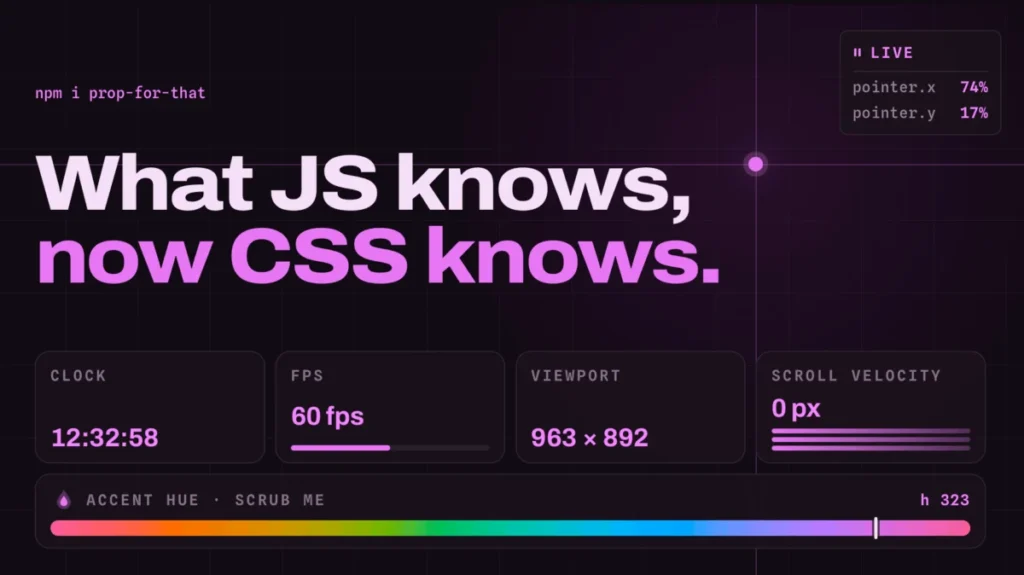
For developers who have spent years manually syncing JavaScript values to CSS properties, this library feels like a liberation. As the demos on the Prop For That website illustrate, the complexity of a task like tracking a cursor or animating based on scroll velocity is reduced to almost nothing.
While it is still early days, the potential for Prop For That to become a staple in the modern web development stack is undeniable. It bridges the gap between what we want to see on our screens and the raw, often inaccessible, data the browser possesses. In the race to make the web more interactive and engaging, Prop For That might just be the tool that lets CSS catch up to our ambitions.