The AI Imperative: Why a 3.3-Star Business Just Outranked a 5-Star Competitor in the New Era of Local Search
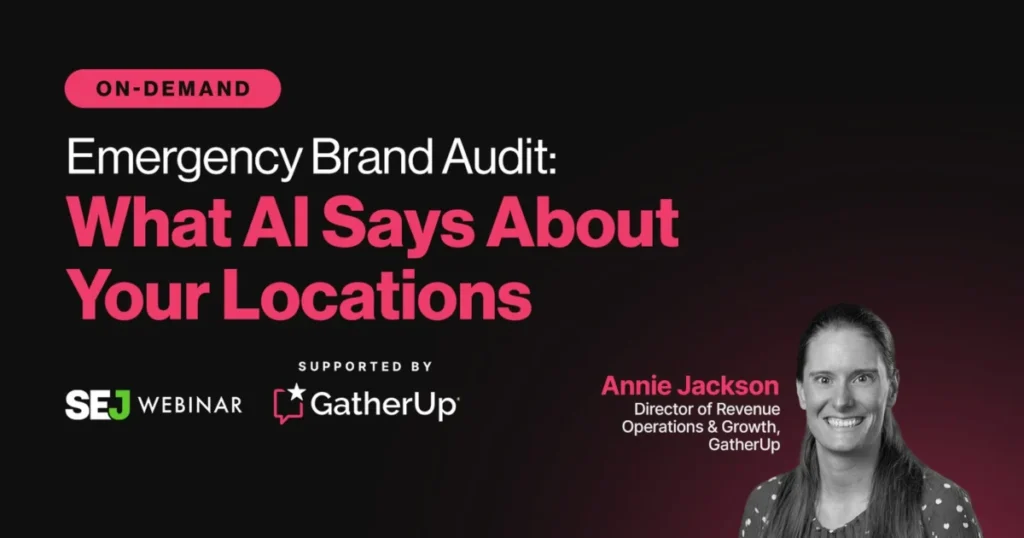
NORFOLK, VA – In a striking illustration of the seismic shift occurring in local search, a 3.3-star car wash recently secured the coveted top answer from Google’s AI, bypassing higher-rated competitors. This seemingly counterintuitive outcome, highlighted by Annie Jackson, Director of Revenue Operations and Growth at GatherUp, during a recent industry webinar, underscores a critical new reality for businesses: in the age of generative AI, query relevance and contextual information are rapidly eclipsing traditional star ratings.
The incident unfolded when Jackson posed a specific, conversational query to Google: "a no-touch car wash that fits an SUV in Norfolk, VA." Google’s AI Overviews, drawing from its vast database of 300 million places and 500 million review contributors, returned a single business. Crucially, the AI answer provided specific details like clearance height and 24/7 operating hours above the business’s modest 3.3-star rating. "Google answered my questions, but this business is actually showing up as a 3.3 star," Jackson observed during the session. "It’s surfaced the context of my query above the star rating."
This example served as the cornerstone for a compelling session co-presented by Jackson and Jason Wertham, Vice President of Review Defense Operations at GatherUp. Their core message: AI tools are now autonomously constructing descriptions of businesses from a diverse array of sources—reviews, listings, and public web mentions—and relaying this synthesized information directly to customers, often before they ever reach a business’s official website. The implications for local businesses, from independent boutiques to multi-location franchises, are profound and immediate.
The Dawn of Conversational AI Search: How Customers Find Local Businesses Now
The way consumers interact with search engines has fundamentally changed. Gone are the days of simple keyword queries like "car wash near me." Today’s users are engaging AI with full, natural language questions, expecting and accepting summarized, context-rich answers. Data collected by GatherUp in Fall 2025 paints a clear picture of this accelerating trend: a staggering 55% of consumers had already consulted Google or Bing AI summaries for local information, 48% had specifically queried ChatGPT about a local business, and 31% reported using these AI tools multiple times.
This behavioral shift means that the intent behind a search is now paramount. As Wertham elaborated, these sophisticated AI tools are not just processing keywords; they are factoring in dynamic elements like the time of day a query is made and even inferred user preferences. An AI that learns a user owns an SUV, for instance, might implicitly apply that context to all future local searches, tailoring results even if the user doesn’t explicitly restate their vehicle type. This level of personalized, contextual understanding is reshaping the competitive landscape of local search.
To navigate this new terrain, Jackson and Wertham unveiled a strategic framework for businesses. This included a "four-prompt emergency audit" designed to reveal precisely what AI Overviews from Google, ChatGPT, and Ask Maps currently articulate about a brand. Following this diagnostic, they introduced a comprehensive "build, manage, defend rollout," a proactive strategy aimed at not just influencing, but actively shaping, the AI-generated narrative around a business.
The Anatomy of an AI Answer: Decoding the Role of Reviews
A critical revelation from the GatherUp experts concerns the source material for AI-generated answers, particularly the often-misunderstood role of customer reviews. While it might seem logical that AI would simply scrape review content directly from major directory platforms, the reality is more nuanced.
"The major directory service providers, Google, Yelp, and others, they do not allow LLM tools like ChatGPT and Claude to scrape or crawl the review data on the business listing," Wertham stated emphatically. He pointed out that users will notice AI summaries rarely cite specific reviews directly from these protected platforms. This protection is a significant barrier, meaning that valuable review content locked within a Google Business Profile or a Yelp page, while still crucial for local rankings and direct conversion on those platforms, contributes nothing to AI’s synthesized answers.
The Game-Changing Insight: These very same reviews, however, become "fair game for the LLM tools to be pulling in" the moment they are republished or made publicly accessible elsewhere. This means that embedding reviews in widgets on a business’s own website, sharing them on public social media channels, or integrating them into other crawlable web surfaces instantly makes that rich, descriptive customer feedback accessible to AI.
This distinction is paramount for businesses vying for AI visibility. When a customer uses phrases like "popular restaurants" or "highly reviewed services," the AI actively searches for review text it can access. If a business’s most compelling reviews are confined to directory listings, they remain invisible to this critical AI function, effectively muting a powerful source of positive brand narrative. "If you’re relying on the review platforms to do that for you, it’s not going to be enough," Wertham cautioned.
Action Item for Businesses: Proactively republishing reviews is no longer merely a best practice for SEO or social proof; it is an imperative for AI visibility. The GatherUp session delved into specific recommendations for which widget and social placements are most effective, even demonstrating how to ensure business replies are carried alongside the reviews, adding further context and showing engagement. Beyond public reviews, Wertham also highlighted the untapped potential of first-party review capture—survey responses and direct feedback that might never reach public platforms but can be leveraged internally and, when appropriate, published to owned channels.
Beyond the Stars: Recency and Velocity Reign Supreme
Perhaps one of the most counterintuitive findings for many businesses accustomed to optimizing for high star ratings is the diminishing importance of the average star rating itself in AI search. The GatherUp audit revealed a startling truth: "No AI answer in the session’s audit examples cited an average star rating; every one cited review content."
This observation is corroborated by evolving consumer behavior. GatherUp’s data indicates that 45% of users now prioritize review recency over the average star rating. Furthermore, 60% trust detailed written reviews far more than rating-only submissions, and a significant 70% prefer to receive a review request within 72 hours of a transaction, underscoring the demand for fresh, relevant feedback.
Wertham elaborated on this phenomenon, noting that consumers frequently override Google’s default "most relevant" review sort, opting instead for "newest." This preference stems from a logical conclusion: the most recent reviews are the best predictors of a current experience. A gleaming 5.0-star average built on reviews from several years ago holds significantly less weight than a consistent, current stream of 3.9 or 4.2-star reviews. "I’d rather go to a business with 1,000 reviews and a 3.9 or 4.2 than 30 reviews and a 5.0," Wertham remarked, encapsulating the sentiment.
This shift necessitates a focus on review volume and velocity—the consistent generation of new reviews—rather than solely chasing a perfect average. The session organized a comprehensive response strategy into three interconnected workstreams: "build, manage, and defend." This framework involves building consistent, optimized listings and cultivating a steady volume of new reviews; actively managing responses and monitoring feedback, ideally within a swift 72-hour window; and robustly defending a business’s reputation against policy-violating reviews and "review smothering" tactics designed to bury negative feedback with a flood of generic positives.
The "Slot Machine" Effect: Why AI Answers Are Never Static
One of the more perplexing aspects of AI search is its inherent variability. Unlike traditional search results, where a query often yields a relatively consistent ranking order, AI-generated answers behave more like a "slot machine," as Jackson vividly described it. Citing research from SparkToro, she noted that the same question posed to LLMs by different individuals, across various devices and accounts, rarely returned identical results or even the same order of information.
"Asking AI a question is kind of like a slot machine," Jackson explained. "It’s going to be giving back similar data, but each time it’s going to look a little differently." This means that traditional metrics like "position one" are ill-suited for measuring AI visibility. Instead, the focus must shift to "total citations"—the breadth and diversity of sources from which AI can draw information. A brand might be entirely absent from one device’s AI answer and prominently featured on another, emphasizing the need for comprehensive and consistent digital presence across numerous crawlable touchpoints.
Adding another layer of complexity, Google recently updated its guide to optimizing for generative AI, introducing a significant punitive measure: the "AI slop penalty." Wertham highlighted this as a crucial development, indicating that Google is now actively detecting and "essentially penalizing businesses" for low-value, AI-generated content. This means generic AI-written blog posts, thinly veiled FAQ scraping, or any content deemed unoriginal or unhelpful by Google’s algorithms will now actively harm, rather than simply be ignored, by a business’s visibility efforts.
Action Item for Businesses: Given the dynamic nature of AI answers, regular auditing is essential. Businesses should run their audit prompts in incognito or temporary-chat modes to prevent stored context from influencing results, and these audits should be conducted on a consistent schedule. The GatherUp session provided a detailed "monthly re-run method" for businesses to effectively measure whether their visibility efforts are genuinely moving the needle in AI’s responses.
Q&A: Practical Insights from the Webinar
The Q&A segment of the webinar provided actionable advice for common challenges businesses face in this new AI landscape.
Q: What is the fastest thing I can do this week to change what AI says about my company?
Jason Wertham’s immediate advice centered on foundational elements: "Address your listings. Make sure your listings are all correct and all consistent, whatever platforms you’re on. And then make sure that you are evangelizing your reviews off of the third-party directory where you’re receiving them. Post them to your social media platform, post them to a section of your website." This two-pronged approach ensures accuracy across platforms and makes valuable review content accessible to AI. Annie Jackson echoed this, emphasizing the importance of "getting the basics down" before moving to more elaborate strategies. She illustrated this with a cautionary tale of a local restaurant whose Facebook page inadvertently listed the owner’s personal cell number, leading to an endless stream of misdirected calls.
Q: How long before content changes actually show up in AI answers?
Annie Jackson offered a pragmatic timeline: "small facts move fast, positioning moves slowly." Minor factual updates, such as store hours or phone numbers, can propagate quickly. However, influencing the broader narrative—"what you’ve been known for"—typically takes longer, ranging from "two weeks to a month with a long tail beyond that." She underscored the importance of a business’s own website as the fastest lever for change, noting that new offerings must first appear on owned channels, as reviews will not announce them.
Q: My weakest location has old bad reviews that keep showing up. Do I have to wait for them to age out?
Jason Wertham explained that while age naturally diminishes a review’s relevancy, certain factors can extend its lifespan, such as keyword-heavy content or reviews from Google Local Guides. Emoji reactions, surprisingly, can also prevent a review from slipping down the rankings, even if they don’t contribute positive momentum. Crucially, policy-violating reviews can be disputed regardless of age; his review defense team routinely removes reviews more than a decade old. However, the most reliable long-term solution remains consistent volume and velocity of new, positive reviews, as recency ultimately outweighs older content in relevancy.
Q: How should franchisors handle this when each franchisee controls their own profile?
Wertham identified this as a significant challenge, pinpointing the "consistency gap" where individual franchisees control their listings while the overarching brand absorbs the collective AI answer. His recommendations included establishing clear best practices, offering white-labeled or partner tools that franchisees are incentivized to use, and providing a clear playbook. He also strongly suggested that franchisors proactively run audit prompts on behalf of their franchisees and coach them on the results, emphasizing that a single location’s inaccurate AI answer can negatively impact the entire brand’s reputation.
The Path Forward: Embracing the AI Narrative
The GatherUp webinar served as a stark reminder that the landscape of local search has irrevocably transformed. The power of AI to synthesize and present information directly to consumers, often bypassing traditional websites and even star ratings, demands a fundamental re-evaluation of local marketing strategies. Businesses that fail to adapt risk becoming invisible or, worse, misrepresented in the new conversational search environment.
The comprehensive strategies outlined—from the critical "four-prompt emergency audit" to the "build, manage, defend rollout"—provide a clear roadmap for businesses to not just survive but thrive in this evolving digital ecosystem. By focusing on consistent, accurate listings, strategically republishing review content, prioritizing review recency and velocity, and conducting regular AI narrative audits, businesses can proactively shape the story that AI tells about them, ensuring they win the answers that matter most to today’s discerning consumers. The future of local business visibility hinges on mastering the AI narrative.
The full on-demand session, including the downloadable audit handout, complete rollout details, and review defense walkthroughs, is available for those ready to dive deeper into this critical shift.