The Trust Crisis in Digital Media: Are Product Recommendations Still Objective?
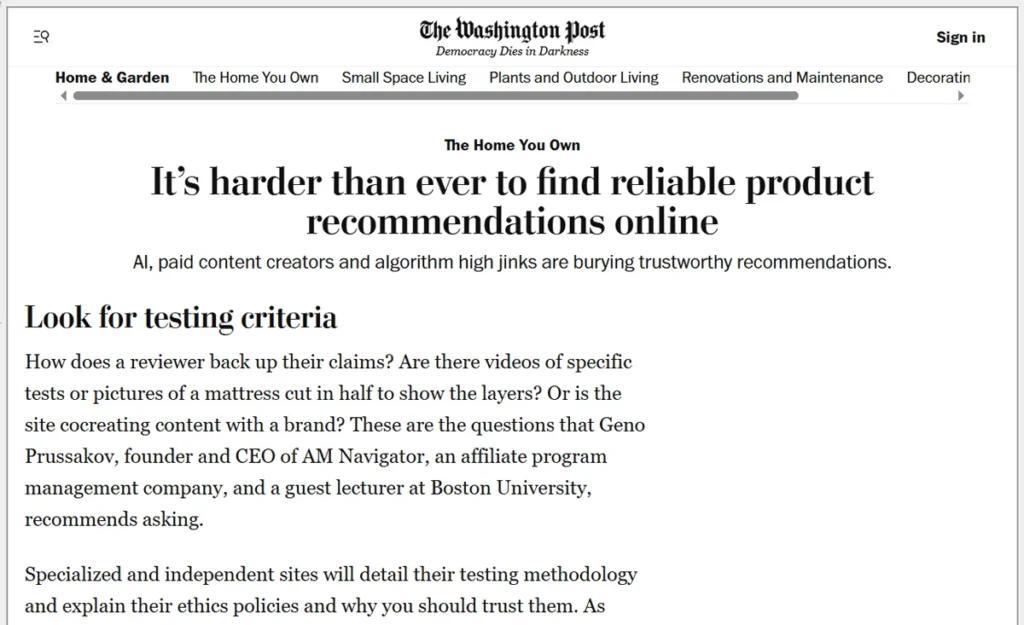
In an era where digital publishers increasingly rely on affiliate marketing to offset declining traditional advertising revenue, the line between editorial integrity and commercial promotion has become dangerously thin. Earlier this year, The Washington Post turned to industry experts to address a growing consumer concern: Can we trust the "Best Of" lists and product roundups published by major media outlets?
While my contribution to that discussion was necessarily concise, the implications of this shift are profound. It is time to peel back the curtain on how media giants monetize their search engine authority and, more importantly, how consumers can navigate a landscape where "expert advice" often comes with a price tag.
The Evolution of Authority Monetization
For decades, big media outlets—newspapers, magazines, and broadcast networks—maintained a strict firewall between their editorial departments and their revenue teams. Today, that firewall has effectively dissolved. Driven by the need to survive in a digital-first economy, household names have pivoted toward "affiliate commerce."
The logic is simple: These organizations possess immense "domain authority," a metric search engines use to rank websites. By publishing product reviews, they can capture high-intent search traffic (e.g., "best wireless headphones 2025") and convert that traffic into revenue through affiliate commissions.
However, this transition creates a complex ethical paradox. When a publication known for investigative journalism begins recommending kitchen appliances or skincare products, they are essentially trading on their brand’s historical trust to influence commercial outcomes. The question is no longer just about the quality of the product, but about the integrity of the recommendation process itself.
How the Sausage is Made: The Publisher’s Perspective
Having spent years managing affiliate programs for merchants and working closely with major media publishers, I have gained an intimate view of their operational mechanics. Contrary to the cynical view that all such content is "pay-to-play," the reality is more nuanced. Many reputable publishers invest heavily in their testing processes.
The Four Pillars of Credible Editorial Testing
Most top-tier media outlets that prioritize long-term brand equity follow a rigorous process to maintain credibility:
- Hands-on Testing: The gold standard involves the actual acquisition and physical testing of products. Teams of writers and editors spend weeks or months putting products through their paces, often in real-world scenarios.
- Editorial Independence: In the best organizations, the editorial team that writes the reviews is siloed from the commercial/business development teams. They choose which products to test based on market relevance, not just on which companies offer the highest commission.
- Transparency Disclosures: Regulatory bodies, such as the Federal Trade Commission (FTC), mandate that commercial relationships be disclosed. Credible publishers provide clear, upfront statements explaining that they may earn a commission on clicks or purchases.
- Data-Driven Selection: High-end publications utilize consumer feedback, return rate data, and long-term performance metrics to ensure their "Top 10" lists aren’t just snapshots in time, but reflections of enduring product quality.
The Shadow Side: Financial Influence and Pay-to-Play
Despite these rigorous frameworks, the system is not infallible. We must acknowledge that commercial incentives occasionally compromise editorial judgment. In the competitive world of affiliate marketing, several mechanisms can tilt the scales in favor of certain advertisers:
- Placement Fees: Sometimes, a brand pays a "placement fee" simply to be included in a list, regardless of whether their product is the best in its category.
- Inflated Commission Rates: Publishers may prioritize products that offer higher affiliate commission rates (often referred to as "bounty" or "commission-bumped" items), incentivizing them to rank these products higher than a superior, lower-paying competitor.
- EPC (Earnings Per Click) Guarantees: In some instances, a merchant might guarantee a specific EPC to a publisher to ensure their product receives premium placement.
- The "Hybrid" Conflict: The most dangerous scenario occurs when these factors are combined, creating an environment where the "recommendation" is mathematically optimized for revenue rather than consumer utility.
Consumer Survival Guide: How to Evaluate Recommendations
As a consumer, you should not be expected to discern the intricate financial arrangements behind a web page. However, you can employ a "critical reader" framework to protect your wallet and ensure you are getting the value you deserve.

1. Look for the "Testing Protocol"
If an article makes sweeping claims about being the "Best [Product] of 2025," look for a section that details how they tested the items. Did they buy them? Did they use them for a week or a month? If the article lacks a description of their methodology, treat it as a thinly veiled advertisement rather than a genuine review.
2. Cross-Reference Against Multiple Sources
Never rely on a single publication. If an item appears as the #1 choice across five different websites, it might be a genuinely superior product. If it appears as #1 on one site but is nowhere to be found on others, look closer at the affiliate disclosures on that specific site.
3. Check for Long-Term Updates
The most trustworthy reviews are "living documents." If a review was last updated in 2022, it is obsolete. Look for articles that explicitly state when they were last reviewed and note whether the author has addressed newer models or changing market conditions.
4. Scrutinize the "Disclosures"
Legitimate sites will explicitly state, "We may earn a commission from links on this page." If you cannot find a clear disclosure, or if the disclosure is buried in a way that feels intentionally deceptive, the publication’s transparency—and by extension, their integrity—is likely suspect.
Implications for the Future of Media
The monetization of search authority is a permanent fixture of the digital ecosystem. As AI-generated content floods the internet, the value of "human-tested" and "expert-vetted" content will only increase. However, this creates a race to the bottom. If media outlets continue to prioritize revenue over reader trust, they will inevitably erode the very authority they are trying to monetize.
We are reaching a tipping point. Consumers are becoming increasingly savvy at identifying "sponsored" content masquerading as organic advice. Publishers that prioritize long-term brand equity over short-term affiliate gains will survive, while those that succumb to the pressure of pay-to-play schemes will eventually lose their relevance in the eyes of their audience.
Conclusion: A Call for Accountability
The responsibility does not lie solely with the publishers. It is also the duty of the affiliate marketing industry—including agencies like AM Navigator—to hold merchants accountable and encourage publishers to maintain high standards.
When we allow our recommendations to be bought, we are not just selling a product; we are selling the future of the media industry. For the consumer, the mantra remains the same: Trust, but verify.
What is your take? Have you ever felt misled by a major media publication’s product recommendation? Do you find that these lists have become less reliable over the years, or are they still a helpful starting point for your research? The comments section is open, and I look forward to engaging with your perspectives on this critical intersection of commerce and content.