OYO’s Third IPO Attempt: A Financial Turnaround Shadowed by Legal Complexity
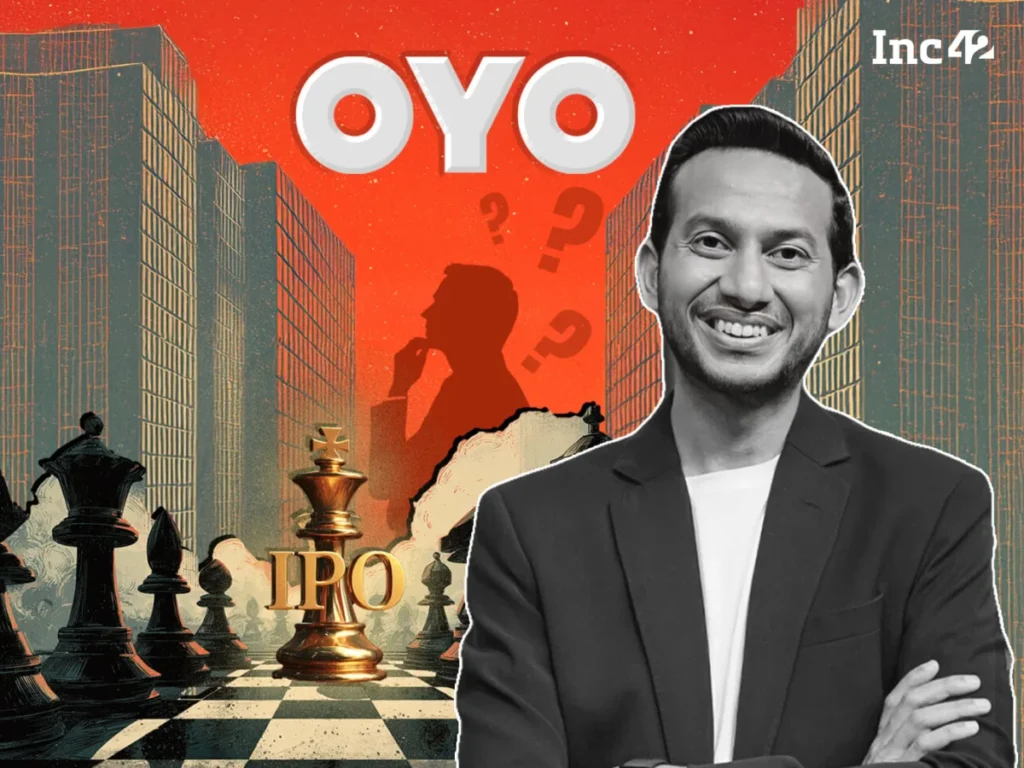
After two failed attempts to tap the public markets, OYO parent entity PRISM has officially filed its updated draft red herring prospectus (UDRHP) with the Securities and Exchange Board of India (SEBI). This third attempt represents a high-stakes pivot for the Ritesh Agarwal-led hospitality giant. While the company’s internal metrics show a marked improvement in fiscal health, the road to a successful listing remains fraught with a dense thicket of litigation that spans continents and jurisdictions.
The Financial Pivot: Turning the Tide
The primary narrative driving OYO’s current IPO bid is one of transformation. Unlike its previous filings, which were characterized by aggressive expansion and bottom-line volatility, the current iteration of the company boasts a leaner, more profitable profile.
According to the latest filing, OYO has achieved a significant milestone by posting a net profit of ₹748.3 Cr for the first nine months of FY26. This financial stabilization is a key selling point for institutional investors, signaling that the company has moved past its "growth-at-all-costs" phase. PRISM aims to raise ₹6,650 Cr through this IPO, with a notable structural detail: none of the existing shareholders are offloading their stakes. Instead, the capital raised is earmarked for debt reduction, specifically to repay or prepay certain borrowings, thereby strengthening the company’s balance sheet ahead of its public debut.
A Legal Minefield: Disclosures in the UDRHP
Despite the positive trajectory in its financial statements, the UDRHP is transparent about the "material risks" the company faces. The document lists a series of legal battles that could, if ruled against the company, have a significant adverse impact on its financial position and management bandwidth. These range from decade-old commercial disputes in India to high-stakes human trafficking litigation in the United States and antitrust regulatory penalties.
1. The Zostel Saga: A Decade-Old Stalemate
The dispute with Zostel remains the most prominent headache for OYO. Dating back to 2015, the conflict originated from a non-binding term sheet for the acquisition of Zostel’s business, which ultimately fell through. OYO has consistently maintained that no definitive agreement was ever signed and that core commercial terms remained unresolved.
- Chronology of the Conflict:
- 2021: An arbitration award suggested the term sheet had become binding by conduct.
- May 2025: The Delhi High Court set aside the award, noting it contradicted Indian public policy and that "specific performance" could not be granted for an incomplete commercial arrangement.
- July 2025: Zostel withdrew its Supreme Court appeal and filed a fresh appeal before the Delhi High Court under the Arbitration Act, which remains sub-judice.
- March 2026: The Delhi High Court permitted OYO’s subsidiary, OYO Hotels and Homes Private Limited (OHHPL), to be removed from the proceedings.
If the final judicial outcome favors Zostel, OYO could be forced to transfer up to 7% of its shareholding or pay an equivalent cash settlement—a outcome that would dilute shareholder value and force a restructuring of its ownership.
2. The US Litigation: The Cost of Global Expansion
The acquisition of G6 Hospitality (the parent of Motel 6 and Studio 6) has introduced a new layer of risk for OYO. The company has inherited a series of legal suits in the United States, with several alleging negligence and human trafficking at franchised motel properties.
One particular case, currently pending in the District Court of Harris County, Texas, involves a lawsuit filed on behalf of a minor, seeking damages exceeding ₹816.4 Cr. OYO’s defense rests on its franchise model: the company argues that it does not manage the day-to-day operations of these properties and that the franchisees are independently responsible for the conduct within their premises. However, the legal precedent is shifting; plaintiffs are increasingly targeting franchisors who prescribe operating standards and benefit from the brand’s commercial reach. The UDRHP notes that while contractual indemnification exists, insurance coverage is not guaranteed, as some providers exclude assault and human trafficking from their policies.
3. European Entanglements
OYO’s European footprint is also the subject of several disputes.
- France: The company is fighting a €2.15 Mn consultancy fee claim by Rochefort & Associés related to the proposed acquisition of CheckMyGuest. While a tribunal ruled against OYO in 2025, the Court of Appeals has stayed the enforcement, provided OYO deposits the disputed amount.
- United Kingdom: An arbitration involving Care Property Management Limited over a 2019 services agreement is ongoing, with claims totaling approximately £1.16 Mn.
- Belgium: Subsidiary Lugos B.V. is navigating insolvency proceedings linked to unpaid social security contributions of €81,175, though OYO insists this will not have a material impact on its broader European operations.
4. Regulatory Battles: The CCI and Antitrust
A major regulatory hurdle remains the Competition Commission of India (CCI) penalty of ₹168.88 Cr. The penalty stems from 2019, when the Federation of Hotel and Restaurant Associations of India (FHRAI) alleged that OYO and MakeMyTrip-Goibibo (MMT-Go) engaged in anti-competitive behavior. The core allegation is that the partnership effectively "delisted" rival chains like FabHotels and Treebo, creating an artificial monopoly. OYO’s appeal against this penalty is pending before the National Company Law Appellate Tribunal (NCLAT), with the company arguing that its agreement did not result in an "appreciable adverse effect on competition."
5. The Promoter Tax Dispute
The filing also discloses a significant tax dispute involving SoftBank Vision Fund (SVF). In 2019, SVF sought clarity on the tax treatment of its acquisition of shares in Oravel Stays Ltd. While SVF has already deposited nearly ₹1,689.53 Cr with Indian tax authorities, the matter remains under the consideration of the Board for Advance Rulings (BAR). The outcome of this case could impact the fiscal standing of the company’s largest investor, though the company notes that the proceedings are primarily at the promoter level.
Implications for Investors
The sheer breadth of these legal challenges presents a complex risk-reward profile for potential investors.
- Operational Distraction: As noted in the UDRHP, the management team’s time and resources are increasingly diverted to handle these ongoing litigations. The company explicitly states, "We cannot assure you that we will not receive any adverse order or claim in the future."
- Balance Sheet Pressure: While the company is profitable, a "worst-case scenario" loss in the Zostel or CCI cases could result in significant cash outflows, potentially threatening the liquidity gained from the IPO proceeds.
- Governance Scrutiny: Institutional investors will likely demand clarity on how OYO intends to ring-fence its operations from the legal liabilities of its franchisees and subsidiaries.
Conclusion: A High-Stakes Balancing Act
OYO’s third IPO attempt is a testament to the company’s resilience and its ability to pivot toward a profitable business model. However, the disclosures in the UDRHP serve as a stark reminder that the company’s rapid global scaling and historical aggressive business practices have left behind a trail of legal consequences.
For the IPO to succeed, OYO must convince the market that its current profitability is sustainable and that its legal liabilities are contained, manageable, and unlikely to fundamentally derail its long-term strategy. As the company moves toward its listing date, the eyes of the financial world will be on whether the market values the company’s current fiscal strength over the shadow of its legal past.