The Resilient Metal: Why India is Re-engineering Armored Warfare for the High Himalayas and the Drone Era
The rapid proliferation of low-cost loitering munitions, precision-guided missiles, and first-person view (FPV) drones has triggered a fierce debate among global military strategists: Is the main battle tank (MBT) becoming an obsolete relic of the 20th century? Dramatic footage from the plains of Ukraine showing multi-million-dollar armored platforms destroyed by commercial drones rigged with explosives has emboldened critics who argue that heavy armor has no place on the transparent, modern battlefield.
Yet, military experts, strategic think tanks, and Indian defense planners argue otherwise. While airpower, cyber warfare, and unmanned aerial vehicles (UAVs) can disrupt and devastate an adversary’s infrastructure, they cannot occupy territory, enforce a physical surrender, or establish lasting political control. History consistently demonstrates that decisive military victory requires a physical ground presence.
Recognizing this, India is embarking on a massive, dual-track modernization of its armored forces. Faced with a unique two-front threat—the flat, canal-crossed plains bordering Pakistan and the oxygen-deprived, high-altitude ridges of the Line of Actual Control (LAC) facing China—New Delhi is proving that the tank is not dying; it is adapting. Through the development of the indigenous Zorawar Light Tank and the ambitious Future Ready Combat Vehicle (FRCV) under Project Ranjeet, the Indian military is reshaping armored doctrine for the 21st century.
Main Facts: The Armored Paradigm Shift
The modern battlefield has become highly transparent, leaving heavy armor vulnerable to asymmetric threats. However, Indian defense planners maintain that tanks remain an indispensable component of combined-arms warfare. The core realities shaping this perspective include:

- The Primacy of Ground Control: Missiles, artillery, and drones can destroy defensive positions, but they cannot hold ground. Ground forces, anchored by mobile armored platforms, remain the only means to achieve decisive, sovereign control over disputed territory.
- The Dual-Front Challenge: India’s security landscape requires two entirely different armored doctrines. The Western front (Pakistan) demands heavy, hard-hitting MBTs capable of high-speed maneuver warfare across plains and deserts. Conversely, the Northern front (China) requires highly agile, lightweight, and air-transportable platforms capable of operating at altitudes exceeding 15,000 feet.
- The Mountain Armor Gap: Following the 2020 Galwan Valley clash, India was forced to deploy its heavy, Russian-origin T-72 and T-90 tanks to the rugged heights of Ladakh. While tactically necessary, these 45-to-48-tonne platforms are ill-suited for the steep gradients, narrow passes, and thin air of the Himalayas, where engines lose power and logistics become nightmarish.
- The Indigenization Push: This modernization coincides with a massive surge in domestic defense manufacturing. India’s defense production reached a historic record of ₹1.78 lakh crore in FY 2025-26, providing the financial and industrial foundation needed to build advanced, indigenous armored platforms rather than relying on foreign imports.
Chronology: The Evolution of India’s Armored Doctrine
[1965 & 1971 Wars] ──> [1987 & 2017 Crises] ──> [2020 Ladakh Standoff] ──> [June 2024] ──> [2028–2029] ──> [Next Decade]
   Tank battles          Sumdorong Chu &          Emergency deployment       PM reviews     Expected Zorawar      FRCV roll-out
   prove ground          Doklam highlight         of heavy T-72/T-90s        Zorawar tank     induction (354      to replace aging
    dominance              mountain gap            triggers Project           at L&T Hazira      units)           T-72 fleet
Zorawar- 1965 and 1971 Indo-Pakistani Wars: India engages in some of the largest tank battles since World War II (such as the Battle of Asal Uttar). These conflicts establish the doctrine that armored breakthroughs are essential for forcing territorial concessions and securing decisive victories.
- 1987 (Sumdorong Chu) and 2017 (Doklam) Crises: Tensions along the Sino-Indian border highlight the difficulty of rapidly deploying heavy armored formations to the high Himalayas. Military planners begin recognizing the need for a dedicated, lightweight mountain tank, though procurement plans languish in bureaucratic red tape.
- May 2020 (Ladakh Standoff): The deadly clashes in eastern Ladakh serve as a major wake-up call. China’s People’s Liberation Army (PLA) rapidly deploys its modern, highly mobile Type-15 (ZTQ-15) light tanks to the LAC. India is forced to airlift T-72 and T-90 tanks to Ladakh as an emergency countermeasure, exposing a severe capability gap.
- Late 2020: The Indian Army launches Project Zorawar, an emergency procurement program to design and manufacture an indigenous 25-tonne light tank optimized for high-altitude warfare.
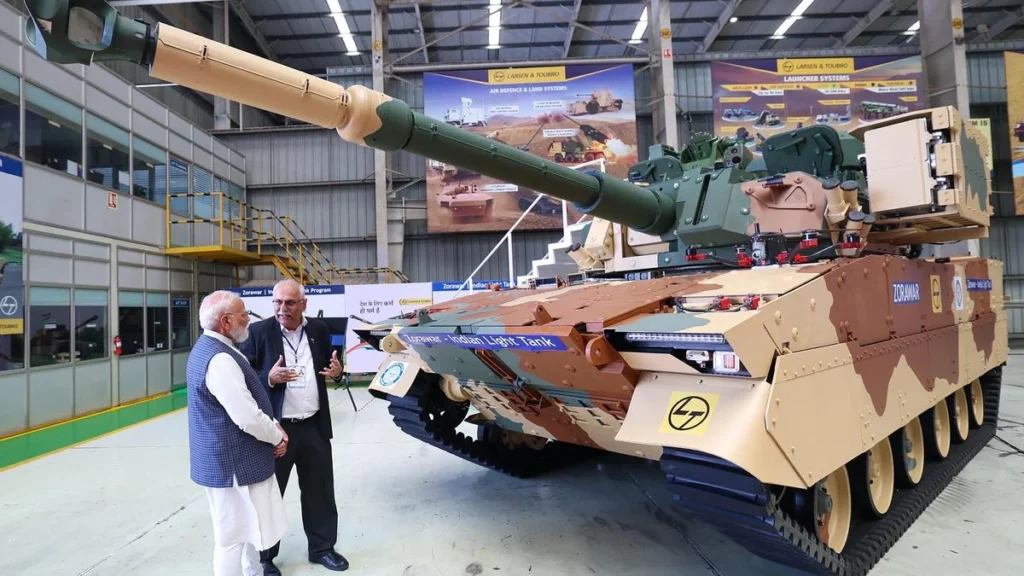
- June 2024: Prime Minister Narendra Modi visits Larsen & Toubro’s (L&T) Hazira manufacturing facility in Gujarat. He reviews the prototype of the Zorawar light tank, jointly developed by the Defence Research and Development Organisation (DRDO) and L&T Defence, signaling top-level political backing for the project.
- 2028–2029 (Projected): The revised timeline for the induction of the Zorawar light tank. The Indian Army plans to induct an initial run of 354 tanks at an estimated program cost of ₹17,500 crore.
- The Next Decade (Project Ranjeet): Parallel to the Zorawar, India intends to roll out the Future Ready Combat Vehicle (FRCV) program to systematically phase out its aging fleet of T-72 tanks with next-generation MBTs.
Supporting Data: Fleet Metrics and Technical Specifications
To understand the scale of India’s armored transition, it is necessary to examine the current composition of the Indian Armoured Corps alongside the technical specifications of its future acquisitions.
Current Indian Armored Fleet Composition
| Platform | Origin | Approximate Quantity | Weight (Tonnes) | Primary Role / Status |
|---|---|---|---|---|
| T-72 Ajeya | Russian / Indigenous | 2,400 – 2,500 | ~41.5 | Backbone of the corps; over 40 years old; slated for replacement by FRCV. |
| T-90S Bhishma | Russian / Indigenous | 1,200+ | ~46.5 | Primary modern MBT; deployed in plains, deserts, and select high-altitude areas. |
| Arjun Mk1 | Indigenous | 124 | 58.5 | Heavy MBT; high firepower but restricted operational mobility due to weight. |
| Arjun Mk1A | Indigenous | 118 (On Order) | 68.5 | Upgraded variant; highly capable but limited to specific western sectors. |
| Zorawar (Future) | Indigenous (DRDO/L&T) | 354 (Planned) | 25.0 | High-altitude light tank; scheduled for induction between 2028 and 2029. |
Technical Specifications: Zorawar vs. Type-15 (PLA)
The Zorawar is designed to directly counter China’s deployed light armor along the LAC.
- Weight & Transportability: Weighing just 25 tonnes, the Zorawar is air-transportable via the Indian Air Force’s C-17 Globemaster III and Ilyushin-76 transport aircraft, allowing for rapid deployment to forward mountain airstrips. In contrast, heavy MBTs like the T-90 require specialized logistics and struggle on weak mountain bridges.
- Power-to-Weight Ratio: High altitudes suffer from low atmospheric pressure and thin air, which can rob standard diesel tank engines of up to 50% of their power. The Zorawar features a high power-to-weight ratio engine specifically supercharged for high-altitude operations.
- Defensive Suite: To survive the modern drone-saturated battlefield, the Zorawar is designed with modular armor, electronic warfare (EW) jammers to disrupt drone control signals, and active protection systems (APS) capable of intercepting incoming anti-tank guided missiles (ATGMs).
   [Zorawar Light Tank: 25 Tonnes]               [Standard T-90S MBT: 46.5 Tonnes]
   ┌──────────────────────────────┐              ┌──────────────────────────────┐
   │ High Power-to-Weight Ratio   │              │ Heavy Composite Armor        │
   │ Air-Transportable (C-17)     │     VS.      │ High Ground Pressure         │
   │ Mountain & Amphibious Capable│              │ Restricted Mountain Mobility │
   │ Integrated EW & APS          │              │ High Fuel Consumption        │
   └──────────────────────────────┘              └──────────────────────────────┘
The Economic Asymmetry of Modern Warfare
A key factor driving India’s tank modernization is the unfavorable economic mathematics of defensive warfare, as demonstrated in recent global conflicts:
- The Shahed-Style Threat: During US-Iran tensions in West Asia, cheap, low-radar-cross-section Shahed-like drones successfully targeted advanced radar systems, including Terminal High Altitude Area Defense (THAAD) sites.
- Operation Sindoor: During this operation, Pakistan reportedly utilized swarms of low-cost drones to saturate Indian airspace.
- The Cost Equation: A commercially assembled or low-cost military drone costing a few lakh rupees can force a defender to launch interceptor missiles costing several crore rupees each. Even if the defender achieves a 100% interception rate, they face economic exhaustion. Tanks must therefore carry localized, cost-effective hard-kill and soft-kill countermeasures rather than relying solely on expensive, theater-level air defense umbrellas.
Official Responses and Military Perspectives
The Ground Commander’s View: Ground Invasion is Irreplaceable
A senior Indian Army officer, speaking on the condition of anonymity, emphasized that the fundamental nature of war has not changed despite technological advancements:

"Drones can create panic, disrupt logistics, and inflict heavy casualties, but they cannot achieve the ultimate objective of war. To enforce a surrender, a physical ground invasion of enemy territory is essential. This is the lesson India demonstrated during the 1965 and 1971 wars against Pakistan. Tanks remain the primary instrument for such breakthrough operations. However, to survive, they are evolving with lighter designs, anti-drone cages, active protection systems, and electronic warfare suites."
The Strategic Think Tank: Adapting, Not Disappearing
Lieutenant General (retd.) Dushyant Singh, Director General of the Centre for Land Warfare Studies (CLAWS), rejected the notion that the age of the tank is over:
"In the India-Pakistan context, territory remains central. Neither side will voluntarily surrender an inch of land. Similarly, the ongoing conflicts in West Asia and Ukraine demonstrate that unless territory is physically occupied and held, victory remains incomplete. Air strikes and missile barrages are highly effective for punitive action and destroying strategic infrastructure, but controlling land requires boots on the ground."
Lt. Gen. Singh pointed out that Russia’s ability to seize and maintain control over large swathes of eastern Ukraine is directly tied to its massive, combined-use of infantry and armored formations.

"Whenever a new weapon system appears dominant—as the drone does today—countermeasures inevitably emerge. Tanks are not disappearing; they are adapting. Future operations will rely on integrated, multi-domain maneuvers where tanks operate with dedicated air defense, electronic warfare, and drone support."
The Leadership: Addressing Design Refinements
The development of the Zorawar has faced some delays, shifting the expected induction timeline to 2028–2029. Addressing these adjustments, former Army Chief General Upendra Dwivedi stated that the timeline revision is a natural part of developing a highly complex, indigenous combat platform:
"The issues identified during initial development and rigorous high-altitude testing are being addressed through routine design refinements. One of our primary focus areas has been the demand for enhanced protection against modern anti-tank weapons without compromising the tank’s strict 25-tonne weight limit. Balancing heavy armor protection with high mobility and an optimal power-to-weight ratio is technically demanding, but our developers are meeting these challenges."
Implications for Modern and Future Warfare
India’s renewed focus on armored capabilities carries profound strategic, tactical, and industrial implications for regional security and the future of ground combat.

1. Rebalancing the Power Dynamics Along the LAC
The deployment of the Zorawar light tank will narrow the operational gap between India and China in the high-altitude regions of Ladakh, Sikkim, and Arunachal Pradesh. By fielding a agile, hard-hitting platform designed specifically for the terrain, the Indian Army will gain a credible offensive and defensive capability. This reduces the risk of incremental, gray-zone territorial encroachments (often referred to as "salami-slicing") by the PLA, as any ground intrusion can be met with rapid armored counter-maneuvers.
2. The Rise of Combined-Arms Integration
The era of the independent, massed tank charge is over. The modern battlefield demands a tightly integrated combined-arms doctrine. In future conflicts, tanks will operate as part of a networked ecosystem:
- UAV Reconnaissance: Forward-deployed tanks will be tethered to localized reconnaissance drones, giving tank commanders over-the-horizon visibility.
- Electronic Warfare Shields: Armored columns will be accompanied by mobile electronic warfare platforms designed to jam drone control frequencies and GPS signals.
- Integrated Air Defense: Mobile short-range air defense (SHORAD) systems will move alongside armored formations to counter loitering munitions and attack helicopters.
                  ┌────────────────────────┐
                  │   Overhead UAV / EW    │
                  │  (Recon & Jamming)     │
                  └───────────┬────────────┘
                              │ (Data Link)
                              ▼
┌────────────────┐  (Radio) ┌────────────────┐  (Support) ┌────────────────┐
│ Infantry & IFV ├─────────>│  Zorawar Tank  │<───────────┤ Mobile SHORAD  │
│  (Clearance)   │          │ (Mobile Fire)  │            │ (Air Defense)  │
└────────────────┘          └────────────────┘            └────────────────┘
3. Project Ranjeet: Setting the Stage for the Next-Gen MBT
While the Zorawar addresses the urgent mountain warfare gap, Project Ranjeet (the FRCV program) will redefine India’s heavy armored capabilities. The FRCV is envisioned as a 55-tonne next-generation MBT that will replace the aging T-72 fleet. Expected to cost between ₹57,000 crore and ₹60,000 crore for approximately 1,700 to 1,800 units, the FRCV will feature:
- A powerful main gun larger than 120 mm.
- AI-assisted fire control systems capable of automatic target classification.
- Advanced explosive reactive armor (ERA) and underbelly mine protection.
- A modular design allowing for rapid upgrades as new technologies emerge.
4. Boosting Domestic Defense Industrialization
The Zorawar and FRCV programs are central to India’s "Aatmanirbhar Bharat" (self-reliance) initiative. With domestic defense production hitting historic highs, these programs ensure that hundreds of billions of rupees remain within the Indian economy, fostering a robust defense ecosystem of private manufacturers, public sector undertakings, and micro, small, and medium enterprises (MSMEs).

Ultimately, modern warfare has shown that technology does not replace the fundamental requirement to control physical space. While drones, missiles, and cyber-attacks can dismantle an enemy’s infrastructure from afar, they cannot hold a mountain ridge or a border town. For that, the military needs soldiers on the ground, supported by mobile, protected, and lethal armored platforms. By adapting its armored forces to the realities of both high-altitude geography and high-tech asymmetry, India is ensuring that its land forces remain prepared to defend its sovereign borders.