The Evolution of AI on AWS: A Deep Dive into the Claude Fable 5 Launch and Regulatory Landscape
By Technology Editorial Staff
Updated July 1, 2026
The landscape of generative artificial intelligence witnessed a significant shift in June 2026 as Amazon Web Services (AWS) and Anthropic moved to integrate the latter’s most advanced models—Claude Fable 5 and Claude Mythos 5—into the AWS ecosystem. This deployment, characterized by cutting-edge performance in software engineering and complex knowledge tasks, also highlighted the increasingly volatile intersection of high-end AI development and global regulatory compliance.
Following a brief but impactful period of service suspension due to government export control directives, access to these models has now been restored, marking a new chapter in the partnership between two of the industry’s most prominent AI entities.
Main Facts: The Power of Claude Fable 5
At its core, the release of Claude Fable 5 on Amazon Bedrock and the Claude Platform on AWS represents a strategic push to make "Mythos-level" capabilities accessible to enterprise users. Anthropic has positioned Fable 5 as a state-of-the-art model that excels in multi-modal reasoning, software architecture, and long-form analytical tasks.
Technical Performance and Safeguards
What sets Fable 5 apart from its predecessors is its balance of raw capability and safety. Anthropic has implemented a sophisticated, tiered-safety architecture. When the model encounters prompts that involve high-risk domains—specifically cybersecurity, biology, chemistry, and specialized health inquiries—it is programmed to intelligently "fall back" to the Opus 4.8 model. This ensures that while the user benefits from Fable 5’s general reasoning, they remain within a secure, guardrailed environment.
Conversely, the Claude Mythos 5 model, which lacks these specific performance-limiting safeguards, remains restricted to a highly vetted, select group of customers, emphasizing a "security-first" deployment strategy for the most potent iterations of the technology.
Chronology of Events: A Turbulent June
The deployment of Claude Fable 5 was not without its administrative and regulatory hurdles. The timeline below captures the rapid changes that defined the release:
- June 9, 2026: Technical documentation updates are released, including refined CLI commands and updated console screenshots for the Bedrock environment, streamlining the integration process for developers.
- June 10, 2026: Further technical refinements are added, detailing how to utilize AWS SigV4 for the Data Retention API, providing a more robust security posture for enterprises.
- June 12, 2026: A sudden industry shock occurs. AWS announces a total revocation of access to both Claude Fable 5 and Mythos 5. The action is taken to ensure compliance with a sudden US Government export control directive. Anthropic confirms that other models, such as Opus 4.8, remain unaffected and fully operational.
- July 1, 2026: Following a period of regulatory review and compliance adjustment, AWS announces the restoration of access to both Claude Fable 5 and Mythos 5, signaling that the necessary framework to meet federal standards has been successfully implemented.
Supporting Data: Implementing the Infrastructure
For developers and enterprise architects, the integration of Claude Fable 5 requires adherence to specific data management protocols. Because the model involves sophisticated inference patterns, Amazon Bedrock requires an explicit "opt-in" to data sharing.
The Data Retention Mandate
To access the model, users must configure the provider_data_share setting. This is a critical requirement, as Anthropic mandates a 30-day retention period for inputs and outputs, coupled with human review protocols to support ongoing abuse detection.
Technical Implementation Example
For those utilizing the bedrock-mantle engine, the transition is managed via a simple PUT request:
curl -X PUT https://bedrock-mantle.us-east-1.api.aws/v1/data_retention
  -H "x-api-key: <your-bedrock-api-key>"
  -H "Content-Type: application/json"
  -d ' "mode": "provider_data_share" '
This granular control reflects the broader industry trend of "Responsible AI," where the burden of data governance is shared between the cloud provider (AWS) and the model developer (Anthropic).
Official Responses and Strategic Implications
The June 12th suspension served as a stark reminder that AI is no longer a "move fast and break things" environment. It is now a critical national security asset.
The Regulatory Landscape
The US Government’s intervention regarding export controls suggests that the capabilities inherent in models like Fable 5 and Mythos 5 have reached a threshold where they are considered "dual-use" technologies. By restricting access to foreign entities or specific sensitive sectors, the government is signaling that the most advanced large language models (LLMs) are now subject to the same oversight as advanced semiconductor manufacturing equipment.
Enterprise Impact
For businesses, this creates a complex environment. On one hand, the ability to build, scale, and iterate on AWS provides a massive competitive advantage. On the other hand, the risk of sudden service revocation necessitates a robust multi-model strategy. Organizations that rely exclusively on one specific model may face operational downtime if regulatory environments shift.

The move to integrate with AWS’s standard tooling—such as the Converse API—is a clear attempt to minimize this friction. By allowing developers to swap models within the same codebase, AWS is enabling a "fail-safe" architecture for enterprise customers.
Future Outlook: Scaling Ambition
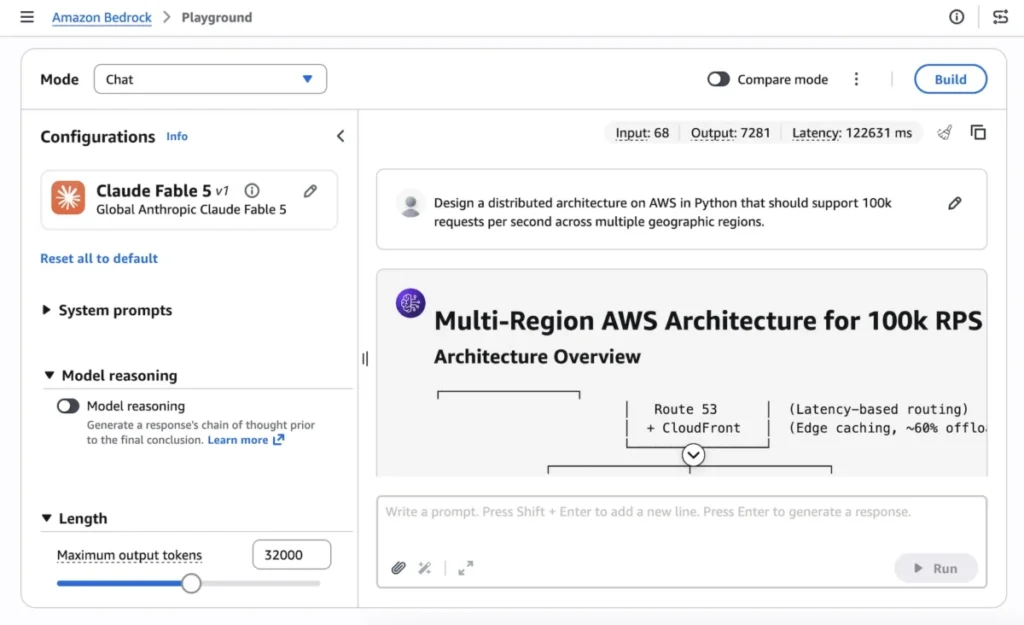
As of July 2026, Claude Fable 5 is available in the US East (N. Virginia) and Europe (Stockholm) regions, with further global expansion anticipated. The "Claude Platform on AWS" further serves as a dedicated environment for organizations that require a more native, integrated experience with Anthropic’s stack.
Moving Beyond the Playground
While the "Playground" in the Bedrock console is an excellent starting point for testing, the real value of Fable 5 lies in its integration into production-grade pipelines. With the ability to handle 100k requests per second across geographic regions, the architecture provided by the combination of AWS infrastructure and Anthropic’s model weights represents the current ceiling of commercial AI.
Closing Thoughts
The return of Claude Fable 5 is more than just a software update; it is a testament to the resilience of the cloud-AI partnership. As we move into the second half of 2026, the focus will undoubtedly shift from simply "deploying" these models to "governing" them. Companies that can successfully navigate the dual demands of high-performance computing and rigid regulatory compliance will be the ones that define the next era of technological progress.
For developers looking to get started, the path is now clear: ensure your data retention policies are compliant, leverage the latest AWS SDKs, and prepare for a future where your AI stack is as dynamic as the regulations governing it.
For further technical guidance or to report feedback, developers are encouraged to visit the AWS re:Post community or contact their designated AWS support representative.