AWS Unveils Lambda MicroVMs: Bridging the Gap Between Serverless Flexibility and Virtual Machine Isolation
In a significant expansion of its serverless ecosystem, Amazon Web Services (AWS) has announced the launch of AWS Lambda MicroVMs, a groundbreaking compute primitive designed to address the complex requirements of modern multi-tenant applications. By offering virtual machine-level isolation with the operational simplicity of serverless, this new offering aims to solve the "isolation vs. performance" dilemma that has long challenged developers building AI-driven platforms, interactive code environments, and secure data analytics tools.
Powered by the battle-tested Firecracker virtualization technology—the same engine that handles over 15 trillion monthly AWS Lambda invocations—Lambda MicroVMs provide a stateful, secure, and rapidly scalable environment for user-supplied code.
Main Facts: A New Compute Primitive
At its core, Lambda MicroVMs represents a departure from the traditional request-response model of standard Lambda functions. While standard functions are ephemeral and stateless by design, MicroVMs are built to persist. They allow developers to provision dedicated, isolated execution environments for individual end-users or specific sessions.

Key Technical Pillars:
- Virtual Machine-Level Isolation: Unlike containerized environments that share a host kernel, every Lambda MicroVM runs in its own hardened environment. This provides a robust security boundary for executing untrusted code—such as scripts generated by AI assistants or user-uploaded plugins—without the risk of cross-tenant interference.
- Rapid Snapshot-Based Launch: The platform utilizes an "image-then-launch" workflow. Developers package their environment via Dockerfiles; AWS then pre-initializes these environments and takes a snapshot of the disk and memory state. Consequently, starting a new session is near-instant, as the system resumes from a "warm" snapshot rather than performing a cold boot.
- Stateful Execution: MicroVMs maintain memory, disk, and process state throughout the life of a session. Even during idle periods, the state is snapshotted to persistent storage, allowing the application to "resume" exactly where the user left off, without the latency of re-bootstrapping.
Chronology of Development
The introduction of MicroVMs is the culmination of years of engineering evolution at AWS, specifically regarding the Firecracker project.
- 2018: The Firecracker Foundation. AWS open-sourced Firecracker, a Virtual Machine Monitor (VMM) designed to create and manage secure, multi-tenant container and function-based services. This technology became the bedrock of AWS Lambda.
- The Rise of Generative AI (2022–2024): As AI coding assistants and interactive data science platforms gained mass adoption, developers struggled with the "multi-tenancy problem." They needed to run LLM-generated code safely for thousands of concurrent users, leading to the creation of custom-built, high-maintenance virtualization stacks.
- 2025: Engineering the Gap. AWS began developing a specialized layer on top of Firecracker that would allow for stateful, long-running sessions, specifically optimized for the unique latency requirements of AI applications.
- June 2026: Official Launch. AWS officially rolls out Lambda MicroVMs, integrating them directly into the Lambda console and CLI, marking a shift toward a more nuanced, "application-centric" serverless model.
Supporting Data: Capacity and Infrastructure
Lambda MicroVMs are designed to handle heavy lifting, moving beyond the lightweight scope of traditional functions.
- Compute Power: Each MicroVM can scale up to 16 vCPUs and 32 GB of memory, with 32 GB of dedicated disk space.
- Architecture: The service currently launches on the ARM64 architecture, leveraging the efficiency of AWS Graviton processors to balance performance and power consumption.
- Idle Management: The platform introduces configurable lifecycle policies. A typical configuration—such as auto-suspending after 15 minutes of inactivity—allows for substantial cost savings while maintaining a seamless user experience. The system is designed to handle up to 8 hours of total runtime per session, covering everything from quick vulnerability scans to extended analytical sessions.
Official Responses and Strategic Implications
The release of Lambda MicroVMs signals a strategic pivot in how AWS views the "serverless" market. During the launch, AWS engineering leads emphasized that this was not meant to replace traditional Lambda functions, but to complement them.

"We saw our customers hitting a wall," one lead engineer noted. "They were building their own orchestration layers to handle stateful, untrusted code execution. We decided to take the heavy lifting of infrastructure management out of the equation so developers could focus solely on the code that powers their application."
Implications for the Industry:
- Security-First AI Development: With AI models now generating executable code, the risk of "prompt injection" and "malicious code execution" is at an all-time high. Lambda MicroVMs provide a "sandbox" that is cryptographically isolated, providing an essential layer of defense for companies building the next generation of AI agents.
- The Death of "Custom Virtualization": Many startups previously spent millions of dollars in engineering hours building proprietary platforms to manage "code-on-demand" features. AWS has effectively commoditized this complexity, allowing smaller teams to compete with tech giants.
- Optimized Cost Modeling: By introducing a "suspend-resume" model, AWS is changing the economics of compute. Users no longer have to pay for an active VM during a user’s "think time." Instead, they pay for the compute while it is active and a significantly reduced rate while the environment is suspended.
Looking Ahead: Integration and Future Potential
The workflow for developers is intentionally streamlined. By leveraging standard Dockerfiles and S3-based artifacts, the learning curve is minimal for those already familiar with the AWS ecosystem.
Implementation Workflow:
- Image Creation: Use
aws lambda-microvms create-microvm-imageto transform a Dockerfile into a bootable, snapshot-ready image. - Deployment: Use
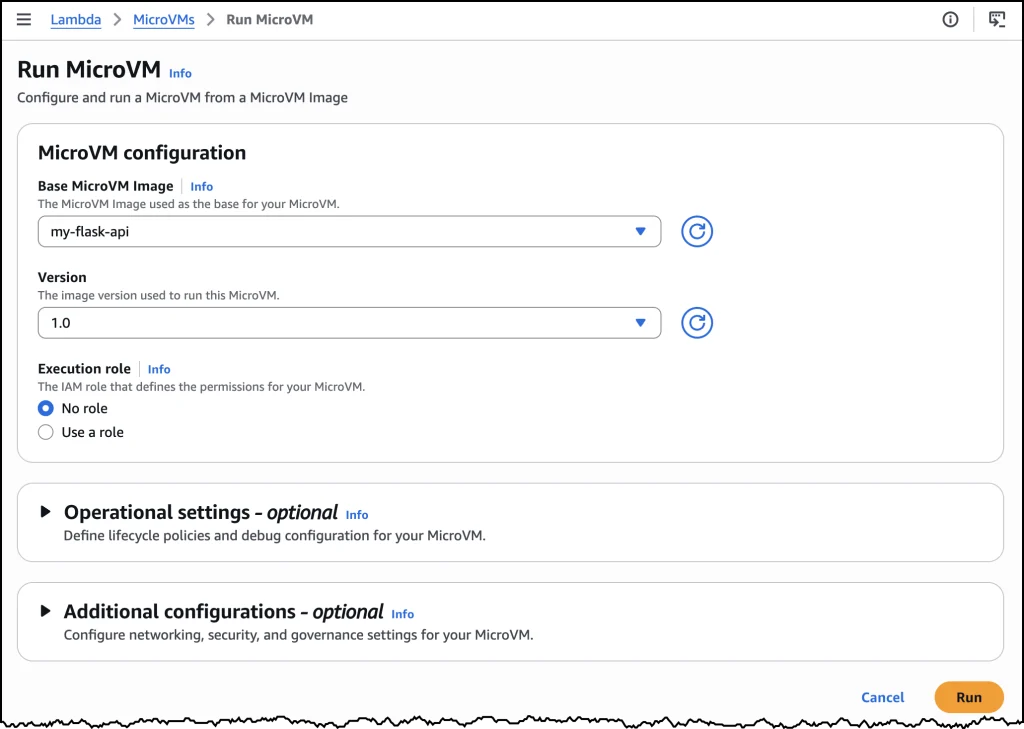
aws lambda-microvms run-microvmto initiate the session, applying custom idle policies. - Security: Authentication is handled via standard AWS IAM, with traffic proxied through dedicated, secure endpoints.
As of today, the service is available in US East (N. Virginia, Ohio), US West (Oregon), Europe (Ireland), and Asia Pacific (Tokyo).

The introduction of Lambda MicroVMs is more than just a new feature; it is an evolution of the serverless paradigm. By granting developers control over state and environment lifecycle without the overhead of managing underlying hardware, AWS is setting a new standard for how interactive, multi-tenant applications will be built in the era of generative AI. Whether it is a collaborative coding platform, a complex data visualization tool, or a secure AI sandbox, the barrier to entry for building high-performance, isolated compute applications has been significantly lowered.
For developers looking to integrate, the path is clear: visit the AWS Lambda console to define your first MicroVM image and explore the new API surface. With the combined power of Firecracker and the scalability of Lambda, the future of stateful, serverless computing has officially arrived.