Streamlining Security: AWS Certificate Manager Introduces Native ACME Support
In an era where digital security is synonymous with business continuity, the management of Transport Layer Security (TLS) certificates has transitioned from a routine IT task to a critical enterprise governance challenge. As industry standards tighten and certificate lifespans shrink, the pressure on DevOps and security teams has mounted. Addressing this, Amazon Web Services (AWS) has announced a significant evolution in its security infrastructure: the introduction of native support for the Automatic Certificate Management Environment (ACME) protocol within AWS Certificate Manager (ACM).
This development represents a major shift for organizations that have historically struggled to balance the agility of automated certificate issuance with the rigid requirements of centralized security compliance. By providing a managed ACME server endpoint, AWS is effectively enabling teams to automate the lifecycle of public certificates while retaining the rigorous oversight necessary for large-scale enterprise environments.

The Shrinking Window: Why Automation is No Longer Optional
The urgency behind this update is rooted in the shifting landscape of internet security. The Certification Authority (CA)/Browser Forum, the industry body that sets the rules for digital trust, has implemented a roadmap that significantly reduces the maximum validity period for public TLS certificates. Starting in March 2027, the mandate reduces maximum validity to 100 days, with a further contraction to 47 days by 2029.
These tighter constraints are designed to limit the window of opportunity for attackers to exploit compromised certificates. However, for organizations relying on manual renewal processes, this transition renders traditional methods obsolete. Manual intervention is not only labor-intensive but also introduces the human error factor—a leading cause of certificate expiration outages. When a certificate expires, services go dark, customers encounter browser warnings, and brand reputation suffers. Automation is no longer a "nice-to-have" feature; it is a fundamental requirement for modern infrastructure.

The ACME Protocol: An Industry Standard
At the heart of this transition is the Automatic Certificate Management Environment (ACME). Originally popularized by the non-profit certificate authority Let’s Encrypt, ACME is an open, standardized protocol that allows for the automated request, renewal, and revocation of TLS certificates. Because it is vendor-neutral and widely supported, it has become the gold standard for DevOps engineers who rely on tools like Certbot, cert-manager for Kubernetes, and acme.sh.
Before today’s update, organizations attempting to leverage ACME within the AWS ecosystem often faced a "fragmented visibility" problem. While they could use ACME to automate certificates, they were frequently forced to rely on external certificate authorities (CAs) outside of the AWS environment. This created a bifurcated system where some certificates were managed in ACM, while others lived in third-party dashboards, leaving PKI (Public Key Infrastructure) administrators blind to the status, lifecycle, and security posture of their entire fleet.
Bridging the Gap: Native ACME in ACM
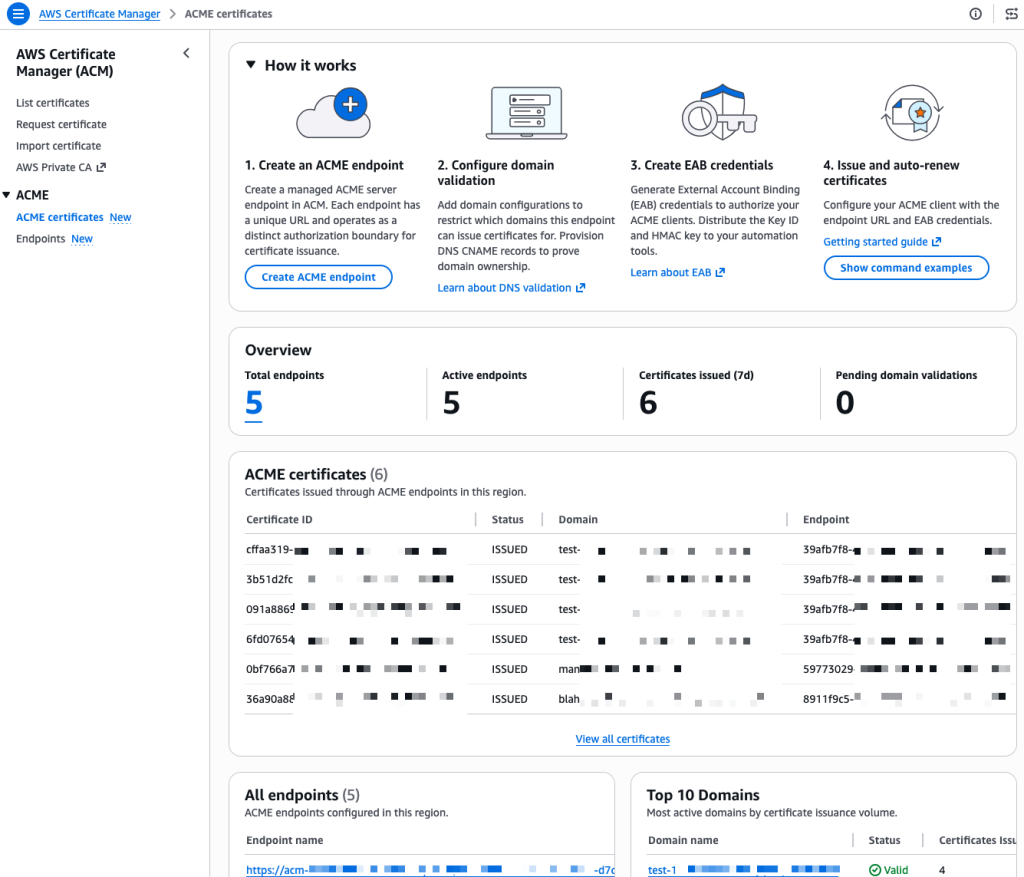
The integration of ACME directly into AWS Certificate Manager serves as a bridge between the high-velocity world of automated DevOps and the high-security world of corporate compliance. AWS now provides a fully managed ACME server endpoint, allowing customers to issue public TLS certificates directly from Amazon Trust Services.
This integration is not merely about functionality; it is about centralization. By bringing ACME into the ACM console, AWS provides a single pane of glass for all certificate management. PKI administrators can now monitor and control ACME certificate usage across an entire organization, regardless of whether those certificates were issued via the console, an API call, or an automated ACME client.
Governance and Access Control
One of the most significant implications of this release is the enhancement of governance. With the new ACME endpoints, PKI administrators can implement granular security policies:
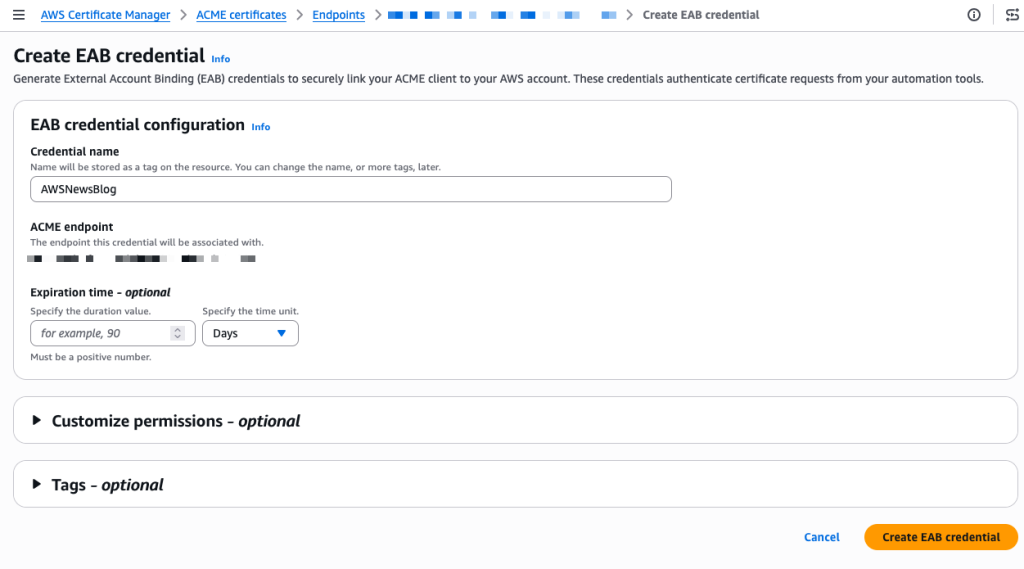
- External Account Binding (EAB): Administrators can generate EAB credentials that allow them to bind Identity and Access Management (IAM) roles to specific ACME accounts. This ensures that only authorized entities can request certificates.
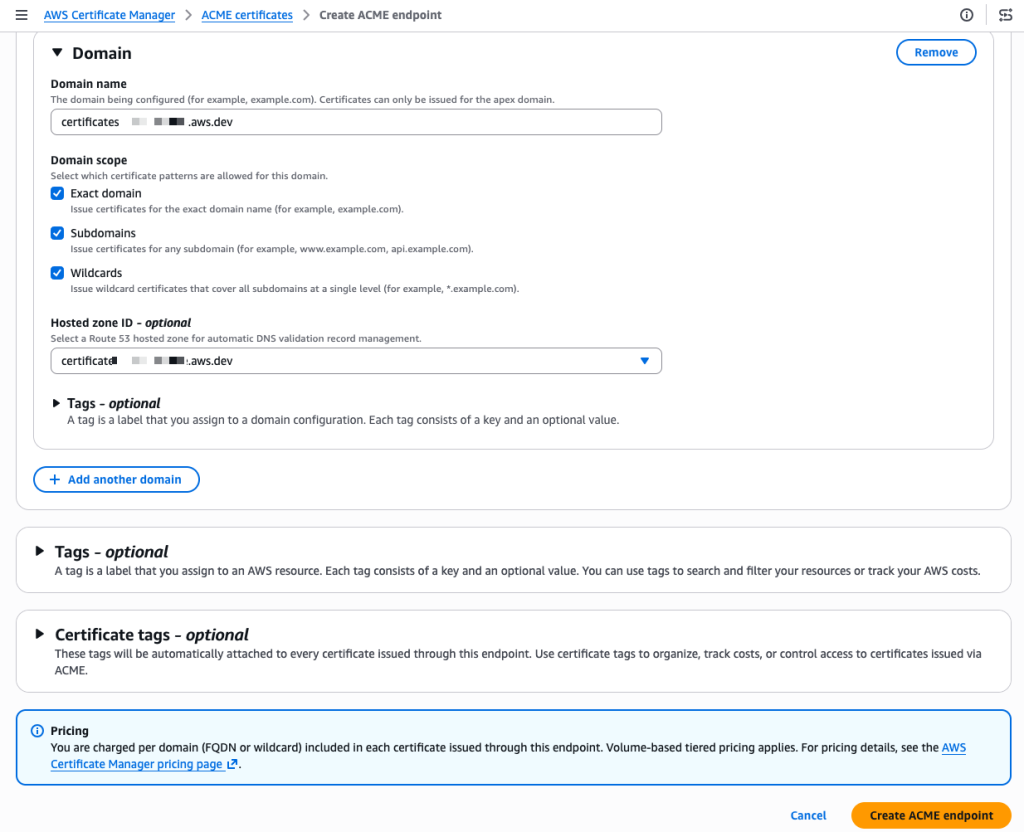
- Domain Scoping: At the endpoint level, administrators can define exactly which domains or patterns (such as subdomains or wildcards) an ACME client is permitted to request. This prevents the "wild west" scenario where developers might accidentally request unauthorized or overly permissive certificates.
- Centralized Logging: Every request is captured by AWS CloudTrail for auditability, while operational metrics are tracked via Amazon CloudWatch.
Technical Deep Dive: The Operational Workflow
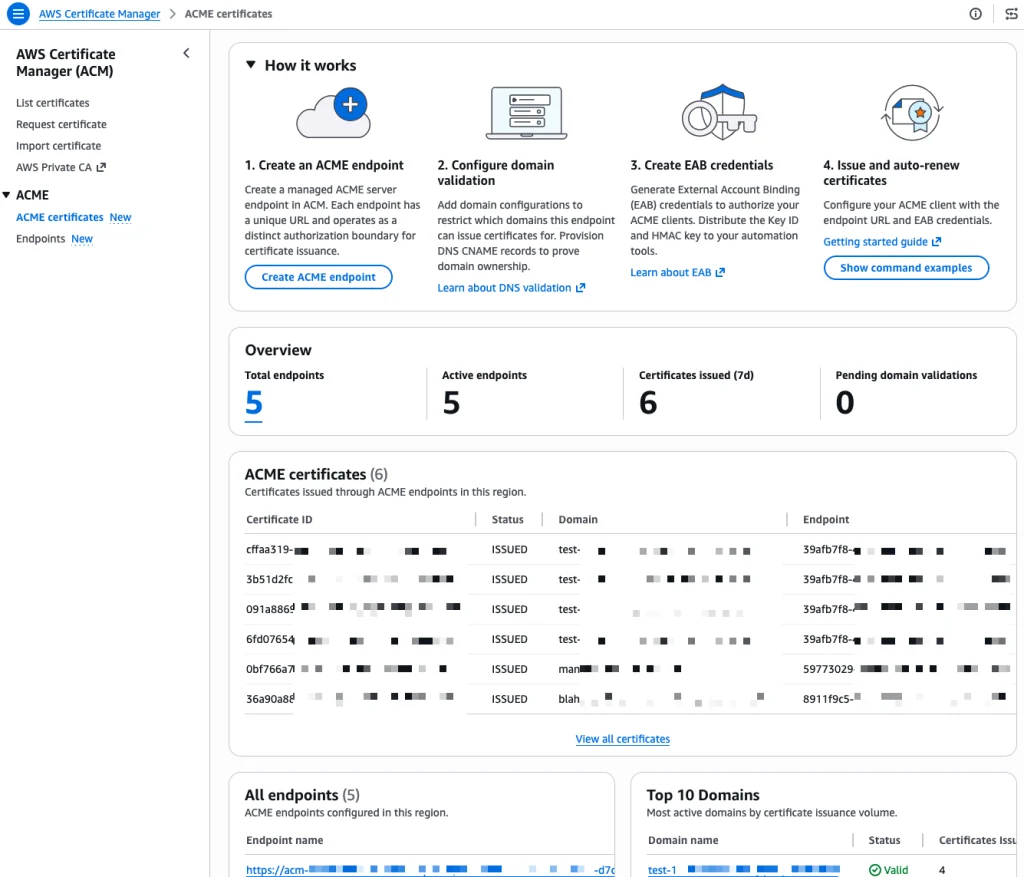
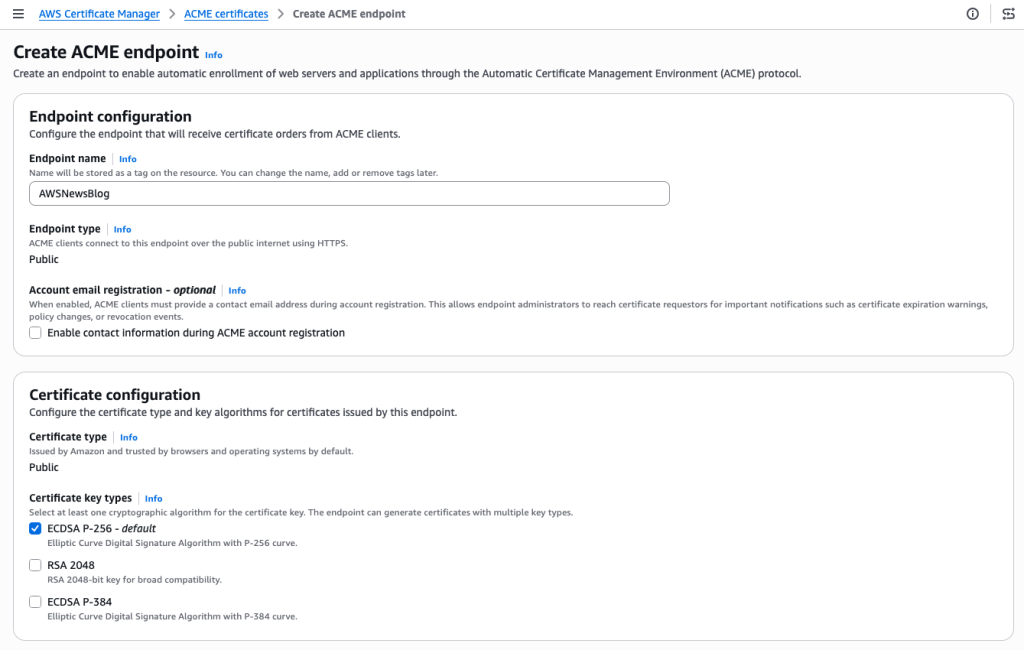
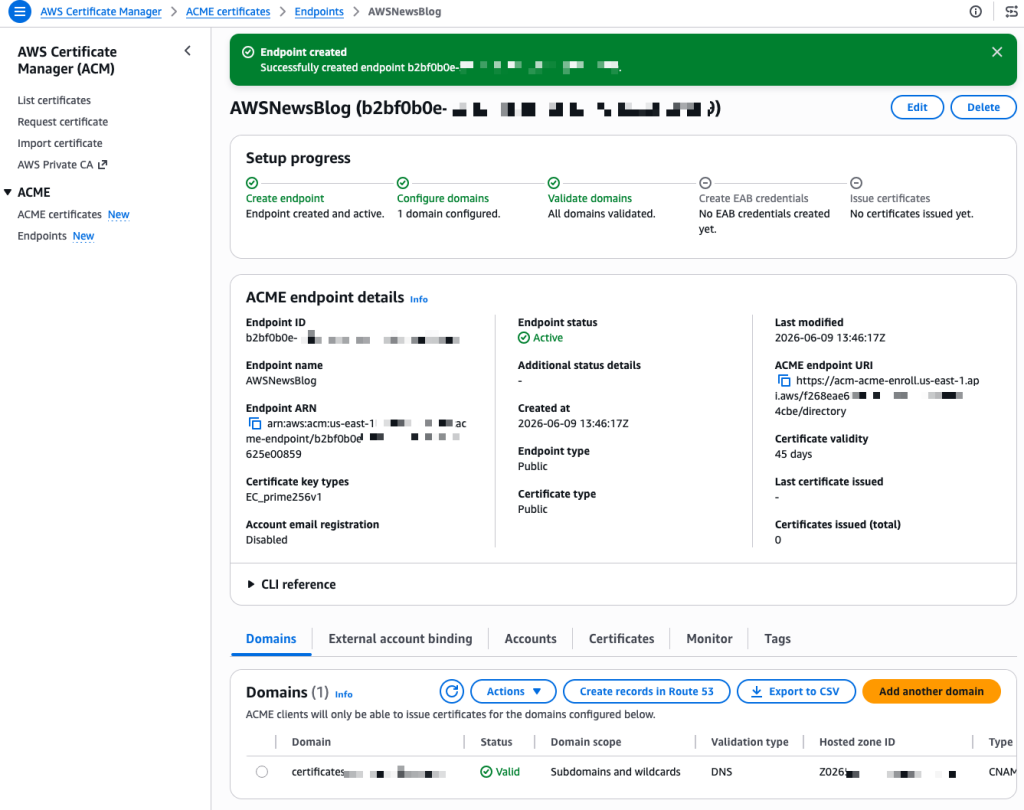
For organizations looking to implement this, the workflow has been designed to prioritize both security and ease of integration. The process begins with the creation of an ACME endpoint within the ACM console.
Setting Up the Endpoint
When an administrator creates an endpoint, they define the "Endpoint type" and the "Certificate type." Because these certificates are issued by Amazon Trust Services, they are natively trusted by all major browsers and operating systems, eliminating the need for manual root certificate distribution.
Domain Validation: Decoupling DNS from Application Owners
A critical innovation in the AWS ACME implementation is the separation of concerns. In traditional ACME setups, the client often needs access to DNS credentials to prove ownership. This poses a security risk, as it requires distributing sensitive DNS keys to various application teams.
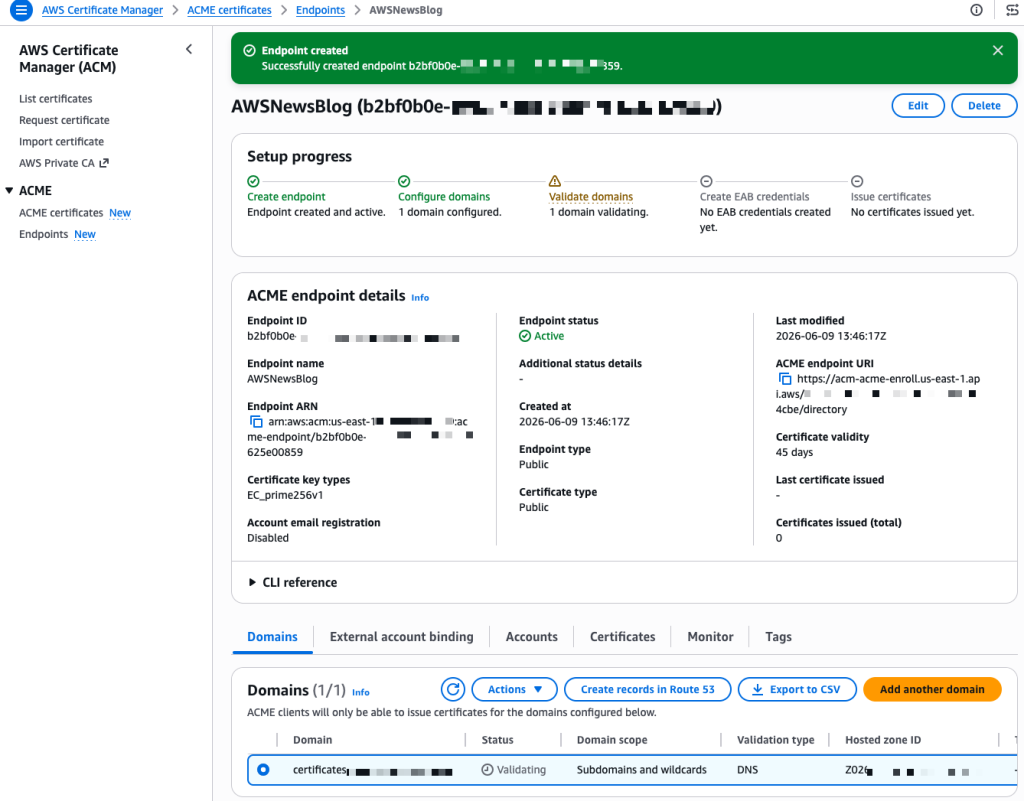
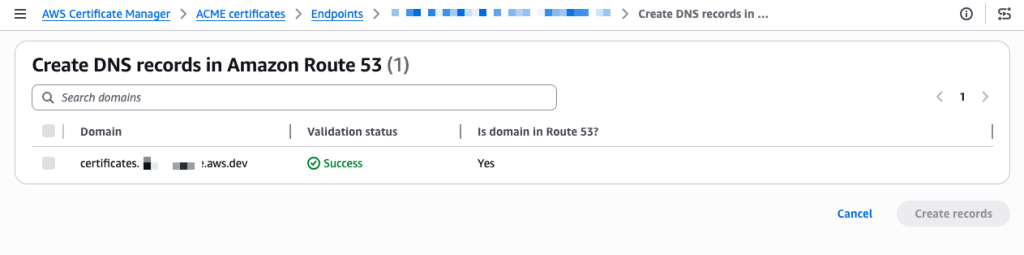
With the new AWS implementation, the PKI administrator handles the DNS validation once at the endpoint level. They can use Amazon Route 53 to automatically handle the necessary CNAME records. Once the endpoint is validated, application owners are granted EAB credentials. These developers can then request certificates without ever touching the organization’s DNS infrastructure, significantly reducing the attack surface while maintaining full compliance.
Implications for the Enterprise
The shift toward native ACME support in ACM carries significant implications for the future of enterprise cloud security:
1. Operational Efficiency
By removing the need for third-party certificate management platforms, companies can reduce both capital expenditure and operational overhead. The ability to use existing, well-understood clients like Certbot within a managed environment allows teams to move faster without sacrificing the security posture mandated by IT departments.
2. Enhanced Security Posture
The ability to restrict wildcard issuance and define specific domain scopes at the endpoint level provides a level of control that was previously difficult to achieve without custom-built policy layers. This is particularly valuable for large organizations with decentralized development teams, where ensuring consistent security policy across thousands of services is a constant challenge.
3. Future-Proofing
As the industry moves toward shorter certificate lifespans, the infrastructure built today will be the foundation for tomorrow. By adopting the ACME standard now, organizations are ensuring that they will be ready for the 47-day validity cycles coming in 2029, effectively "future-proofing" their web services against forced migration or manual failure.
Official Stance and Availability
AWS has confirmed that the new ACME support is available immediately in all commercial AWS Regions. The company has indicated that support for AWS GovCloud (US), China Regions, and the AWS European Sovereign Cloud partitions will follow in a subsequent rollout.
The pricing model has been structured to scale with usage, based on the number of domains included in each certificate at the time of issuance. This ensures that organizations only pay for what they use, with volume-based tiers that incentivize consolidation and efficient lifecycle management.
Conclusion
The integration of ACME into AWS Certificate Manager marks a maturation point for cloud-native security. By embracing open standards while providing the robust governance expected of an enterprise platform, AWS has effectively solved the "automation vs. control" dilemma. For security leaders, the message is clear: the path to the 47-day certificate era is through automation, and with this update, the tools to manage that transition are now firmly in place. As the digital ecosystem becomes increasingly complex, tools that simplify security while strengthening the perimeter will remain the bedrock of sustainable, reliable cloud architecture.