The Paradox of Convenience: Navigating the Complex Landscape of E-commerce Returns in Europe
The modern e-commerce journey no longer concludes at the "Checkout" button. In the contemporary European digital economy, the transaction is increasingly seen as a loop rather than a linear progression. As consumer expectations for convenience skyrocket, the "return" has transitioned from a logistical nuisance to a pivotal touchpoint in the customer relationship. For European retailers, managing this reverse logistics flow has become a high-stakes balancing act between maintaining customer loyalty, preserving thin profit margins, and meeting increasingly stringent environmental mandates.
The State of Play: An Overview of European Return Trends
The European e-commerce market is far from monolithic; it is a tapestry of diverse regulatory environments, consumer behaviors, and logistical infrastructures. However, a singular trend unites the continent: the rise of the high-return culture.
Statistical Reality: The "Try-Before-You-Buy" Era
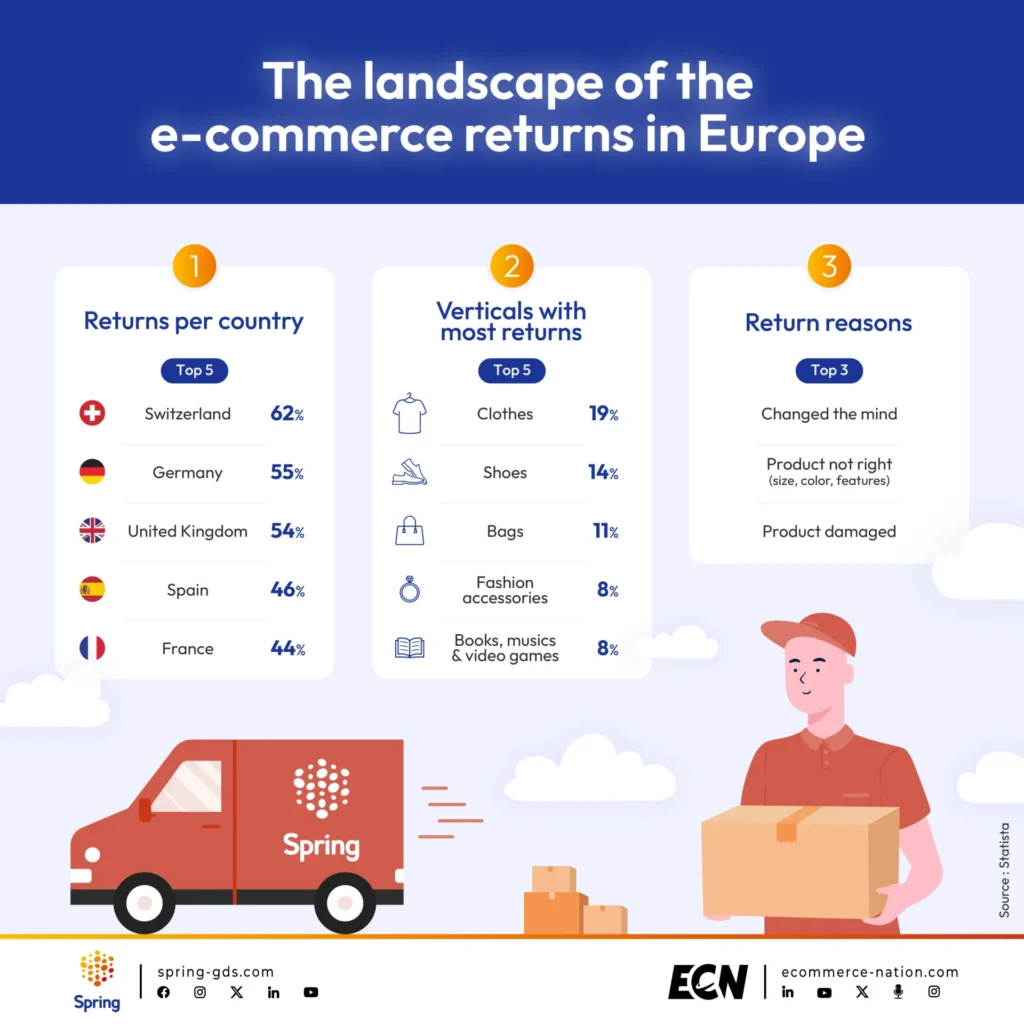
Recent data from 2023 highlights a striking reality for European merchants. Average return rates across the continent fluctuate between 30% and 40%, with certain markets pushing these figures significantly higher. Switzerland leads the European landscape with an staggering 62% return rate per online buyer, followed closely by Germany (55%) and the United Kingdom (54%).
These figures are not merely anecdotal; they represent a fundamental shift in how European consumers interact with digital storefronts. The phenomenon of "bracketing"—where customers purchase multiple sizes or colors of the same item with the full intention of returning all but one—has become an industry standard, particularly in the fashion and apparel sectors.
The Financial and Customer Satisfaction Dichotomy
For retailers, returns present a double-edged sword. On one hand, a frictionless return policy is often the primary driver for customer acquisition. In a competitive market, consumers are more likely to commit to a purchase if they know the exit strategy is painless. Conversely, the operational costs—including shipping, inspection, refurbishment, and potential liquidation—can erode the profitability of a sale entirely.
Brands are now at a crossroads: absorb the rising costs of "free" returns to maintain market share, or implement return fees to discourage habitual, low-intent purchasing.
A Chronology of the Return Evolution
The evolution of the "return" can be categorized into three distinct phases:
- The Primitive Phase (Pre-2010s): Returns were considered an exception. Policies were often restrictive, and the burden of shipping costs was almost exclusively borne by the consumer.
- The Customer-Centric Boom (2010–2020): Driven by the rise of giants like Amazon and Zalando, "free returns" became the gold standard. This era prioritized market penetration and customer acquisition over operational efficiency, leading to the current high-return environment.
- The Sustainability and Profitability Pivot (2021–Present): Facing supply chain disruptions, rising fuel costs, and a growing public outcry over the carbon footprint of reverse logistics, retailers are entering a phase of "rationalized returns." This involves the implementation of return fees, data-driven sizing tools, and more robust circular economy models.
Deep Dive: Key Challenges in the European Market
The complexity of managing returns in Europe is exacerbated by the fragmented nature of the continent’s geography and legal frameworks.
Logistical Complexity and Cross-Border Hurdles
While the European Union promotes a Single Market, the reality of cross-border logistics is fraught with friction. Each country operates with varying customs regulations, differing parcel traceability requirements, and disparate postal infrastructure. When a product is returned across borders, the administrative burden often exceeds the value of the item, leading many merchants to adopt "keep it" policies for lower-cost goods—a strategy that poses its own set of waste-management issues.
The Regulatory Landscape
European merchants must navigate a dense web of consumer protection laws. The EU’s Consumer Rights Directive provides a baseline for returns, but national interpretations and local requirements for labeling and packaging create a compliance minefield. Failure to navigate these nuances can lead to legal disputes, fines, and severe reputational damage.
The Ecological Footprint
Perhaps the most pressing long-term challenge is the environmental impact. The "reverse supply chain" is carbon-intensive. The constant movement of individual parcels across Europe contributes significantly to greenhouse gas emissions. Furthermore, the practice of destroying returned goods—often due to the high cost of processing—has come under intense scrutiny from regulators and eco-conscious consumers alike.
Strategic Frameworks: Optimizing for the Future
To survive in this landscape, retailers must pivot from reactive management to a proactive strategy.
1. Data-Driven Precision
The best return is the one that never happens. By leveraging AI-powered sizing recommendations, high-fidelity product imagery, and detailed video demonstrations, retailers can bridge the "expectation gap" between the screen and the physical product. Predictive analytics can also help merchants identify high-return segments and adjust their pricing or inventory strategies accordingly.
2. Technological Integration
Advanced Return Management Systems (RMS) are no longer optional. These platforms provide an end-to-end view of the return journey, from the customer’s request to the restocking of the item. By automating the verification process and offering real-time tracking, merchants can reduce administrative overhead and improve transparency.
3. The Shift to "Circular Logistics"
Forward-thinking brands are incorporating sustainability into their return operations. This includes:
- Batch Shipping: Consolidating returns to reduce the number of transport legs.
- Local Return Hubs: Utilizing third-party logistics (3PL) providers to aggregate returns within specific regions, thereby minimizing the distance returned goods travel.
- Second-Life Channels: Developing dedicated outlets or platforms to resell returned goods, preventing them from ending up in landfills.
Implications for the Future of E-commerce
The implications of the current return crisis are clear: the era of "unlimited, free, and consequence-free" returns is drawing to a close. We are moving toward a model characterized by:
- Tiered Return Policies: Where loyal customers may enjoy free returns, while others pay a fee.
- Regulatory Pressure: The EU is likely to introduce stricter transparency requirements regarding the fate of returned goods, forcing brands to be more accountable for their waste.
- Personalized Service: Customer service will move toward a consultative model, where retailers assist customers in making the right choice before they buy, rather than just facilitating the return after the fact.
Conclusion
The management of e-commerce returns in Europe has evolved from a simple post-sales task into a sophisticated strategic pillar. While the challenges—logistical, financial, and ecological—are substantial, they are not insurmountable. By embracing transparency, investing in data-driven technologies, and prioritizing sustainability, retailers can transform the return process into a competitive advantage. The future of European e-commerce belongs to those who recognize that while the customer may want the right to return, they value a brand that helps them get the order right the first time.