Amazon Web Services Introduces Kubernetes Version Rollbacks for Amazon EKS, Eliminating the Industry’s Historic "One-Way Door" Dilemma
SEATTLE — For nearly a decade, upgrading a Kubernetes control plane has been universally acknowledged by cloud architects and systems engineers as a high-stakes, "one-way door" decision. Because native, open-source Kubernetes has historically lacked support for control plane downgrades, pushing forward into a new minor version meant there was no turning back.
If unexpected compatibility issues, broken API deprecations, or subtle workload failures surfaced post-upgrade, teams had no recourse other than emergency patching, complex forensic troubleshooting under immense pressure, or undertaking the painful process of rebuilding clusters from scratch.
To mitigate this intrinsic risk, organizations worldwide developed sprawling, defensive engineering paradigms. Elaborate staging environments, cautious bake periods, multi-tiered stagger groups, formal automated sign-offs, and drawn-out, months-long upgrade cycles became standard operating procedure. Yet, with the upstream Kubernetes project maintaining a rapid release cadence of three minor versions per year, these complex bureaucratic friction points often resulted in the opposite of their intended effect. Terrified of a catastrophic, unrecoverable failure, many enterprises—particularly those bound by strict regulatory and compliance frameworks—simply delayed their upgrades entirely.
The consequences of this hesitation have compounded across the industry: massive fleets of production clusters stuck on aging, end-of-life minor versions, exposed to unpatched vulnerabilities, and hurtling toward extended support deadlines.
Addressing this foundational pain point head-on, Amazon Web Services (AWS) announced the official launch of Kubernetes version rollbacks for Amazon Elastic Kubernetes Service (Amazon EKS). This new capability introduces a robust safety net for cloud administrators, effectively establishing an "undo button" for container orchestration upgrades.
Main Facts: What is EKS Version Rollback?
The newly released Amazon EKS version rollbacks feature allows cluster administrators to reverse a Kubernetes version upgrade within a seven-day window if unforeseen issues arise. Rather than keeping a cluster trapped in an experimental or transitional holding state—such as those created by upstream testing mechanisms like emulated versions—EKS version rollback returns the cluster to a fully validated, production-proven previous version that was actively running before the upgrade.
Key pillars of the new feature include:
- The Seven-Day Window: Administrators have a generous seven-day operational window post-upgrade to evaluate system health, monitor application logs, and initiate a rollback if critical faults are detected.
- Production-Grade Restoration: The rollback mechanism restores the exact state of a previously functioning minor version rather than relying on software simulations or emulations.
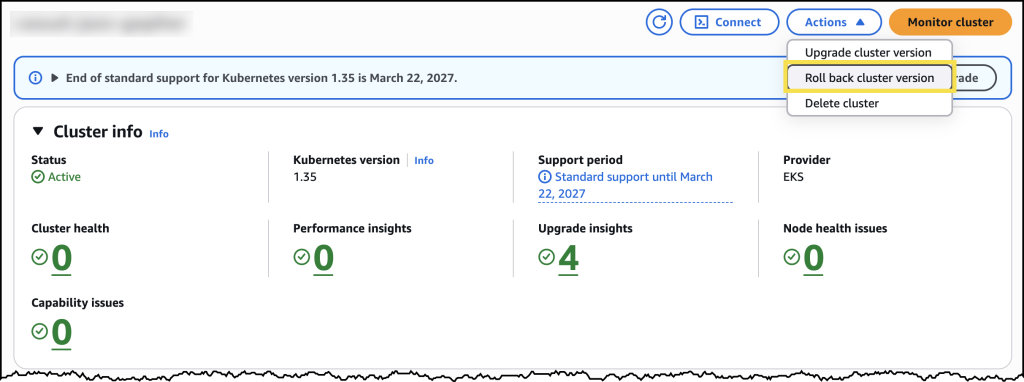
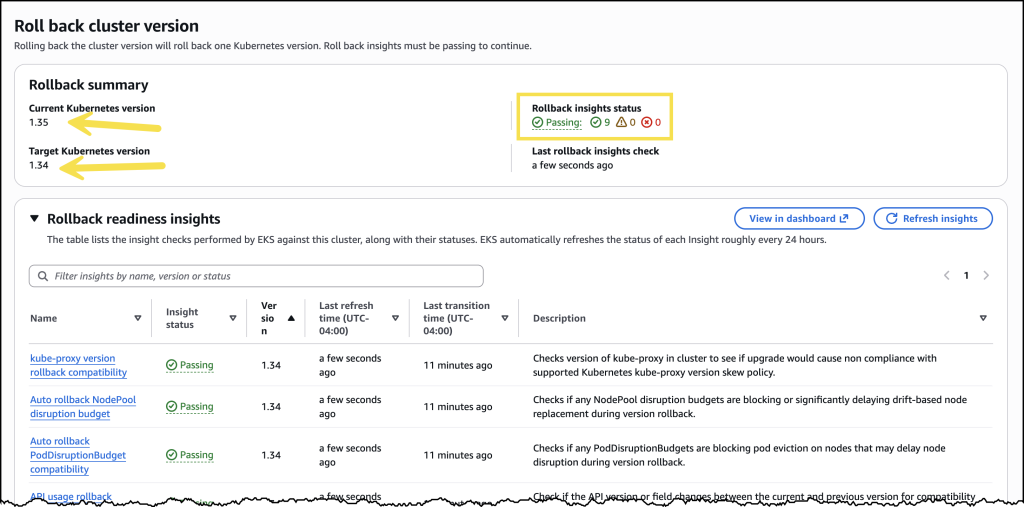
- Incremental Alignment: Mirroring the standard upgrade methodology mandated by Kubernetes and EKS, rollbacks operate sequentially, allowing teams to step back one minor version at a time (e.g., reverting safely from Kubernetes 1.35 back to 1.34).
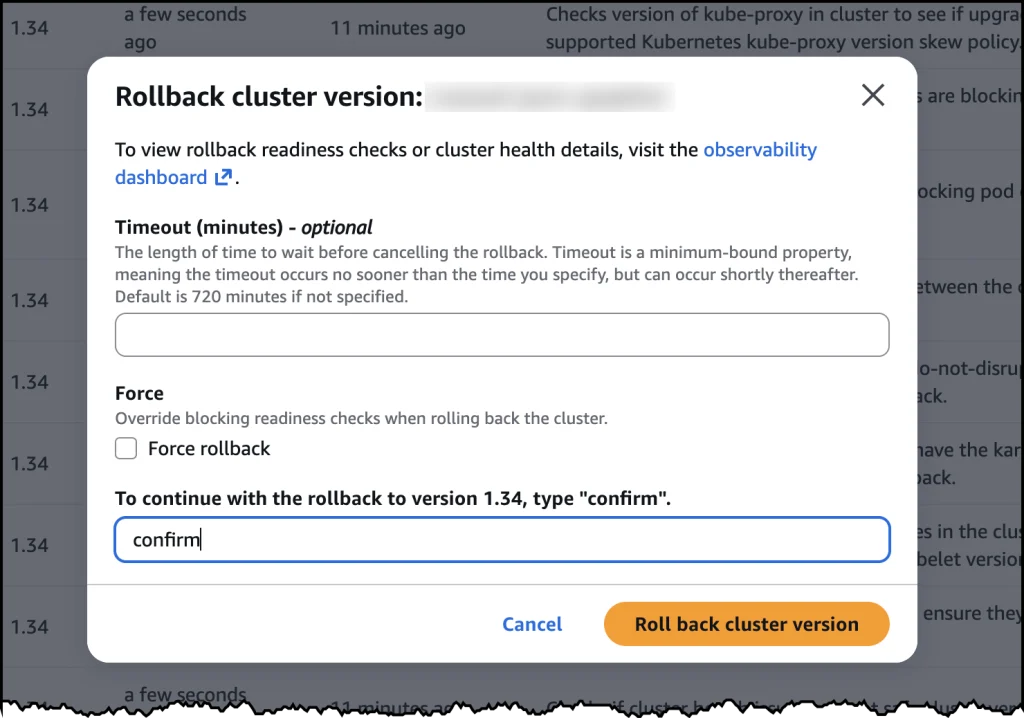
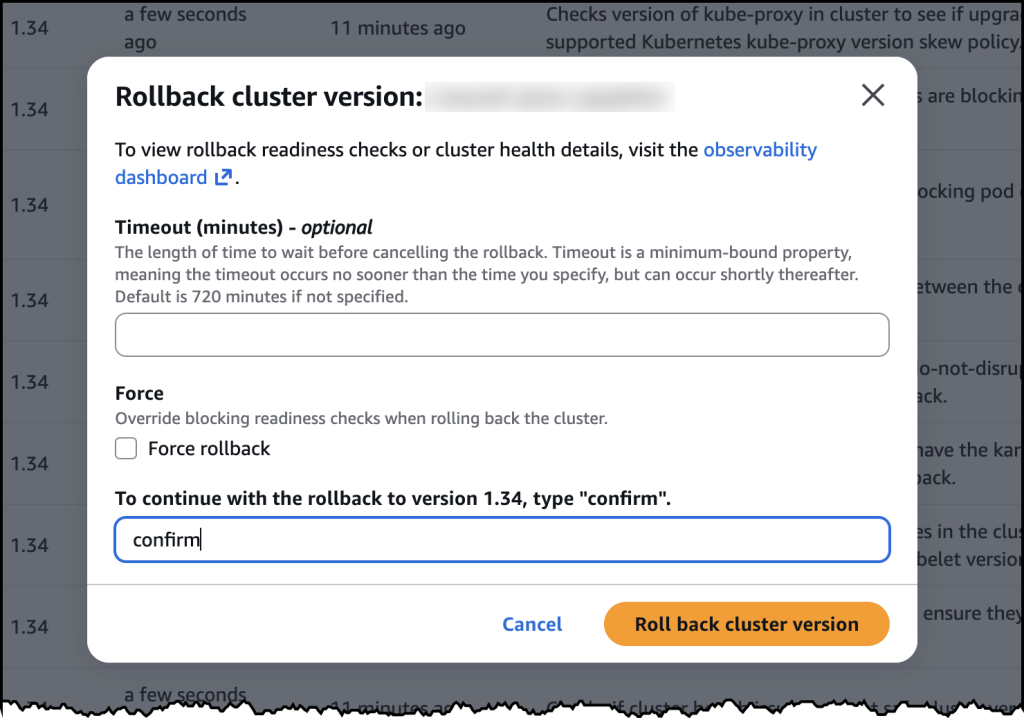
- Automated Readiness Evaluation: Integrated directly into Amazon EKS Cluster Insights, the system automatically checks cluster health, add-on dependencies, and node version compatibility before executing a rollback. For advanced operators who have already performed exhaustive pre-checks, a
--forceflag is available to bypass these validation checks and expedite the recovery process. - Cost Structure: The capability is available immediately at no additional charge. Customers pay only for standard Amazon EKS control plane fees and underlying compute resources.
Chronology: Evolution from Open-Source Constraint to Managed Solution
To understand the magnitude of the AWS announcement, it is necessary to trace the historical timeline of Kubernetes lifecycle management and the gradual evolution toward risk-mitigation strategies.

The Upstream Gap
Since the inception of the Cloud Native Computing Foundation (CNCF) Kubernetes project, control plane rollbacks were deemed technically intractable due to the complexities of etcd schema migrations, persistent state persistence, and mutating API definitions across minor versions. While the open-source community has made incremental progress—evidenced by initiatives like Kubernetes Enhancement Proposal (KEP-4330), which introduced emulated versions to ease the transition burden—these community approaches primarily ease the forward path rather than offering a clean backward trajectory.
The EKS Innovation Pipeline
Recognizing that enterprise adoption hinges on operational predictability, the Amazon EKS engineering team prioritized lifecycle safety. Over the past several years, AWS introduced granular upgrade tooling, including enhanced pre-upgrade validation checks and automated cluster insights. However, the absence of a true fallback mechanism remained the single largest friction point for enterprise migrations.
The Launch Today
Following extensive internal testing and preview phases, AWS officially rolled out the capability globally across all commercial AWS Regions where Amazon EKS is operational. The feature supports all standard EKS control planes, extending robust rollback automation down to the node layer for customers utilizing EKS Auto Mode.
Supporting Data and Technical Architecture
The execution of a Kubernetes version rollback involves careful orchestration between the managed control plane and the underlying compute infrastructure. While control plane rollbacks function similarly across all deployment topologies, environments utilizing fully managed infrastructure introduce unique variables.
Rollback for EKS Auto Mode
For organizations that have embraced EKS Auto Mode—the managed architecture designed to eliminate the operational overhead of compute, storage, and networking management—version rollbacks require simultaneous coordination between the control plane and managed node groups.
Because node-level rollbacks must strictly respect Kubernetes Pod Disruption Budgets (PDBs) to prevent application downtime, the overall execution duration is heavily dependent on workload configuration. By default, EKS preserves these safety guardrails, refusing to bypass PDBs during a rollback to ensure absolute workload stability.
To prevent administrative gridlock in emergency scenarios where a rollback needs to move faster than disruption budgets allow, AWS has introduced a dedicated Cancel API.
- The Cancel API Mechanism: If an administrator determines that a node rollback is proceeding too slowly, they can invoke the cancel API to halt the process mid-stream. From there, operators can adjust or temporarily lift their PDB constraints to accelerate the operation, or pivot to an alternative remediation strategy.
Step-by-Step Execution Profile
An architectural walkthrough of the rollback process demonstrates how the feature integrates into everyday AWS workflows:
- Console Identification: Administrators navigate to the Amazon EKS console, select the target cluster, and inspect the cluster configuration page to view the active rollback window and eligibility status.
- Cluster Insights Review: Prior to clicking execute, operators review the automated Cluster Insights tab. This dashboard highlights potential node version mismatches, incompatible mutating webhook configurations, or outdated third-party add-ons.
- Execution & Continuity: Upon confirmation, the control plane rollback initiates. Throughout the approximately 20-minute control plane reversion process, the cluster remains functional. For Auto Mode clusters, nodes drain and cycle gracefully in strict accordance with defined availability parameters.
- Validation: Once completed, the cluster is verified to be operating stably on the prior minor version, freeing engineering teams from emergency firefighting under pressure.
Official Responses and Industry Perspective
Industry analysts and AWS leadership emphasize that the introduction of version rollbacks is less about fixing a bug and more about transforming how enterprises approach risk management in cloud-native environments.
"Upgrading Kubernetes has long been viewed as a high-wire act without a safety net," notes a senior AWS cloud strategist. "By giving teams a validated, seven-day window to step backward without rebuilding infrastructure, we are effectively removing the psychological barrier that has kept thousands of enterprise clusters frozen on outdated, vulnerable software versions."
Enterprise feedback from early preview participants has echoed this sentiment. Organizations managing fleets comprising hundreds of geographically distributed clusters report that the reduction in pre-upgrade testing overhead will allow them to align more closely with upstream Kubernetes release cycles. Rather than hoarding upgrades into risky, massive annual maintenance windows, engineering teams can now adopt a continuous, agile adoption model, secure in the knowledge that an immediate safety fallback is built directly into the platform.
Implications for Enterprise Cloud Strategies
The release of EKS version rollbacks carries broad implications for the broader cloud-native ecosystem, touching security posture, operational efficiency, and regulatory compliance.
1. Accelerated Security Patch Adoption
Security compliance is often held hostage by upgrade fear. When organizations delay upgrades for 12 to 18 months out of concern that a single breaking change will shatter production workflows, they accumulate technical debt and leave systems exposed to known Common Vulnerabilities and Exposures (CVEs). By lowering the stakes of an upgrade failure, EKS rollbacks encourage a faster cadence of adoption, ensuring that clusters stay current with critical security patches and upstream bug fixes.
2. Streamlined Compliance and Auditing
In regulated sectors—such as financial services, healthcare, and federal defense—change management boards (CABs) enforce rigorous documentation and risk mitigation plans before any production modification. The inclusion of automated pre-rollback readiness evaluations via Cluster Insights provides compliance officers with quantifiable, auditable data points proving that rollback paths are verified before any change window opens.
3. Redefining Managed Kubernetes Expectations
As hyper-scalers compete intensely for enterprise workloads, the definition of a "fully managed" service is shifting. It is no longer sufficient for a cloud provider to merely automate initial provisioning and patching. True managed services must provide comprehensive lifecycle error recovery. By establishing an operational safety net for control plane and node rollbacks, AWS has raised the bar for what enterprise customers should expect from managed container platforms across the industry.
Conclusion
Amazon EKS version rollbacks transform one of cloud computing’s most persistent operational bottlenecks into a manageable, low-risk administrative task. By combining a production-grade seven-day rollback window, automated Cluster Insights readiness checks, and advanced cancellation controls for Auto Mode infrastructure, AWS has delivered what amounts to an enterprise-grade "undo button" for container orchestration—empowering organizations to innovate faster without fearing the drop.