Amazon Ushers in a New Era of Ambient Computing with the Launch of Generative AI-Powered Alexa+ in India
NEW DELHI — In a milestone announcement for the country’s consumer technology landscape, Amazon has officially launched Alexa+, its next-generation, generative AI-powered personal assistant, in India. Unveiled on Wednesday, the newly reimagined assistant represents a massive technological leap from the original Alexa, moving away from rigid, keyword-driven commands toward fluid, context-aware, and natural conversations.
Tailored specifically for the diverse linguistic and cultural fabric of the Indian subcontinent, Alexa+ launches with robust support for English, Hindi, and Hinglish—the ubiquitous code-mixed vernacular of urban India—with plans to integrate additional regional Indian languages in the near future.
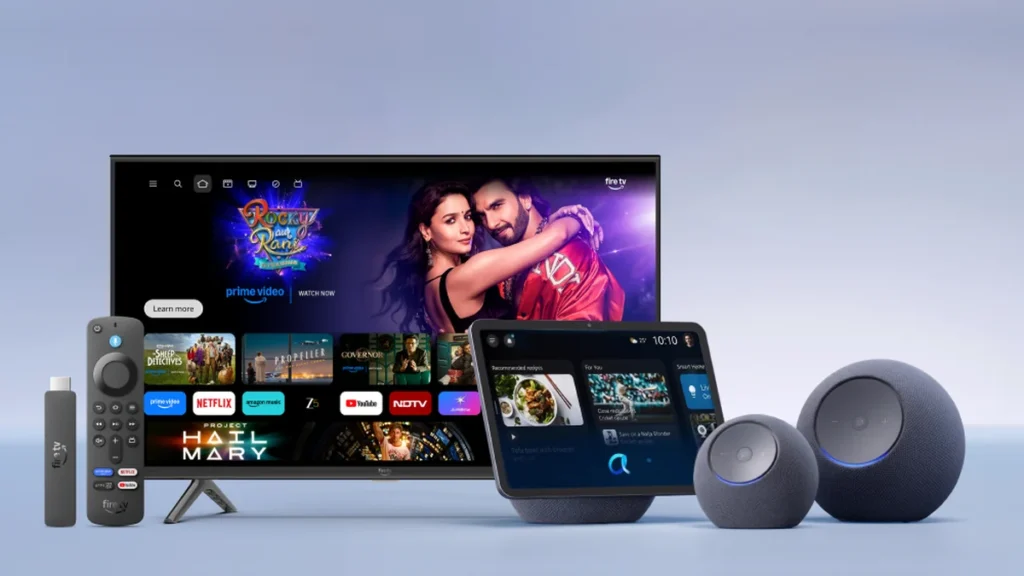
Available immediately as a free early-access preview, Alexa+ is rolling out across a wide array of compatible hardware, including eligible Echo smart speakers, smart displays, Fire TV streaming devices, and the dedicated Alexa mobile application, with direct web browser access slated to launch later this year.
Main Facts: What is Alexa+ and How Does It Work?
The introduction of Alexa+ marks a fundamental paradigm shift for consumer voice assistants. While legacy voice assistants relied heavily on fixed trigger phrases and pre-scripted responses, Alexa+ is underpinned by sophisticated generative artificial intelligence capable of maintaining multi-turn conversations, grasping nuanced intent, and remembering contextual threads.
Built in India, for India
Amazon has emphasized that Alexa+ is not merely a localized version of a Western product, but a system engineered locally from the ground up. Cross-functional teams of scientists, linguists, and software engineers stationed across Amazon’s major Indian development hubs in Bengaluru, Hyderabad, Pune, and Chennai collaborated to build the core architecture.
Engineers fine-tuned automatic speech recognition (ASR) systems to account for the unique acoustic challenges of Indian households—such as ambient street noise, television audio, and multi-speaker environments. Simultaneously, language models were trained to seamlessly comprehend code-mixed Hinglish and culturally nuanced requests, such as recognizing regional idioms, festive greetings, and culinary variations across states.
Powered by Amazon Bedrock
Under the hood, Alexa+ leverages Amazon Bedrock, Amazon’s fully managed service for building and scaling generative AI applications. The assistant utilizes a novel, highly scalable architecture capable of orchestrating more than 70 distinct large language models (LLMs). This ecosystem combines proprietary Amazon-built models with leading third-party foundational models, such as those from Anthropic, linking them directly to hundreds of enterprise services, cloud tools, and smart home devices.
Personalization, Routine Integration, and Voice ID
Alexa+ is designed to act as an active, proactive member of the household. By leveraging advanced machine learning, the assistant learns individual customer preferences, understands complex family routines, and adapts dynamically to the rhythms of specific households.
Through integrated Voice ID and Visual ID technologies, Alexa+ can distinguish between different members of a family. This allows the assistant to deliver tailored, personalized responses—distinguishing, for instance, between a parent’s schedule request and a child’s media query.
Furthermore, the assistant is deeply integrated with Amazon Now, allowing users to execute voice-driven e-commerce transactions, from restocking household essentials to tracking deliveries, entirely through conversational dialogue.
Chronology of Development: The Road to Gen-AI Voice Assistants
To understand the significance of the Alexa+ launch, it is helpful to trace the evolution of conversational interfaces over the past decade:

- 2014–2016 (The Dawn of Voice): Amazon introduces the original Echo speaker powered by Alexa in the United States, followed by its broader global rollout. While revolutionary for its time, interactions are largely transactional and restricted to weather reports, timers, and music playback.
- 2017–2020 (Localization and Expansion): Alexa arrives in India with localized capabilities, including support for Indian English accents, local music catalogs, and basic Hindi language queries. Skill developers expand the ecosystem rapidly.
- 2022–2023 (The Generative AI Revolution): The rapid rise of foundational models and Large Language Models (LLMs) transforms the tech sector. Amazon pivots its long-term strategy toward ambient intelligence, aiming to overhaul legacy voice architectures with generative AI capabilities.
- 2024–2025 (Global Testing and Architecture Upgrades): Amazon lays the groundwork for Alexa+, integrating advanced LLM capabilities via Amazon Bedrock and testing deep context-awareness in select markets.
- September 2026 (The India Launch): Amazon officially launches Alexa+ in India under an early-access preview, highlighting indigenous engineering efforts and multi-language support for English, Hindi, and Hinglish.
Supporting Data, Ecosystem, and Pricing Architecture
The launch of Alexa+ is accompanied by a robust hardware lineup and a carefully structured pricing model designed to scale adoption across Amazon’s existing customer base.
Purpose-Built Hardware Ecosystem
To fully harness the advanced computational and visual capabilities of Alexa+, Amazon has introduced a new generation of hardware devices optimized specifically for the assistant. The newly launched hardware lineup includes:
- Echo Show 8 and Echo Show 11: Next-generation smart displays featuring enhanced visual interfaces that adapt dynamically to generative AI prompts, multimedia summaries, and smart home controls.
- Echo Dot Max: An upgraded, acoustically superior iteration of the world’s most popular smart speaker.
- Echo Studio: A high-fidelity spatial audio smart speaker designed for immersive sound and complex multi-modal interactions.
Subscription and Pricing Models
While Alexa+ is available completely free of charge during the early-access period, Amazon has detailed its long-term commercial framework:
- Prime Members: Following the conclusion of early access, Alexa+ will remain permanently free for core Amazon Prime members as part of their existing subscription benefits.
- Prime Lite, Prime Shopping Edition, and Non-Prime Users: Customers subscribed to tier-restricted plans or those without an active Prime membership will not see automatic renewals. Instead, they can opt for Alexa+ either as a standalone subscription priced at ₹2,000 per month or by upgrading to a full Prime membership plan.
Privacy, Security, and Data Governance
With generative AI systems interacting more deeply with personal routines, family dynamics, and household environments, consumer privacy remains a paramount concern. Amazon has built robust security frameworks directly into the foundation of Alexa+.
The platform features an advanced Privacy Dashboard, designed to give users complete transparency and control over their data footprint. Through the dashboard, customers can:
- Review, audit, and manage all of their interactions with Alexa+.
- Listen to exact audio recordings to verify what the system heard.
- Review shared file attachments and contextual snapshots.
- Customize voice recording retention preferences, including setting automated deletion windows.
Amazon maintains that user data processed by Alexa+ is encrypted both in transit and at rest, adhering strictly to enterprise-grade security standards and evolving regional regulatory frameworks regarding data protection.
Implications: Transforming Indian Smart Homes and E-Commerce
The arrival of Alexa+ in India carries profound implications for the consumer technology sector, retail, and the broader artificial intelligence landscape in South Asia.
Redefining Smart Home Automation
For years, smart home adoption in India has faced friction due to the fragmented nature of connected devices and the cognitive load required to remember exact command phrases. By introducing a context-aware assistant that understands natural human hesitation, colloquial phrasing, and complex multi-part instructions ("Alexa, turn off the living room AC, dim the lights to warm white, and remind me to check the pressure cooker in 15 minutes"), Amazon is lowering the barrier to entry for smart home technology.
The Voice-First Commerce Economy
The integration of Amazon Now with Alexa+ signals a strategic push into conversational commerce. In a market where digital commerce is expanding rapidly into tier-2 and tier-3 cities, voice interfaces—particularly those fluent in Hinglish and regional languages—offer a frictionless shopping medium for users who may find typing on mobile keyboards or navigating complex app menus cumbersome. This could unlock a massive demographic of first-time digital shoppers.
Competitive Pressures in the AI Assistant Market
Amazon’s aggressive deployment of Alexa+ in India intensifies the race among global tech giants to dominate consumer AI touchpoints. As Google, Apple, and Microsoft refine their respective generative AI assistants, Amazon’s deep integration of hardware, software, and e-commerce infrastructure gives it a distinct advantage in the physical living space.
As early-access users begin testing the boundaries of Alexa+ across India’s diverse households, the success of this rollout will likely serve as a blueprint for Amazon’s global expansion of ambient intelligence, cementing India’s position not just as a major consumer market, but as a crucial crucible for world-class AI engineering.