Beyond the Prompt: Ex-CRED Executives Emerge from Stealth with $4 Million for Proactive AI Assistant ‘Sol’
By Tech & Enterprise Desk
Published: September 2026
Executive Summary: The Shift from Reactive to Proactive Work
For the past few years, the evolution of workplace artificial intelligence has followed a predictable, albeit repetitive, trajectory. Whether interacting with Microsoft Copilot embedded deep within Outlook or Google Gemini natively woven across Workspace, knowledge workers have grown accustomed to a reactive paradigm. These tools draft emails, summarize long conversation threads, organize messy inboxes, and capture structured meeting notes—yet they all share a singular bottleneck: they wait for human instructions. They sit quietly in the sidebar, idling until a user types a prompt or clicks a final go-ahead button.
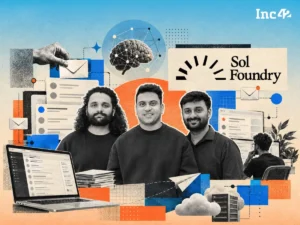
Enter Sol, a new proactive AI assistant founded by a trio of former executives from Indian fintech major CRED. Emerging from stealth today, Sol has secured $4 million (over ₹38 crore) in a seed funding round backed by marquee venture capital firms General Catalyst, Nexus Venture Partners, DeVC, and Peercheque, alongside notable angel investor and CRED founder Kunal Shah.
Sol’s core thesis challenges the very foundation of modern productivity tools: The next wave of AI agents will not wait for prompts; they will act autonomously on commitments already made. If a professional writes "I’ll send the deck by tomorrow" or "I’ll set up time for a sync" in an email thread, Sol captures that implied promise, triggers its own execution engines, and begins producing the requested deliverables—from research briefs and slide decks to calendar invitations—without requiring a separate human command.
While major tech incumbents are racing to embed generative AI deeper into corporate communication channels, Sol represents a radical shift toward autonomous, intent-driven execution. Operating initially with a US-first go-to-market strategy and running primarily on Google Workspace, Sol is currently accessible through an exclusive waitlist as it prepares to redefine the boundaries of human-AI collaboration.
Main Facts: What is Sol and How Does It Work?
Sol is designed to bridge the gap between communication and execution. For decades, knowledge workers have suffered from a workflow tax: they articulate a thought or a promise in an email, and then they have to manually recreate, prompt, or execute that promise using external software applications.
The Core Offering
At its technical and operational core, Sol functions as an autonomous background agent. The platform continuously scans a user’s Gmail account to identify implicit and explicit commitments. Once a commitment is detected, the AI orchestrates the necessary work:
- Research and Document Generation: Assembles deep-dive research, briefs, and formatted Google Docs based on conversational context.
- Deck Creation: Automatically synthesizes information across multiple threads to build slide decks.
- Calendar Coordination: Negotiates and schedules meetings by parsing availability and email intent.
- Cross-Thread Synthesis: Pulls together disparate fragments of information from multiple email chains to draft comprehensive, contextual replies.
Despite its proactive nature, Sol does not bypass human oversight entirely. While it initiates the work autonomously, the human user retains final approval before any external deliverable is sent or finalized.
Architecture and Technology Stack
Under the hood, Sol is built to be nimble and model-agnostic. While it currently leverages advanced models from OpenAI as its primary intelligence engine, the platform utilizes internal routers capable of switching between different foundation models depending on the complexity of the task.
Sol operates within its own dedicated computer environment, granting it the capability to browse the live web and draw from a proprietary library of more than 100 specialist skills. Architecturally, the startup runs on Amazon Web Services (AWS) infrastructure based in the United States. Integrations currently center tightly around Google Workspace (Gmail, Docs, and Slides), though a closed testing group is actively evaluating support for Microsoft Outlook.
Chronology: From CRED Corridors to Global Ambitions
The genesis of Sol traces back to the internal hallways and product labs of CRED, one of India’s most prominent consumer fintech unicorns.
The CRED Genesis
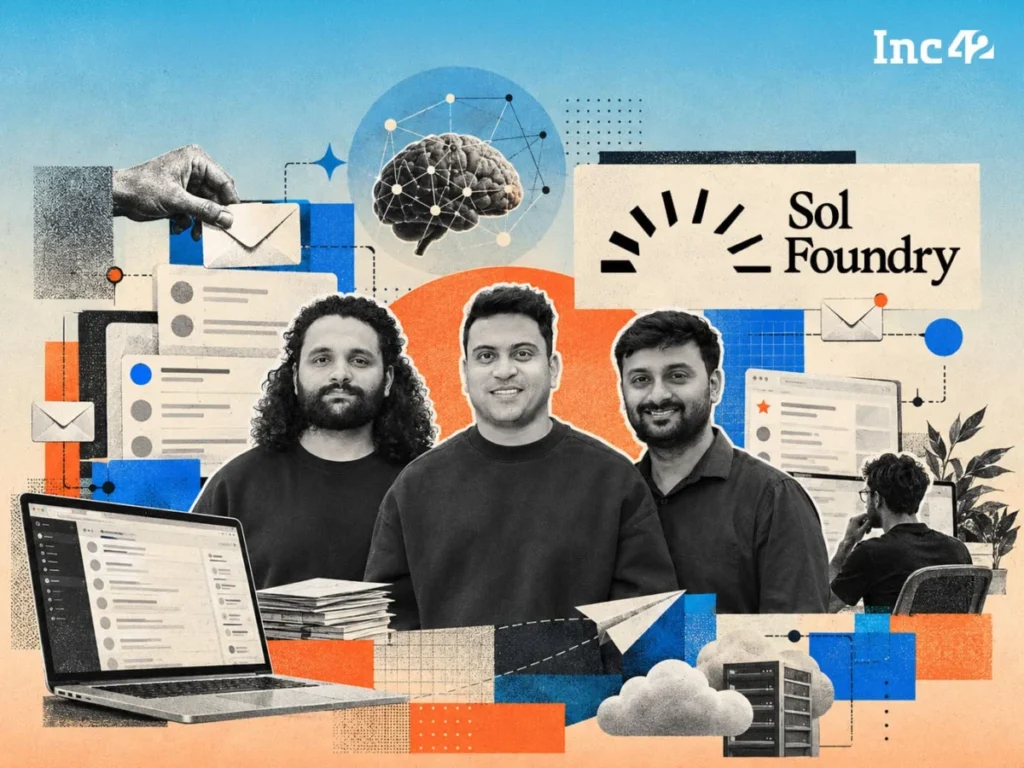
The three co-founders—Anish Karan, Prateek Srivastava, and Ranjith Nair—spent years building massive scale at CRED.
- Anish Karan operated within the core product organization, managing feature rollouts and user workflows.
- Ranjith Nair led design and product architecture, focusing heavily on user experience and frictionless interfaces.
- Prateek Srivastava served as the engineering lead, steering complex backend systems and technical scalability.
Working in high-velocity fintech environments exposed the trio to the friction inherent in modern digital communication. Executives and product managers spend a disproportionate amount of their day buried in email threads, making commitments they later have to manually fulfill across a fragmented suite of productivity tools.
Global Validation
Rather than building solely for the Indian market, co-founder Anish Karan took a methodical approach to market validation. Before writing a single line of code for the new venture, Karan interviewed roughly 55 enterprise teams spread across the United States, South Korea, and Australia.
The goal was simple: determine whether the administrative drag of email commitments was a localized nuisance or a universal enterprise pain point. The feedback from international markets was resounding. Professionals across continents experienced the exact same friction: the constant need to repeat instructions first in an email, and then a second time when prompting an AI tool to take action.

Armed with this global validation, the trio officially incorporated the startup in 2025, operating in stealth mode while building out their core technology stack and securing institutional backing. Today, they officially step out of stealth with $4 million in seed funding.
Supporting Data, Business Model, and Monetization Strategy
The $4 million seed infusion represents a strong vote of confidence from top-tier institutional investors. The round was led by General Catalyst and Nexus Venture Partners, with participation from early-stage catalysts DeVC and Peercheque, alongside prominent fintech founder Kunal Shah.
Commercial Roadmap
As of its public launch, Sol remains strictly pre-revenue. The founding team has intentionally deferred setting fixed pricing tiers or subscription packages.
According to Karan, the future pricing architecture will not rely on a flat monthly SaaS fee. Instead, Sol plans to implement a usage- or outcome-based pricing model augmented by a fixed component. This approach accounts for the reality that the volume and computational complexity of work executed by the AI will vary wildly from user to user. Initially, all commercial transactions and pricing tiers will be denominated in US dollars, with no immediate plans for localized Indian Rupee pricing structures.
When pressed on unit economics and gross margin targets, Karan maintained that chasing short-term margins is secondary to driving user adoption and perfecting product-led reliability. With foundational model inference costs continuously declining globally, the startup is prioritizing rapid product iteration and user acquisition over immediate profitability.
Go-To-Market Strategy
Sol is deploying a classic "prosumer-first" distribution model:
- Individual Adoption: Any professional can sign up for the platform via the public waitlist.
- Viral Enterprise Expansion: Once critical mass or departmental density is reached within a single organization—where multiple colleagues are interacting via Sol-augmented workflows—an organic enterprise sales motion kicks in to formalize corporate billing and security compliance.
Official Responses and Perspectives
The founders and investors behind Sol believe that the current wave of generative AI tools has hit a plateau of convenience, forcing users to do too much of the heavy lifting.
"People whose work runs through email often have to repeat themselves: first in email, then again when they ask an AI tool to act," co-founder Anish Karan told Inc42 during an exclusive briefing. "We shouldn’t have to become experts in AI to benefit from it."
Karan argues that Sol’s ultimate competitive moat does not lie in proprietary foundational models—which are easily commoditized—but rather in achieving uncompromised reliability and designing an ultra-simple interface that removes cognitive friction.
Investors share this optimistic outlook on autonomous agents. General Catalyst and Nexus Venture Partners identified Sol’s proactive stance as a distinct evolutionary step beyond the chatbot interface that currently dominates the enterprise landscape. By shifting the locus of AI interaction from a chat window back to the natural flow of human correspondence, Sol attempts to eliminate the prompt engineering barrier entirely.
Implications: The Future of Autonomous Work and Industry Challenges
Sol’s emergence signals a profound architectural shift in how productivity software will be consumed over the next decade. However, the startup’s ambitious roadmap faces formidable headwinds and complex industry dynamics.
1. The Incumbent Threat
Sol does not operate in a vacuum. Big Tech incumbents—most notably Microsoft with Copilot and Google with Gemini—possess immense distribution power. They are rapidly embedding AI agents directly into Outlook and Workspace natively, often bundled at little to no extra cost to existing enterprise license holders. For Sol to survive against tech behemoths giving away similar features for free, its autonomous execution engine must deliver exponentially higher accuracy and time-savings.
2. The Trust and Liability Dilemma
Every email-based AI agent inherits a fundamental psychological hurdle: trust.
While an unapproved draft generated by a chatbot is largely harmless (the user simply deletes or edits it), an autonomous agent acting on commitments carries the user’s professional reputation, name, and legal accountability. If an AI misinterprets an email commitment and sends out an unauthorized deck, schedules an inappropriate meeting, or promises commercial terms without human verification, the fallout can damage client relationships. Sol’s insistence on keeping the human in the loop for final approval is a crucial safeguard, but managing false positives remains an ongoing engineering challenge.
3. Capital Allocation and R&D
The fresh $4 million injection will not be spent on aggressive top-funnel marketing. Instead, Karan confirmed that the capital is earmarked primarily for Research and Development (R&D). This includes aggressively hiring engineering and design talent, absorbing heavy initial model inference costs, and conducting deep customer time-and-motion studies to refine the agent’s specialist skills library.
Outlook
As Sol gradually opens its doors beyond the initial waitlist and scales its infrastructure, the broader tech industry will be watching closely. Whether proactive AI assistants like Sol become the default administrative operating layer for corporate email—or whether their core capabilities are quickly absorbed by Gmail and Outlook as standard feature updates—will depend entirely on how seamlessly and safely autonomous software can navigate the messy, unpredictable nuances of human communication.