Main Facts: The Evolution and Current Scale of Pine Labs
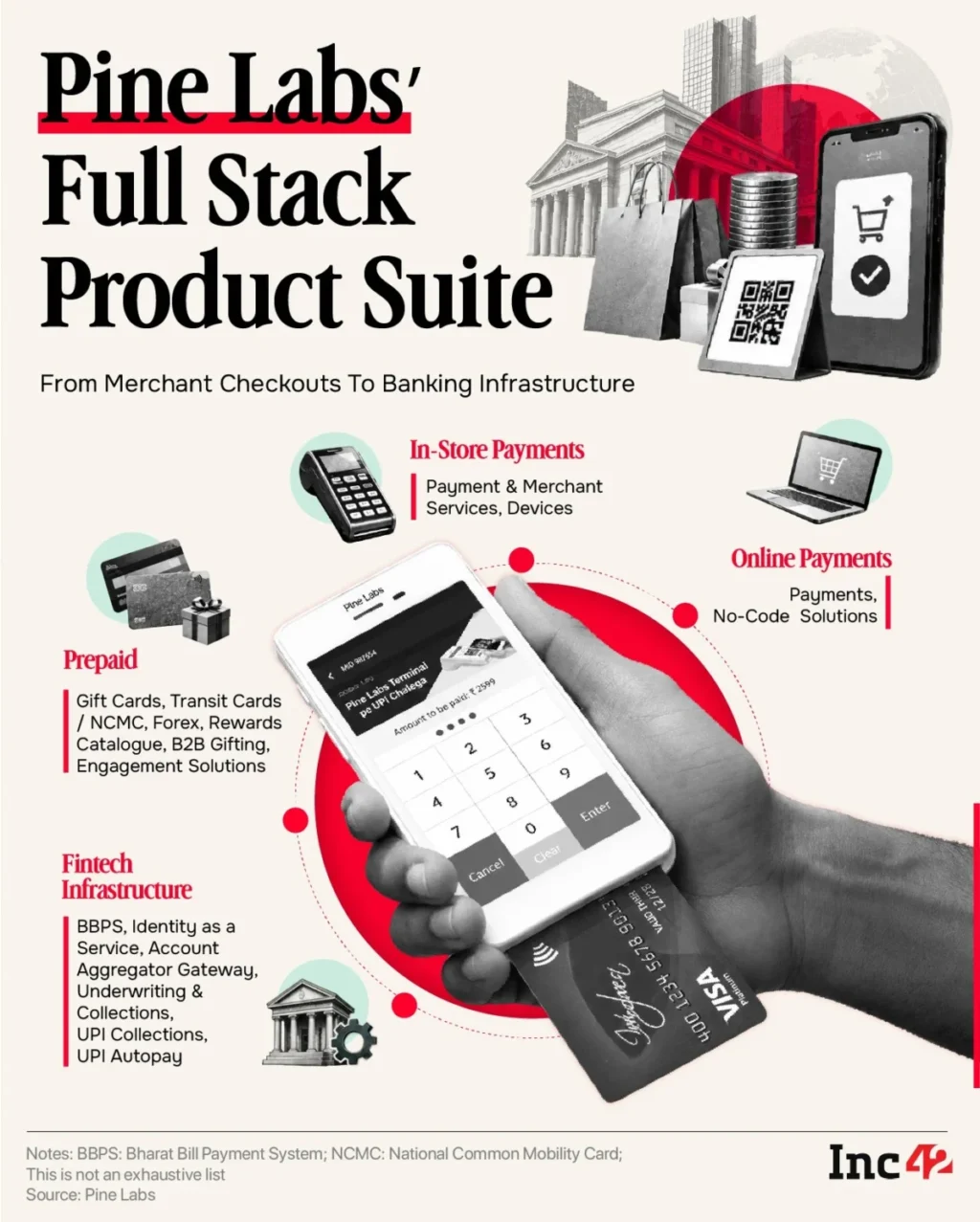
Founded in 1998, Pine Labs began its journey with a singular, modest mission: helping petrol pumps accept electronic payments and manage rudimentary loyalty programs. Nearly three decades later, the company has metamorphosed into a publicly listed fintech powerhouse, evolving far beyond hardware into a sprawling, multi-layered digital commerce ecosystem. Today, its operations span online checkouts, consumer financing, prepaid gift cards, card-issuing technology, and robust banking infrastructure.
By the first quarter of fiscal year 2027 (Q1 FY27), the fintech titan was servicing over 11.5 lakh merchants, alongside an array of leading brands and financial institutions, across India, Southeast Asia, and the Middle East. This remarkable expansion was not organic alone; it was deliberately architected through a string of strategic acquisitions.
The company integrated Qwikcilver to capture the gift card market, brought in Fave for consumer rewards, acquired Mosambee to fortify merchant acceptance, and absorbed Qfix and Shopflo to scale online payments and checkout experiences. Furthermore, the acquisition of Setu bolstered its fintech API infrastructure, while Credit+ and Saluto added robust card-issuing and enterprise rewards capabilities.
However, this aggressive, breadth-first expansion came at a steep financial price. Before making its public market debut, Pine Labs raised nearly $1.6 billion in funding to fuel its ambitions. For years, the company struggled to translate top-line expansion into consolidated net profits, as payment hardware deployments, heavy employee overheads, transaction processing fees, cloud infrastructure, and overseas scaling required continuous capital injection.
The tipping point arrived in FY26 when Pine Labs finally reported its maiden full-year consolidated profit of ₹112.5 crore, a stark reversal from the ₹145.5 crore loss posted in FY25. Operating revenue surged 19% to ₹2,710.6 crore, while adjusted EBITDA jumped 57% to ₹559 crore. While Q1 FY27 revenue continued this upward trajectory—rising 20% year-on-year to ₹736.9 crore with a net profit of ₹19.6 crore—narrowing EBITDA margins highlight that the fintech’s turnaround story still demands close scrutiny from investors.
Chronology: The Long and Winding Road to the Public Markets
Pine Labs’ trajectory from a localized hardware provider to a multinational listed entity was defined by strategic pivots, regulatory restructurings, and shifting market dynamics.
1998: Pine Labs is incorporated in India, initially focusing on payment solutions and loyalty program management for petrol pumps.
2019–2022: The company aggressively scales up through acquisitions, snapping up Qwikcilver (2019) for gift cards, Fave (2021) for consumer rewards, and Setu (2022) for API-driven banking infrastructure, alongside launching its payment gateway, Plural, in 2021.
2022: Amid a turbulent global market and depressed tech valuations, Pine Labs defers a planned US Initial Public Offering (IPO), which had reportedly targeted a $500 million raise.
June 2025: Changing course from a US listing, Pine Labs consolidates its corporate structure by merging its Singapore holding company back into its Indian entity, paving the way for a domestic public markets debut.
FY26: The strategic overhaul pays off. Pine Labs reports its first-ever full-year consolidated net profit of ₹112.5 crore on operating revenues of ₹2,710.6 crore, driven by strict operational leverage and stabilizing indirect expenses.
February–May 2026: Competitors ramp up the pressure. Razorpay unveils an AI foundation model, and PhonePe announces aggressive plans to deploy millions of new payment devices, setting off a new wave of fintech competition.
Q1 FY27: Pine Labs reports a 20% year-on-year revenue increase to ₹736.9 crore and a net profit of ₹19.6 crore. However, adjusted EBITDA margins narrow to 17.1% due to surging technology, cloud, and employee expansion costs.
Supporting Data: Decoding the Financials and Revenue Engines
Pine Labs’ financial health rests on two primary operational pillars: its Digital Infrastructure and Transaction Platform (DITP) and its Issuing and Acquiring Platform.
Revenue Segments Breakdown
Digital Infrastructure and Transaction Platform (DITP): Comprising checkout infrastructure, affordability schemes, value-added services, and core transaction processing, DITP remains the company’s bread and butter. In FY26, DITP generated ₹1,837 crore—up 15% year-on-year—accounting for roughly 68% of the company’s total operating revenue.
Issuing and Acquiring Platform: Mentioned extensively in its Red Herring Prospectus (RHP), this segment focuses on extracting higher value from existing merchants via EMI options, online payment gateways, and software integration rather than relying solely on physical terminals. In FY26, this segment contributed the remaining 32%, pulling in ₹874 crore—a robust 30% jump compared to the previous year.
Margin Dynamics and Cost Structures
Pine Labs’ FY26 profitability was aided significantly by operational leverage. While operating revenue grew 19%, indirect expenses (excluding ESOP costs) grew by just 8%. This discipline pushed the adjusted EBITDA margin from roughly 16% to 21%. Furthermore, lower depreciation and amortization charges, higher other income (rising from ₹44 crore to ₹84 crore, excluding write-backs), and a drop in exceptional charges (falling from ₹37 crore to ₹8 crore) bolstered the bottom line.
However, the cost of scaling remains visible. In Q1 FY27, data, cloud, and technology costs spiked 33% to ₹64 crore as the company onboarded new enterprise clients and invested heavily in artificial intelligence initiatives.
Official Responses and Strategic Insights
Leadership commentary from Pine Labs sheds light on how the company plans to defend its market share and protect its margins in an increasingly cutthroat environment.
Chief Executive Officer Amrish Rau has consistently emphasized that the future of digital commerce extends far beyond basic money movement. During the Q1 FY27 earnings call, Rau noted:
"The future of payments is not going to be only in terms of money movement, but also in terms of data movement."
This philosophy underpins the rollout of products like SignalIQ, an enterprise tool that leverages Setu’s infrastructure to analyze financial data for banks and Non-Banking Financial Companies (NBFCs), helping them make sharper lending decisions. Already, six major financial institutions have signed up for the service.
Addressing the hardware side of the business, Chief Financial Officer Sameer Kamath highlighted the company’s continuous push toward automation and self-reliance:
"Today, almost 50% of our terminals are self-healing."
By utilizing automated diagnostics and moving away from expensive field-service visits, Pine Labs is actively lowering the maintenance overhead of its massive physical network. Additionally, Rau pointed out that shifting more upfront terminal purchase costs onto merchants has successfully reduced the company’s internal depreciation burden, even though direct device sales yield thinner margins.
Regarding expansion strategies, management has doubled down on AI and agentic commerce. The company’s proprietary agentic payment system, P3P, has already gone live with major retail partners like Vijay Sales and Gullak, allowing automated, rule-based transactions. Despite spending roughly ₹24 crore on AI initiatives in FY26—which reportedly cut software testing cycles by over 95%—management acknowledges that these upfront expenditures will take time to reflect fully in net profitability.
Implications: Navigating a Crowded Market and the Test of Scale
Pine Labs’ successful pivot to profitability is a watershed moment for the Indian fintech ecosystem, proving that mature startups can transition from cash-burning growth engines to self-sustaining public enterprises. However, the road ahead is fraught with systemic challenges and intense competition.
The Competitive Battlefield
Pine Labs does not operate in a vacuum. The Indian digital payments landscape is fiercely contested:
PhonePe continues to aggressively expand past standard QR codes into soundboxes, card terminals, and rural retail deployments, backed by plans to deploy millions of new devices and hire tens of thousands of sales agents.
Paytm maintains a dominant grip on subscription merchants, crossing 1.5 crore active subscription devices by the end of FY26 while combining hardware terminals with merchant lending.
Razorpay and Cashfree dominate the online-first segment, leveraging advanced AI-driven payment solutions, cross-border capabilities, and full-stack business banking.
Strategic Vulnerabilities
While Pine Labs offers an integrated platform that allows merchants to seamlessly connect multiple acquiring banks, billing software, and affordability programs under one roof, its own RHP carries a vital warning: switching costs may not permanently prevent merchants from migrating transactions to rival platforms if pricing pressures escalate.
Furthermore, the company’s aggressive hiring spree—adding roughly 500 new sales personnel over a six-month window—introduces immediate cost burdens. Because new sales teams typically require 6 to 12 months to reach full productivity, these expenditures weigh heavily on short-term margins, as evidenced by the compressed EBITDA margins seen in Q1 FY27.
The Final Verdict
Pine Labs has successfully evolved from a niche petrol-pump payment helper into a diversified financial infrastructure giant. Its ability to record consistent profits validates its full-stack monetization strategy, proving that cross-selling gift cards, enterprise rewards, online gateways, and banking APIs can insulate the business against commoditized payment terminal margins.
The ultimate test for Pine Labs moving forward will not be its ability to expand, but its capacity to extract efficiency from its sprawling ecosystem. As competition intensifies and technology spending climbs, the fintech must prove that deeper customer relationships, automated self-healing hardware, and AI-driven efficiencies are enough to sustain long-term earnings growth in a hyper-competitive market.