Balancing Sovereignty and Sanctions: India Navigates Geopolitical Tensions at UNGA 81
NEW YORK — As the 81st session of the United Nations General Assembly (UNGA 81) unfolded in the heart of Manhattan, the global diplomatic landscape appeared increasingly fractured. Against the backdrop of escalating regional conflicts and a shifting American legislative agenda, India’s External Affairs Minister S. Jaishankar engaged in a series of high-stakes diplomatic maneuvers, signaling New Delhi’s intent to maintain a strategic middle path amidst intensifying pressure from Washington.
The diplomatic flurry occurred just days after U.S. President Donald Trump signed the Lindsey O. Graham Sanctioning Russia and Iran Act of 2026 into law. This sweeping legislation, which dramatically broadens the scope of statutory sanctions and introduces punitive tariffs on nations importing oil and gas from Moscow and Tehran, has sent shockwaves through energy-importing economies, most notably India and China.
The Diplomatic Balancing Act: A Chronology of Engagements
The UNGA session served as a crucial forum for India to solidify its "special and privileged strategic partnership" with Russia while simultaneously managing its complex, energy-dependent relationship with Iran.
The Moscow-New Delhi Dialogue
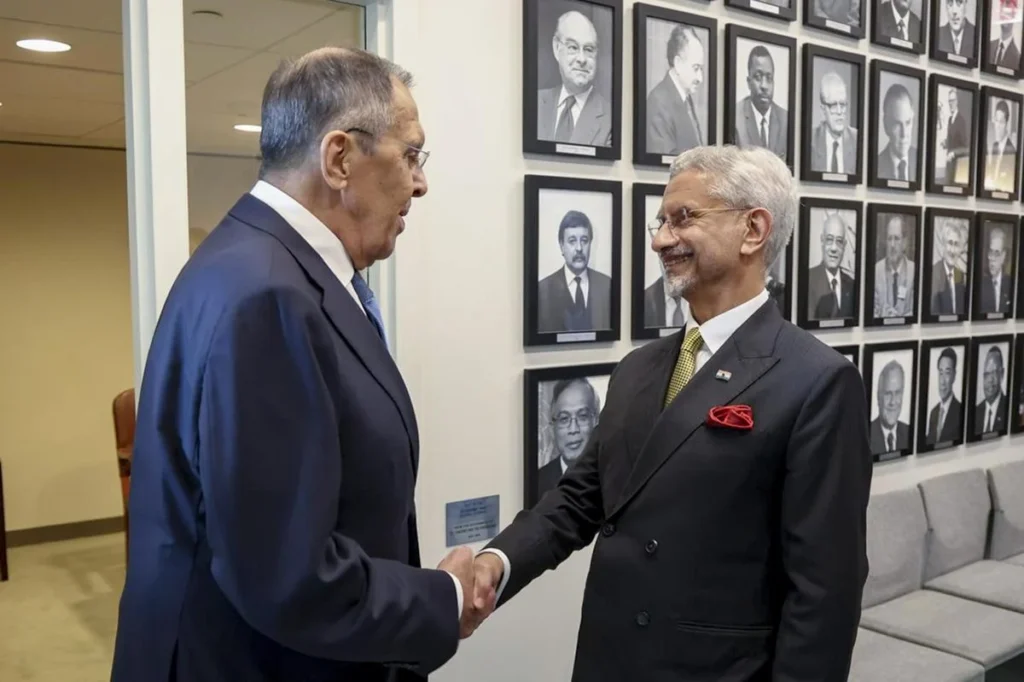
Minister Jaishankar’s bilateral meeting with Russian Foreign Minister Sergey Lavrov was a focal point of the week. The two leaders reviewed the current state of their bilateral ties and discussed the trajectory of the BRICS grouping—a bloc that has grown in influence following India’s hosting of the BRICS Leaders’ Summit earlier this month, which saw both President Vladimir Putin and President Masoud Pezeshkian in attendance.
According to a readout from the Russian Foreign Ministry, the discussions were comprehensive, covering "key issues of Russian-Indian cooperation, the schedule of upcoming bilateral contacts, and current regional and global issues, including the Ukraine crisis and the situation in the Middle East." The emphasis on "close coordination" within the G20, BRICS, and the UN underscores a mutual desire to insulate the India-Russia relationship from Western geopolitical pressures.
The Tehran Connection
Parallel to his talks with Mr. Lavrov, Minister Jaishankar held a strategic consultation with Iranian Foreign Minister Seyed Abbas Araghchi. Given the volatility in the Gulf and the new U.S. sanctions regime, the meeting was widely viewed as an effort to ensure continued communication regarding regional stability. Mr. Jaishankar noted that the two leaders discussed "latest developments with regard to the Gulf conflict," reiterating that India intends to remain actively engaged with all stakeholders to protect its regional interests.
The Impact of the ‘Graham Act’ on Energy Security
The Lindsey O. Graham Sanctioning Russia and Iran Act of 2026 represents a significant escalation in American foreign policy. By authorizing the President to impose steep tariffs on trading partners who continue to engage with the Russian and Iranian energy sectors, the law threatens to disrupt the global energy market.

India’s Strategic Stance
India’s response has been one of measured defiance. With a population of 1.4 billion and a rapidly expanding economy, New Delhi has consistently maintained that its energy security is a non-negotiable sovereign priority. Government officials have signaled that India will continue to pursue a policy of "diversified sourcing."
This stance is rooted in the practical reality that an abrupt decoupling from discounted Russian and Iranian energy sources would cause domestic inflationary spikes and jeopardize India’s industrial growth. New Delhi’s strategy is clear: it will seek to comply with international norms where possible but will not allow its national developmental goals to be dictated by unilateral sanctions imposed by third parties.
Multilateralism and Regional Partnerships: The GCC Troika
Beyond the bilateral tensions with the U.S., India leveraged the UNGA to bolster its presence in the Middle East through the India-Gulf Cooperation Council (GCC) Troika Ministerial Meeting. Co-chaired by Minister Jaishankar, the meeting served as a platform to review the India-GCC Joint Action Plan 2024–28.
The announcement of the launch of formal India-GCC free trade agreement (FTA) negotiations marks a significant milestone in India’s "Look West" policy. The integration of trade, investment, and energy cooperation with the GCC countries offers a vital buffer for India, diversifying its economic dependencies away from a sole reliance on any single power bloc. The Minister expressed gratitude to the GCC leadership for their continued support of the massive Indian diaspora, a key component of India’s soft power in the region.
AI, Maritime Security, and Global Governance
In a pivot from hard power politics to the future of technology and security, Minister Jaishankar co-chaired a high-level event alongside Greek Foreign Minister George Gerapetritis, titled “AI in the Context of International Peace & Security, with an Emphasis on Maritime Security.”
The Dual-Edged Sword of Innovation
Minister Jaishankar’s address highlighted a sophisticated understanding of the risks associated with artificial intelligence. While acknowledging that AI can revolutionize maritime domain awareness, search and rescue operations, and port infrastructure resilience, he issued a stark warning regarding the potential for misuse.
"This calls for an approach that enables innovation while remaining conscious of its security implications," the Minister stated. He highlighted the New Delhi Declaration’s core tenets:

- Democratic Access: Ensuring AI resources are not monopolized by a few states or corporations.
- Systemic Security: Building trustworthy, resilient systems to prevent cyber-attacks on critical maritime infrastructure.
- Accountability: Addressing the challenges of attribution in autonomous maritime systems, where decision-making speeds may outpace human oversight.
He concluded that the UN Charter and the Law of the Sea must remain the bedrock of maritime governance, even in an era of rapid technological disruption.
Implications for the Global Order
The events of UNGA 81 reveal a world in transition. The tension between the United States’ legislative efforts to enforce a specific global order and India’s commitment to "strategic autonomy" suggests that the coming years will be defined by a delicate dance of diplomacy.
Navigating the "Multi-Aligned" World
India’s position as a "multi-aligned" power—maintaining strong ties with the West while refusing to abandon its relationships with Russia or Iran—is becoming the litmus test for 21st-century diplomacy. By simultaneously hosting BRICS summits, negotiating GCC trade deals, and engaging in constructive dialogue with Washington’s primary targets, India is attempting to redefine its role from a passive observer to an active mediator.
However, the effectiveness of this approach will ultimately depend on the durability of these partnerships. The U.S. sanctions, if enforced rigorously through tariffs, will force India into increasingly difficult trade-offs. The coming months will likely see India intensifying its efforts to build regional coalitions—such as the GCC partnership—to provide the necessary economic resilience to withstand external pressure.
Conclusion: A Resilient Path Forward
As Minister Jaishankar concluded his engagements at the United Nations, the takeaway for the international community was clear: India is committed to an independent foreign policy that prioritizes its internal developmental needs while actively contributing to global peace and stability.
From the high-level corridors of the UN to the practical realities of energy procurement and technological governance, New Delhi is signaling that it will not be easily swayed by the shifting winds of Western domestic politics. Instead, it is betting on the long-term value of deep, diversified, and pragmatic international partnerships. As the world watches to see how the Graham Act is implemented, India’s response will likely serve as a blueprint for other emerging economies attempting to navigate the precarious terrain of modern global power dynamics.