The Hidden Leak: How Affiliate Brand Bidding is Silently Inflating Your Paid Search Budgets
For digital marketers and performance teams, branded keywords are universally treated as sacred ground. They represent the cheapest, highest-intent clicks in any paid search portfolio. Users searching directly for a brand name already know who the company is, what they sell, and are often moments away from converting.
Yet, marketing teams everywhere are currently facing a perplexing and costly mystery: Why are branded Cost-Per-Clicks (CPCs) steadily creeping upward?
A thorough check of Auction Insights, seasonal traffic fluctuations, and active bid strategies often yields no logical answers. The culprit, as it turns out, is frequently hiding in plain sight. The competition driving up your brand auction costs may not be an aggressive market rival—it could be your own affiliate partners.
When affiliates quietly bid on restricted brand terms to siphon off high-intent traffic, brands are forced into a disastrous double-payment loop. They pay inflated CPCs to win their own brand auctions, and then they pay out a commission to the affiliate for a sale that likely would have happened organically anyway.
The Anatomy of Affiliate Hijacking: What Happens Before the Conversion
To understand the scale of the issue, marketers must look beyond the standard affiliate dashboard. Mature affiliate programs excel at tracking the downstream metrics: clicks, final conversions, paid commissions, and high-level partner performance metrics.
However, they suffer from a massive blind spot regarding what occurs before a conversion enters the affiliate platform.
Consider a standard scenario: An affiliate dashboard might proudly report that "Partner A" drove 150 conversions this month. What the report fails to show is that Partner A was secretly bidding on restricted branded keywords, using complex redirect chains to mask their activity, and intercepting users who were already attempting to navigate directly to the brand’s website.
Traditionally, detecting this kind of behavior required exhaustive manual labor. Affiliate managers would manually search branded keywords, scan for competing advertisers, follow multi-layered redirect paths, and attempt to cross-reference their findings with individual partner accounts.
The core issue here is scale and coverage. Paid search environments fluctuate dynamically across different markets, keywords, target devices, and times of day. Meanwhile, malicious brand bidders constantly alter their domains, targeting parameters, and redirect routes. For a marketing team, keeping pace manually quickly transforms into an unwieldy full-time job, pulling valuable resources away from actual program growth.
Chronology of an Evolution: Q2 2026 Data Reveals Shifting Blind Spots
Recent data released by adment, a specialized fraud-detection platform, highlights just how rapidly affiliate hijacking tactics and geographical targets are evolving. Analyzing customer monitoring data through Q2 2026, the insights demonstrate that unauthorized brand bidding does not conform to traditional domestic assumptions.
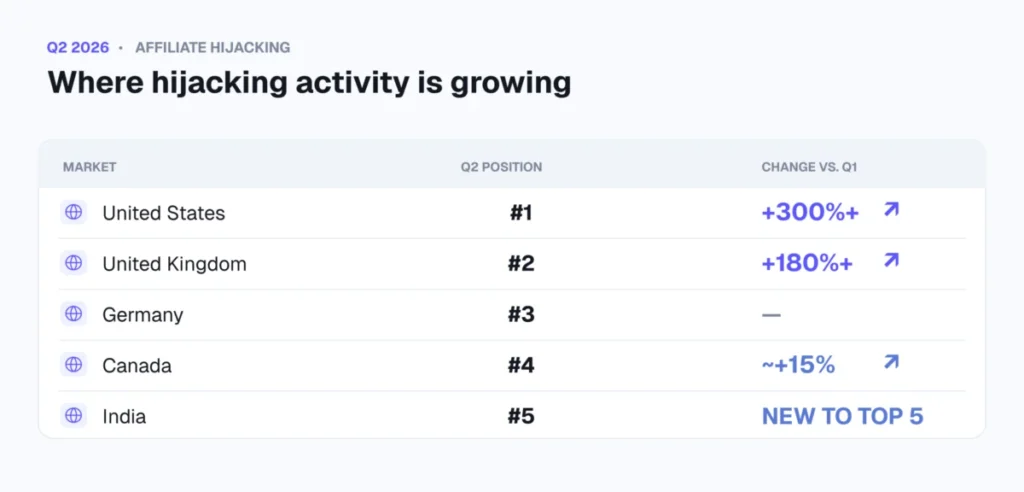
- Market Distribution: The United States led all monitored markets in hijacking activity during Q2, followed closely by the United Kingdom, Germany, Canada, and India.
- Emerging Regions: Notably, India entered the top five monitored markets for the first time, bumping Belgium out of the top tier.
This geographical shift carries significant strategic weight. Manual monitoring procedures naturally tend to focus on major markets that internal teams already deem high-priority. However, unauthorized paid search activity routinely defies these assumptions.
Seasonality also plays a distinct role, with Q1 historically acting as a quieter window across many monitored programs before rogue bidding escalates in subsequent quarters. The speed at which these patterns shift proves that static, periodic checks are no longer sufficient for global digital strategies.
The Illusion of Success: Why Strong Affiliate Metrics Mask the Problem
One of the primary reasons affiliate brand bidding evades detection for months—or even years—is that it masquerades as high performance. It rarely triggers the red flags associated with traditional ad fraud or bot traffic because real humans are making genuine purchases.
Take the typical customer journey: A prospective buyer discovers a brand through organic SEO, a targeted social media campaign, or word-of-mouth recommendation. Ready to purchase, the user opens a search engine and types the brand name directly into the search bar.
Instead of seeing the official brand ad, they encounter an affiliate’s ad. The user clicks, lands on the brand’s website via an affiliate tracking link, and completes a transaction.
Technically, every mechanism checks out. The conversion is valid, the tracking cookies execute correctly, and the affiliate rightfully claims their commission under standard last-touch attribution models.

Yet, the hidden cost is immense. By entering the branded search auction, the affiliate introduces artificial competition against the very brand they are supposed to be promoting. This drives up the auction’s clearing price, forcing the brand to pay a premium to capture demand it generated entirely on its own.
Real-World Impact: $8,000+ Saved in Hours
The financial consequences of unmonitored brand bidding are immediate once proper visibility is established.
For instance, a prominent sales engagement SaaS company was recently grappling with affiliates bidding heavily on restricted branded terms and claiming commissions on traffic they never genuinely influenced. Previously, their investigations were entirely reactive: an employee had to spot an unauthorized ad, manually reproduce it, identify the affiliate, and painstakingly gather enough evidence to enforce compliance.
Once the company implemented continuous, automated monitoring, the landscape changed overnight. Active policy violations were flagged on the very first day. Within the first few hours of deployment, the platform surfaced enough concrete evidence of fraudulent activity to save the brand over $8,000 in unearned commissions and platform fees. Ultimately, the company successfully identified and removed more than 75 fraudulent affiliates from its program.
This case study underscores the financial value of rapid detection. Catching a violation within hours—in unexpected regions like Belgium, which would have otherwise bypassed manual audits—stops capital leakage before another commission cycle can compound the damage.
Step-by-Step Guide: How to Manually Audit Your Affiliate Program for Brand Bidding
For organizations looking to conduct an immediate audit of their paid search channels, uncovering affiliate brand bidding requires a systematic, methodical approach.
Step 1: Define Your Policy Boundaries
Review your affiliate agreements and paid search terms of service with a fine-tooth comb. Clearly establish:
- Which specific branded keywords are strictly off-limits.
- Whether partners are permitted to use your exact brand name in their ad copy.
- Which geographical markets or specific device types are restricted under the agreement.
Step 2: Build a Comprehensive Search Test List
Compile a robust testing list containing your brand name, core product variations, high-volume common misspellings, and modifier combinations such as [brand] discount, [brand] coupon, or [brand] login. Ensure your test parameters cover all languages, regions, devices, and search engines dictated by your policy. Conduct searches in clean, unpersonalized browser sessions to avoid algorithmic skew.
Step 3: Capture and Document Ads
When a suspicious ad appears in search results, record every critical metadata point:
- Target keyword, search engine, exact date, and timestamp.
- Geographical location and device type.
- Exact ad copy and the displayed advertiser domain.
- The position of the ad on the search engine results page (SERP).
- Crucial: Take full-page screenshots before clicking on the ad.
Step 4: Map the Redirect Path and Match Affiliate Data
Carefully follow the ad’s redirect path, keeping an eye out for third-party tracking networks. Isolate the final destination URL and inspect its parameters for affiliate identifiers, partner IDs, or custom tracking tokens. Cross-reference these identifiers against your internal affiliate platform records to spot associated conversions and commissions during the exact time windows the ads appeared.
The Strategic Shift: Moving From Tracking to True Visibility
The modern digital marketing ecosystem suffers from a false sense of security. Having access to extensive attribution data does not automatically equate to true operational transparency. A conversion can be recorded accurately while the behavioral source of that traffic remains completely obscured.
The critical signals required to protect profit margins exist across a decentralized web: search result pages, ad copy variations, landing page behaviors, regional IP data, and hidden redirect paths. When marketing teams successfully connect these external search signals back to internal affiliate data, they gain a holistic view of how partners actually acquire customers.
However, as programs scale internationally, manual monitoring inevitably hits a hard ceiling. Brands operating across dozens of countries, languages, and search engines cannot rely on manual queries to police millions of daily auctions.
This operational reality has accelerated the adoption of AI-powered monitoring infrastructure. Automated systems can continuously analyze global search activity at scale, map complex redirect paths, and surface verifiable policy violations in real-time.
Broader Implications for the Affiliate Industry
The push for enhanced affiliate visibility extends far beyond simply plugging financial leaks. For brand managers and affiliate directors, proactive monitoring offers three distinct broader advantages:
- Policy Enforcement: It transforms compliance from an occasional guessing game into a predictable, automated standard.
- Protecting Legitimate Partners: When rogue affiliates drain budgets and manipulate brand traffic, honest partners who add genuine value suffer. Eliminating bad actors preserves budget pools for high-performing, ethical affiliates.
- Data-Driven Judgement: Traditional tracking only tells you what transaction was recorded. Real-time search visibility provides the necessary context to understand how it happened.
Ultimately, brands must realize that tracking tells a story, but visibility uncovers the truth. By adopting advanced monitoring solutions—such as platforms like adment, which offer continuous audits and automated evidence collection—affiliate managers can spend less time chasing ghosts and more time building profitable, transparent partnerships.