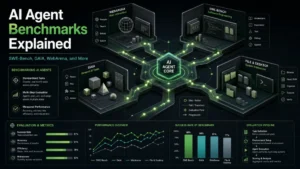
Beyond the Leaderboard: A Deep Dive into AI Agent Benchmarking
Every AI provider currently claims their agent is "state of the art." Weekly, the industry is flooded with new leaderboard updates, and marketing pages glow with percentages suggesting superhuman performance. But for those who have actually attempted to deploy an AI agent into a production environment, one fundamental question looms larger than any benchmark score: Does it reliably do the job I hired it for?
As the hype cycle around autonomous agents reaches a fever pitch, it is critical to distinguish between raw language processing and true task-oriented agency. This guide dissects the current landscape of AI agent benchmarks, explaining what they measure, where they fail, and why they should be treated as directional compasses rather than absolute performance guarantees.
The Core Distinction: Agent Benchmarks vs. Model Benchmarks
To understand the current state of AI evaluation, one must first recognize the fundamental shift from static to dynamic testing.
The Limitations of Traditional Benchmarks
Traditional benchmarks, such as MMLU (Massive Multitask Language Understanding) or HumanEval, were designed for a different era of AI. They test a model’s ability to generate a correct response in a single, isolated turn. You provide a prompt, the model calculates the most probable completion, and a judge (often an automated script or a human) scores the output. These tests are excellent for measuring static knowledge, syntax, and raw reasoning capabilities, but they are fundamentally "closed-book" exams.
The Agentic Challenge: Real-World Friction
Agent benchmarks introduce a categorically different challenge. They drop an AI model into a semi-autonomous environment where it must take sequences of actions over multiple steps. It must use external tools, adapt to environmental errors, and persist until a goal is achieved—a goal that cannot be reached in a single response.
The contrast is stark: if a traditional benchmark is a written exam, an agent benchmark is a live work simulation. The "candidate" must navigate real tools, endure friction, and handle surprises. Failure in this context is rarely just a "wrong answer"; it is a stuck loop, a corrupted database, or a task abandoned in a state of confusion.
Chronology of Evaluation: The Evolution of Benchmarking
The trajectory of AI testing has moved from pure text generation (2020–2022) to tool-use and environment interaction (2023–present).
- Phase 1: Knowledge Extraction. Testing models on datasets like MMLU to see if they "know" facts about medicine, law, or history.
- Phase 2: Code Generation. Introducing HumanEval and MBPP, where models write snippets of code. This was the first hint of functional evaluation.
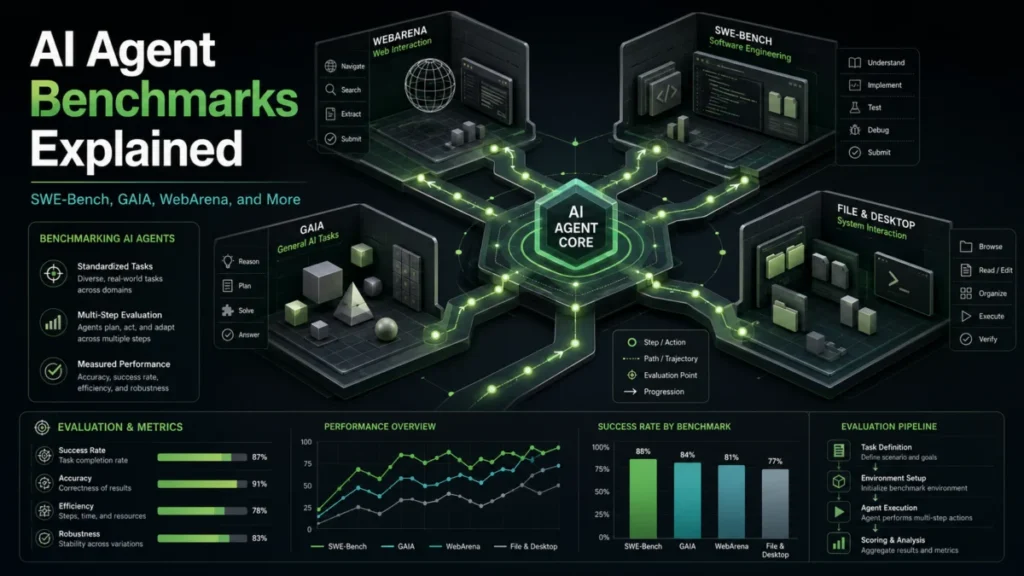
- Phase 3: The Agentic Turn. With the rise of GPT-4 and Claude 3, the industry realized that writing code is useless if the agent cannot deploy it or debug it. This led to the development of SWE-bench, GAIA, and OSWorld, shifting the focus from "writing" to "doing."
The Major Benchmarks: A Detailed Breakdown
SWE-Bench and SWE-Bench Verified
SWE-bench is currently the gold standard for software engineering agents. It presents an agent with a real GitHub issue drawn from major Python repositories like Django or scikit-learn. The agent must locate the relevant files, write a patch, and ensure the patch passes the repository’s existing unit tests.
- The "Verified" Improvement: The community introduced SWE-bench Verified to combat the noise of the original dataset, where some tasks were ambiguous or flawed. By having humans curate the tasks, researchers ensured that the unit tests accurately reflected a genuine fix.
- The Hidden Flaw: Passing a unit test is not synonymous with writing "good" code. An agent can satisfy an automated test suite while introducing a memory leak or a massive security vulnerability. SWE-bench measures the satisfaction of a constraint, not the elegance or long-term maintainability of the software.
GAIA (General AI Assistants)
GAIA is designed to test the ability to synthesize information across multiple modalities. A typical task might require an agent to cross-reference a PDF document, search the web for current market data, perform a complex calculation, and synthesize the result.
- The Goal: To simulate tasks that are "trivially easy for a human with internet access" but "genuinely difficult for an AI."
- The Limitation: GAIA tasks tend to have a single, verifiable correct answer. In the real world, assistant workflows are rarely so clean. Goals shift, instructions are often ambiguous, and the "correct" outcome is frequently subjective.
WebArena and BrowserGym
These benchmarks move the agent into the browser—the primary workspace for most modern knowledge workers. WebArena spins up sandboxed versions of e-commerce sites, forums, and content management systems. The agent must interact with these interfaces just as a human would: clicking, typing, and navigating through state changes.
- The Contamination Problem: Because many of these tasks have existed in the public domain for some time, there is a risk of "data contamination"—where the model has effectively "memorized" the test during its training phase. High scores may reflect pattern-matching rather than actual navigation skills.
OSWorld: The Final Frontier
OSWorld represents the most ambitious scope in current benchmarking. It places an agent inside a sandboxed desktop operating system. The agent is tasked with manipulating files, navigating GUI applications, and coordinating tasks across multiple windows.
- The Infrastructure Dependency: Because this simulates an entire OS, the benchmark is fragile. If the virtual machine lags or a UI element fails to render, the agent fails. Consequently, an agent’s score in OSWorld is often as much a reflection of the benchmark’s infrastructure stability as it is of the AI’s reasoning capability.
Supporting Data: What Benchmarks Ignore
While leaderboards provide a snapshot of performance, they systematically ignore the "production realities" that keep CTOs up at night:
| Metric | What Leaderboards Show | What Production Requires |
|---|---|---|
| Cost | Success Rate | Token consumption vs. Business value |
| Latency | Accuracy | Time-to-resolution (TTR) |
| Safety | Task completion | Boundary-following and refusal to act |
| Recovery | Final result | Ability to self-correct after an error |
Automated Grading Noise
Many evaluations rely on an "LLM-as-a-judge" approach. This introduces a recursive failure mode: a confident, eloquent, but fundamentally wrong answer can often trick an automated grader into awarding points. This inflates scores in ways that would never pass a rigorous human quality assurance process.
Official Responses and Industry Sentiment
Leading AI research labs (such as OpenAI, Anthropic, and Google DeepMind) generally acknowledge that public benchmarks are "directional signals." In private correspondence, researchers often note that internal evaluations—built on proprietary, confidential data—are significantly more rigorous than public tests.
The prevailing industry sentiment is that benchmarks are a marketing tool for the community, but a starting point for developers. As one lead engineer at a top-tier AI lab recently remarked: "We use SWE-bench to see if our model is in the right ballpark, but we wouldn’t ship a product based on those scores alone. We build our own ‘Golden Set’ of tasks that mirror our specific client interactions."
Implications for Future Deployment
What does this mean for those tasked with building or buying AI agents?
- The "First Filter" Strategy: Use public leaderboards to narrow down which model architectures are worth your time. If a model fails consistently on GAIA, it is likely not ready for complex, multi-step orchestration.
- Custom Evaluation Frameworks: The most successful teams are those that build their own "Evaluation Suites." If your agent is meant to manage travel bookings, you must evaluate it on real-world booking scenarios, including edge cases like flight cancellations or missing passport data.
- Prioritize Observability over Scoring: In production, the most important feature is not the score, but the ability to observe the agent’s reasoning process. Implement logging that allows you to see where an agent failed, not just that it failed.
Conclusion
AI agent benchmarks like SWE-bench, GAIA, WebArena, and OSWorld represent a massive leap forward in our ability to quantify machine intelligence. They illuminate dimensions of capability that were once invisible. However, they are not a substitute for rigorous, internal testing.
The gap between a sterile, sandboxed environment and a live, chaotic production workflow remains wide. To deploy agents confidently, developers must treat public leaderboards as the start of the conversation—the "filter" to eliminate low-performing models—and view their own private, task-specific evaluations as the only true metric for success. In the era of autonomous agents, the winners will be those who stop chasing the leaderboard and start perfecting their own quality assurance.