Amazon Unveils CloudWatch Omni: A Paradigm Shift in Observability for Agentic AI and Modern Application Workloads
SEATTLE — In a major development poised to reshape how developers build, test, and manage autonomous systems, Amazon Web Services (AWS) has officially announced the general availability of Amazon CloudWatch Omni. Billed as a unified observability experience tailored explicitly for application and AI workloads, CloudWatch Omni is app-centric, AI-powered, built entirely on open standards, and—crucially—delivered off-console.
The launch addresses a growing chasm in the enterprise software ecosystem: while organizations are rapidly deploying generative AI and agentic workflows, traditional monitoring tools remain blind to the non-deterministic nature of these systems. By bridging the gap between local development environments and cloud-scale operations, CloudWatch Omni introduces a purpose-built solution designed to bring rigor, transparency, and collaborative efficiency to the AI agent lifecycle.
Main Facts: What is CloudWatch Omni?
At its core, CloudWatch Omni is a comprehensive observability, evaluation, and experimentation platform built to help software engineering and operations teams design, evaluate, and operate AI agents seamlessly. Operating independently of model providers, frameworks, or runtimes, the solution incorporates an evaluation-driven workflow that integrates directly into existing developer tooling while offering a standalone web experience for operations teams.
Key architectural highlights of CloudWatch Omni include:
- Dual-Surface Delivery: Native extensions for integrated development environments (IDEs) such as VS Code and Kiro, paired with a dedicated web experience separate from the traditional AWS Management Console.
- Non-Deterministic Agent Visibility: Built-in instrumentation that captures every trace, mapping out multi-step decisions, tool selections, and reasoning chains.
- Comprehensive Evaluation Suite: 17 built-in evaluators—spanning correctness, coherence, retrieval quality, and routing accuracy—coupled with advanced prompt management and experimentation tools.
- Open Standards Compatibility: Native support for OpenInference and AWS Distro for OpenTelemetry (ADOT), ensuring compatibility with frameworks like LangChain, LangGraph, CrewAI, and the OpenAI SDK without requiring re-platforming.
- Frictionless Onboarding: Free-to-use IDE extensions that require no upfront AWS account or credentials to begin local development and telemetry capture.
Chronology: The Evolution of Agentic Observability
The journey toward CloudWatch Omni reflects the rapid evolution of generative AI from static text-generation prompts to complex, autonomous agents capable of chaining multiple thoughts, invoking tools, and executing multi-turn interactions.
The Generative AI Blind Spot
For years, application monitoring relied on deterministic metrics: CPU utilization, memory thresholds, HTTP 500 error codes, and latency spikes. However, the rise of agentic AI broke these traditional paradigms. When an AI agent fails to solve a user’s problem, standard metrics often register zero errors. A minor adjustment to a system prompt can silently degrade response quality, leading to hours of tedious, manual log-diving across siloed systems.

Developers previously faced an agonizing choice: adopt fragmented generative AI monitoring tools that lacked enterprise-grade cloud telemetry, or endure constant context-switching between localized coding environments and heavy browser-based dashboards.
The Rise of Omni
Recognizing this bottleneck, AWS engineered CloudWatch Omni to unify these disparate workflows.
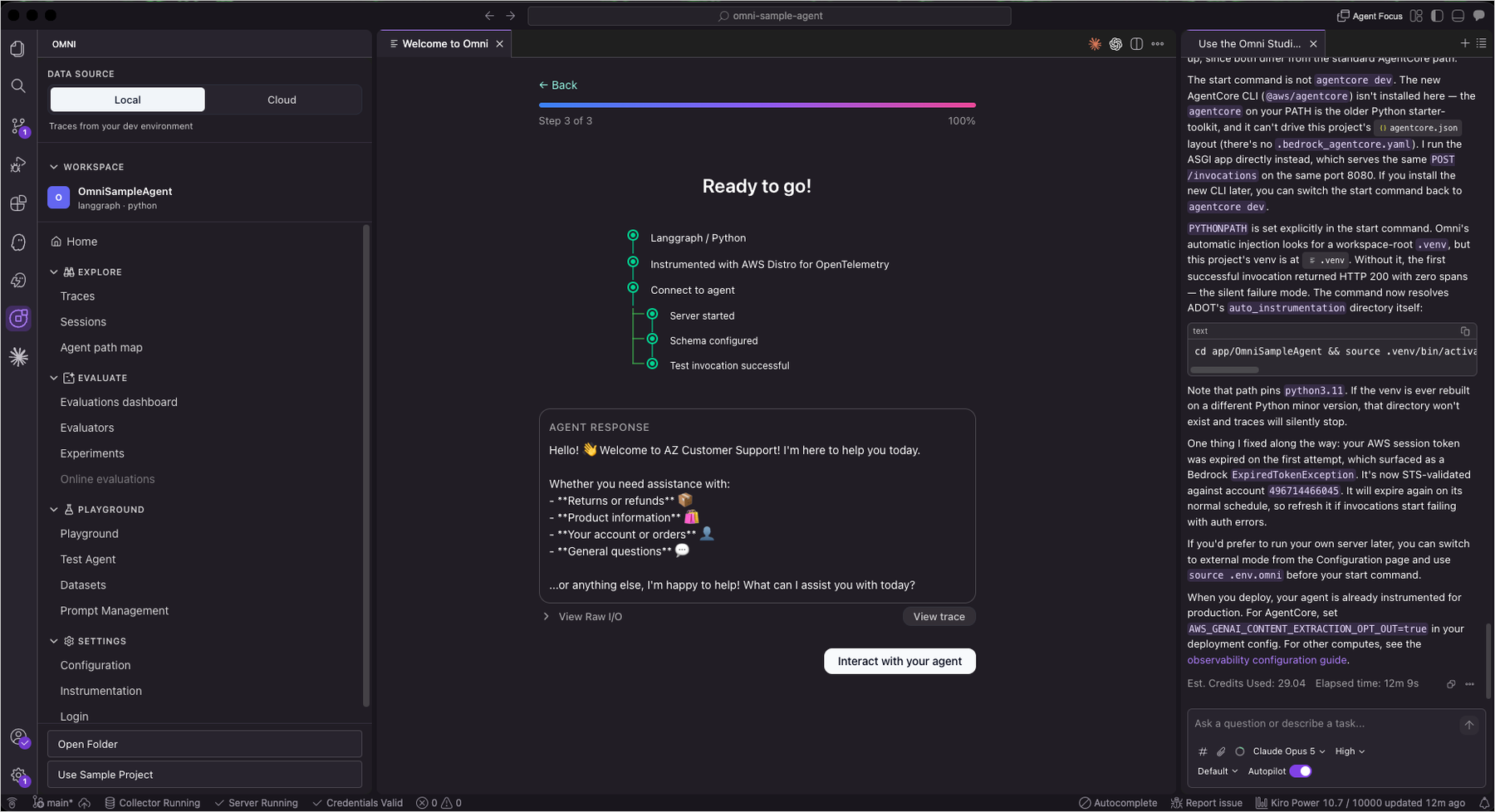
- Local-First Development: Developers initiate projects locally, leveraging AI code assistants like Kiro, Claude Code, or Codex to automate OpenTelemetry instrumentation and development server setups within minutes.
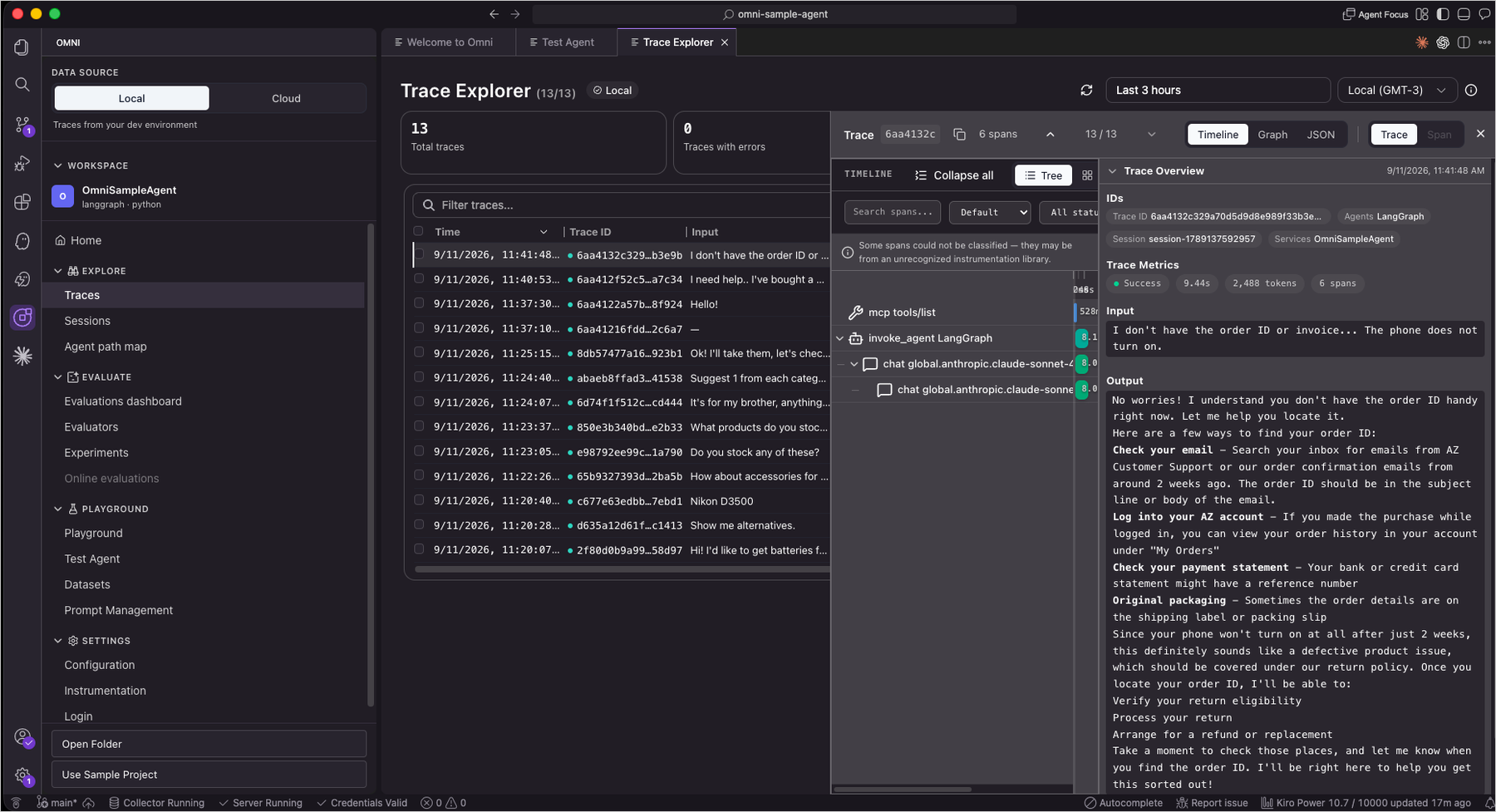
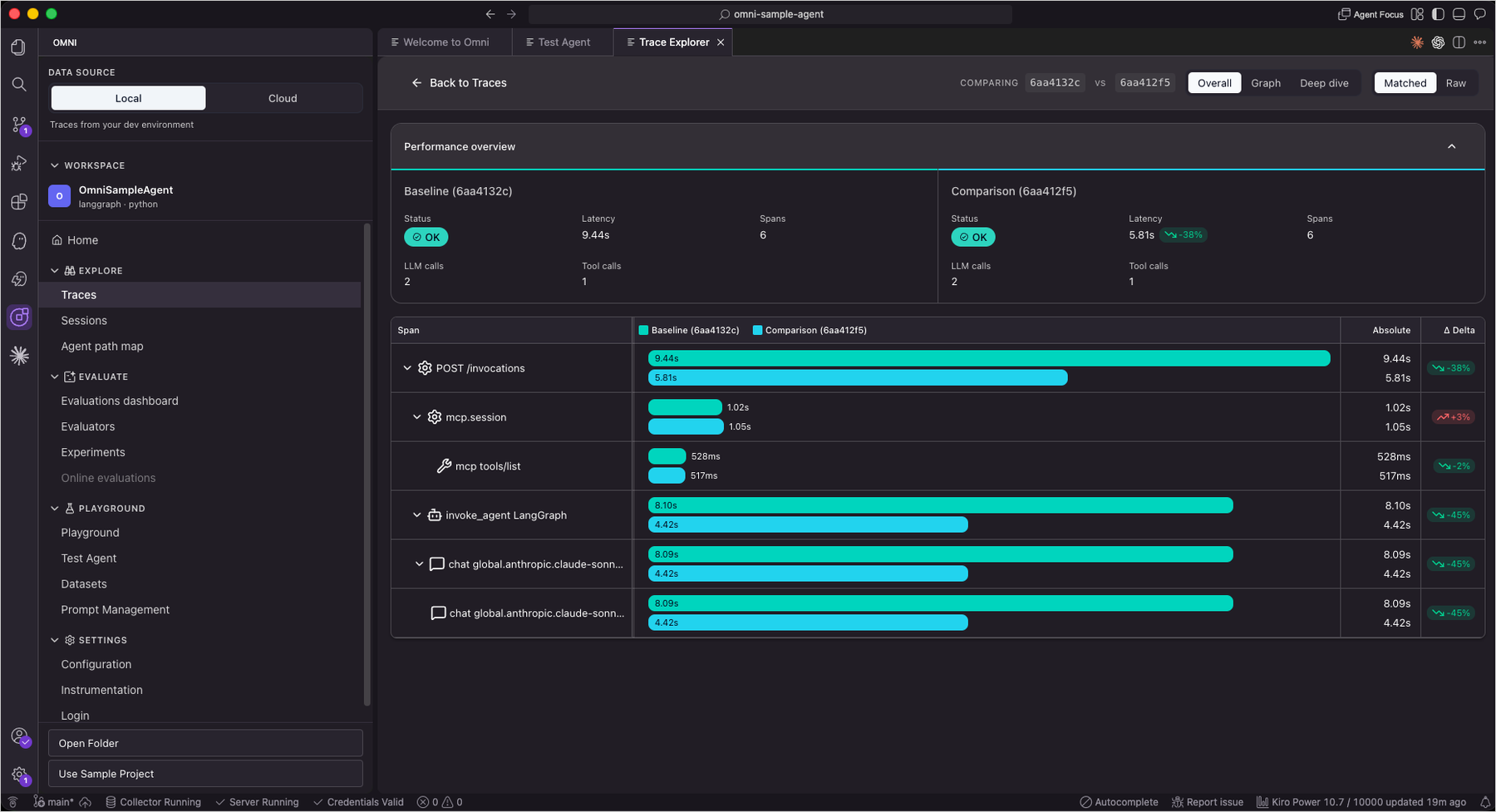
- Trace Capture and Exploration: As agents run locally or in production, Omni captures every execution step. Developers can instantly review the Trace Explorer to inspect latency, token usage, and sub-call hierarchies.
- Evaluation and Experimentation: Teams utilize built-in golden datasets, side-by-side prompt comparisons in the playground, and automated regression testing to evaluate agent quality before rolling changes out to production.
- Cloud Persistence and Fleet Operations: Through an optional "Cloud Login" feature, local telemetry seamlessly synchronizes with Amazon CloudWatch for persistent storage, allowing operations teams to monitor agent fleets via secure Single Sign-On (SSO) web dashboards without ever needing access to the AWS Management Console.
Supporting Data: Features and Technical Architecture
CloudWatch Omni’s technical architecture is designed to eliminate friction while providing deep, granular insights into complex AI agent behaviors.
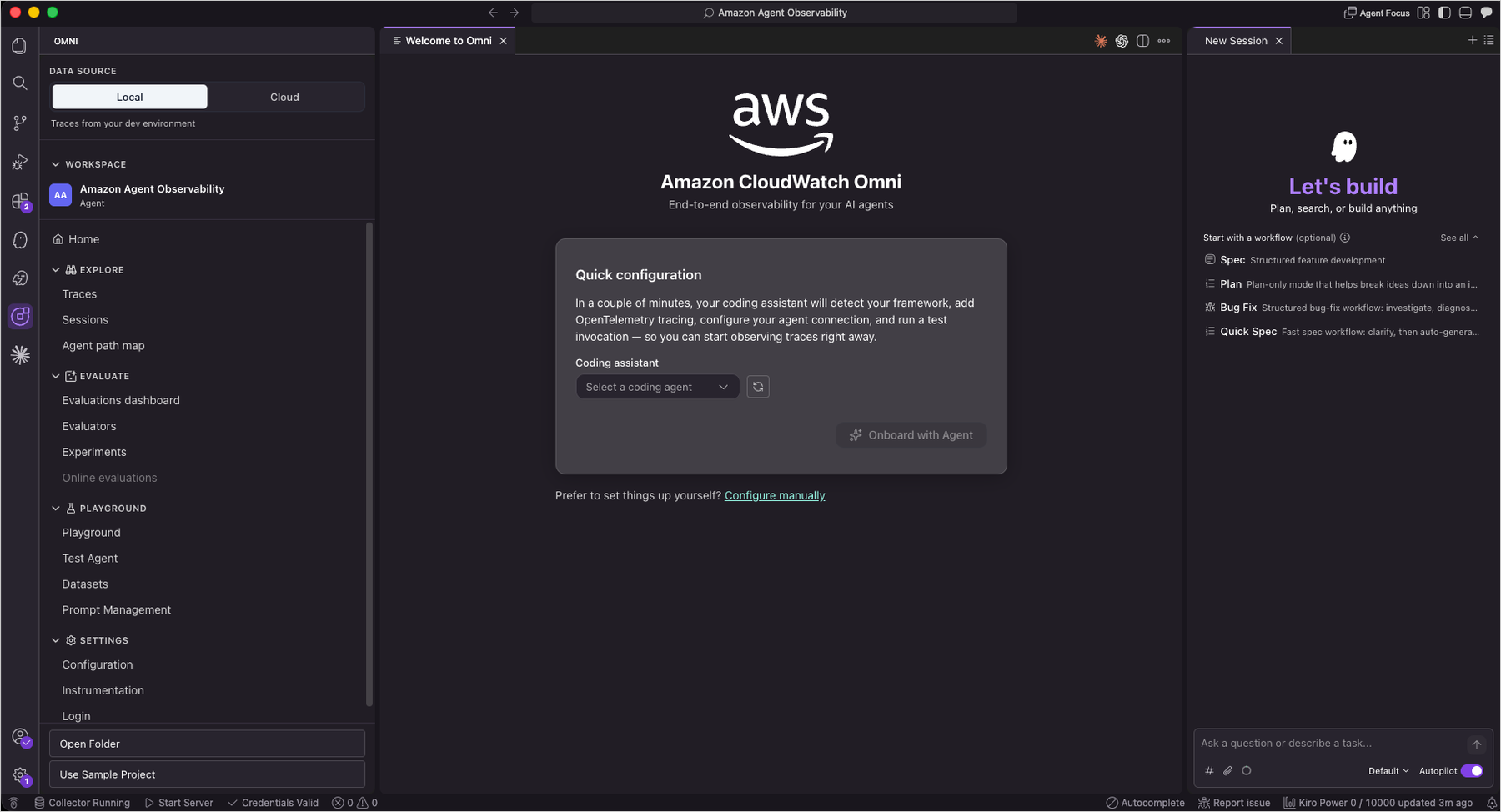
The Dual-Surface Experience
The platform operates across two complementary environments that share a unified data layer:
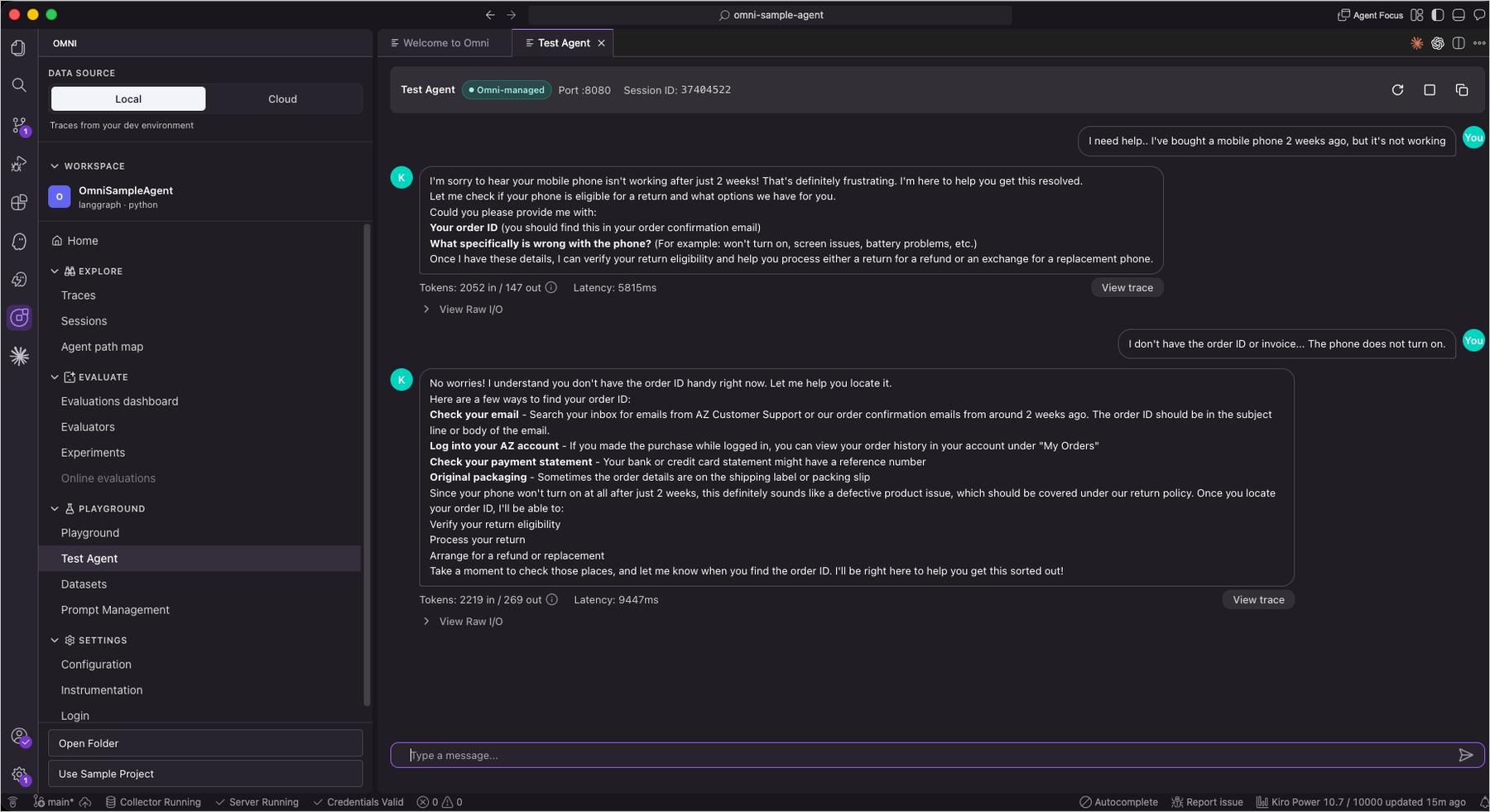
- The IDE Extension: Available via the VS Code Marketplace and supporting editors like Kiro, this surface embeds traces directly into the developer’s workflow. Traces appear in real time as agents execute, placing debugging playgrounds and evaluation metrics just a click away.
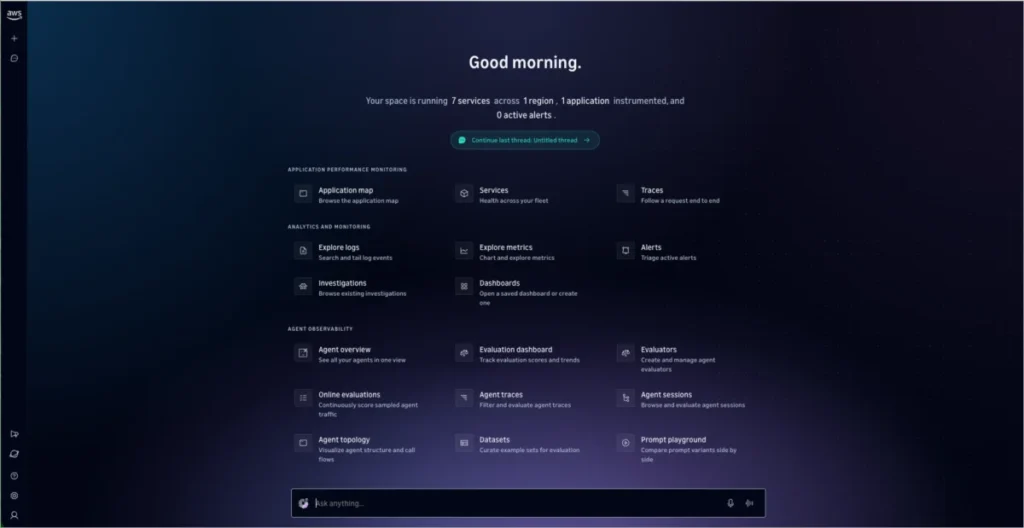
- The Standalone Web Experience: Purpose-built for operators, site reliability engineers (SREs), and collaborative stakeholders, this web-based interface delivers application monitoring, analytics, and agent topology visualization without necessitating an AWS console workflow.
Advanced Tracing and Session Exploration
Because AI agents make numerous decisions per invocation—such as choosing which APIs to call, evaluating retrieval-augmented generation (RAG) contexts, and composing nested prompts—standard logging falls short. CloudWatch Omni provides:
- Trace Explorer: A structured, hierarchical timeline of LLM calls, tool invocations, and reasoning steps. Engineers can drill into any span to inspect exact inputs, outputs, and execution bottlenecks.
- Compare Mode: A side-by-side visualization tool that contrasts two distinct traces, enabling developers to isolate why a prompt modification or configuration change caused a behavioral regression.
- Ask Assistant: An embedded AI analyst that reviews complex traces to surface anomalies and answer diagnostic queries (e.g., "Why did the agent call this specific tool twice?").
- Session Explorer & Agent Topology: Tools that visualize multi-turn conversation histories and map out the overarching architecture of sub-agents, tools, and their interconnectivity.
Rigorous Evaluation Frameworks
Moving beyond subjective testing, Omni integrates 17 built-in evaluators measuring dimensions such as helpfulness, faithfulness, and routing correctness. Developers can curate production traffic into "golden datasets" to run batch experiments, comparing multiple agent variants simultaneously across evaluation scores, latency metrics, and token consumption.
Official Responses and Industry Context
According to AWS leadership, CloudWatch Omni represents a fundamental shift toward collaborative, AI-native observability.
"Organizations deploying agentic AI systems face observability challenges that traditional monitoring simply cannot address," notes Daniel Abib, AWS product leader behind the release. "Agent behavior is non-deterministic, meaning a prompt change can degrade response quality even when standard metrics show zero errors. CloudWatch Omni provides an evaluation-driven workflow that brings clarity, precision, and collaboration directly to where developers and operators work."
Industry analysts have echoed these sentiments, pointing out that as enterprises move past experimental Retrieval-Augmented Generation (RAG) proofs-of-concept into fully autonomous agent deployments, production governance will be the primary determinant of success. By remaining model-agnostic—supporting frameworks like LangChain, LangGraph, CrewAI, and Amazon Bedrock AgentCore—AWS has positioned Omni as an open, highly adaptable control plane for the broader generative AI ecosystem.
Implications for Enterprises and Developers
The general availability of Amazon CloudWatch Omni carries profound implications for software engineering organizations, DevOps teams, and enterprise security postures:
1. Accelerated Time-to-Market for AI Agents
By automating the tedious setup of OpenTelemetry instrumentation via AI code assistants and offering pre-configured sample projects, Omni reduces the onboarding friction for developers building with complex LLM frameworks. Teams can transition from conceptualization to production-ready tracing in minutes rather than days.
2. Bridging the Developer-Operator Divide
Historically, developers lived in their IDEs while operators lived in monitoring consoles, creating communication silos during incident responses. By ensuring that the exact trace a developer debugs locally is the exact trace an operator investigates in the cloud web experience, Omni fosters unprecedented alignment between engineering and operations.
3. Cost and Quality Optimization
With built-in tracking for token usage, latency, and evaluation scores across prompt versions, organizations can continuously optimize their AI spend. Prompt management and regression detection protect enterprise applications from silent degradations in response quality, ensuring brand safety and reliability for end-users.
4. Zero-Barrier Adoption Model
By making the IDE extension completely free and removing the immediate requirement for an AWS account or complex credential setup, AWS has lowered the barrier to entry. Developers can experiment freely using local storage before making a deliberate choice to sync telemetry data to the cloud.
Getting Started and Availability
Amazon CloudWatch Omni is generally available starting today.
- Developers: Can immediately install the CloudWatch Omni extension from the VS Code Marketplace.
- Cloud & Operations Teams: Can access the standalone web experience and explore comprehensive documentation via the CloudWatch on AWS Builder Center and the AWS Documentation Portal.
- AI Tool Integration: Teams looking to query APIs, search documentation, or automate troubleshooting can leverage the AWS MCP Server alongside their preferred AI toolkits.
As autonomous agents become the primary interface for enterprise digital transformation, solutions like Amazon CloudWatch Omni establish the necessary foundation of trust, visibility, and control required to scale intelligent workloads securely into the future.