Meesho’s Strategic Pivot: Navigating the Path to Profitability in Q1 FY27
Main Facts: A Leaner, Meaner Marketplace
In the competitive landscape of Indian e-commerce, Meesho has emerged as a bellwether for the "value-first" segment. The company’s financial performance for the first quarter of FY27 underscores a pivotal transition: moving from a growth-at-all-costs model to a disciplined, efficiency-driven enterprise.
During Q1, Meesho recorded a significant narrowing of its losses, fueled by robust revenue growth and a rigorous optimization of its operational cost structure. The company’s core marketplace engine—its primary driver—has successfully increased its contribution margin per unit. By leveraging better delivery conversions, a reduction in the "return-to-origin" (RTO) phenomenon, and smarter logistics, Meesho is effectively generating higher profit per rupee of gross merchandise value (GMV).
While the headline narrative focuses on profitability, the company is concurrently investing in future-proofing its operations. The strategic focus remains on maintaining its value-proposition dominance, even as the e-commerce sector faces intensifying pressure from both incumbent giants and emerging quick-commerce players.
Chronology: The Journey to Q1 FY27
The current financial health of Meesho is not an overnight success but the result of a multi-quarter effort to streamline operations.
- FY25-FY26 (The Foundation Phase): During this period, the company underwent significant restructuring, trimming its workforce and reducing marketing spend to focus on core unit economics.
- Late FY26: The company began integrating advanced Generative AI (GenAI) agents into its coding and seller onboarding workflows. This move was instrumental in doubling engineering productivity and lowering the cost of acquiring and retaining sellers.
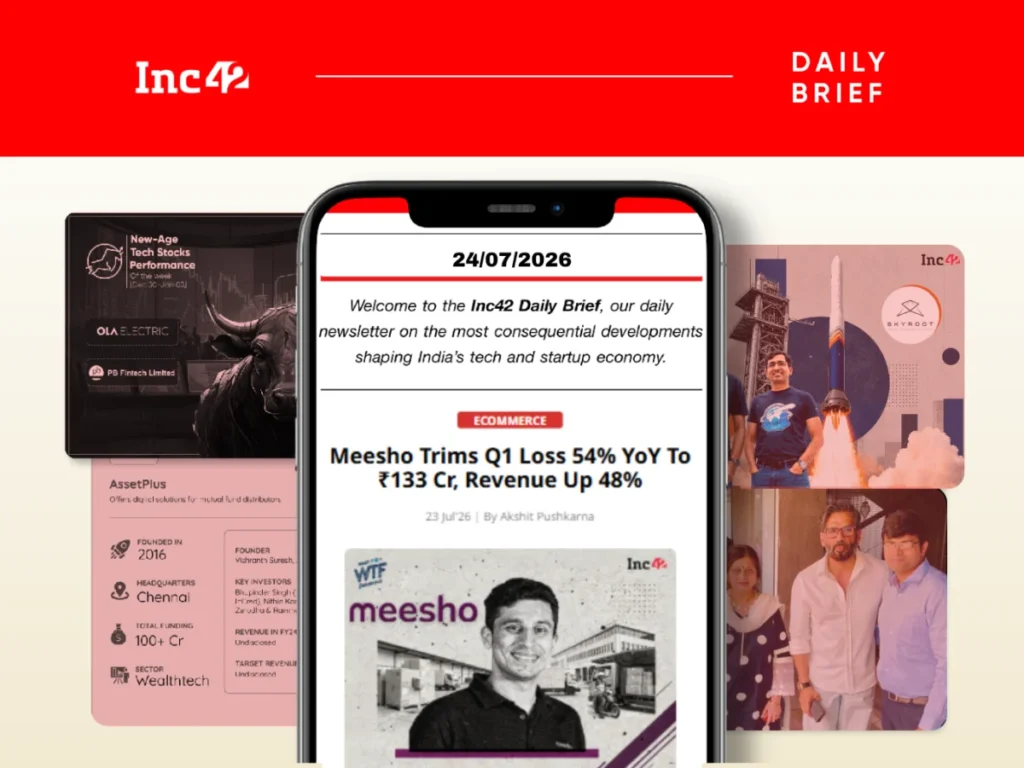
- Q1 FY27 (The Execution): The company reported a 48% year-on-year revenue increase while simultaneously cutting losses by 54% to ₹133 Cr. This quarter also saw the board greenlight a ₹75 Cr capital infusion into its grocery arm, signaling a long-term commitment to the segment despite market volatility.
Supporting Data: Dissecting the Financials
The financial data for Q1 paints a clear picture of a platform maturing. The core marketplace, which relies on high-volume, low-ticket-size transactions, is benefiting from economies of scale.

The Marketplace Engine vs. New Bets
The marketplace segment remains the bedrock of the company. Healthy Net Merchandise Value (NMV) growth, paired with an expanding user base, has allowed the core platform to achieve a level of operational self-sufficiency.
Conversely, Meesho’s "Other Bets"—specifically Meesho Mall (branded commerce) and its content-led commerce initiatives—are in a scaling phase. While these ventures contributed to an adjusted EBITDA loss of ₹39 Cr, they represent a long-term strategic play. By diversifying into branded and content-driven commerce, Meesho is expanding its Total Addressable Market (TAM) and moving into segments that offer higher margins than its traditional unbranded apparel and lifestyle business.
The GenAI Efficiency Multiplier
A critical, often overlooked data point is the impact of AI on internal operations. By shifting coding workflows to automated agents, Meesho has successfully lowered its tech overheads. The automation of seller onboarding—a notoriously manual and resource-heavy process—has allowed the company to scale its merchant base without a proportional increase in headcount, further proving the efficacy of their tech-led cost-cutting measures.
Official Responses and Governance
Beyond the quarterly numbers, the company’s recent board meeting resulted in significant structural changes. The board has formally proposed amendments to the Articles of Association, which serve to formalize long-term board nomination thresholds for its co-founders and major institutional investors.
This move is widely seen as an attempt to stabilize governance as the company eyes a potential public listing in the future. By securing the influence of early-stage backers and founders, Meesho is ensuring that its "value-focused" mission remains the guiding principle even as it faces the scrutiny of public markets.

The ₹75 Cr investment into the grocery arm is equally telling. Despite the intense competitive environment—where players like Zepto and Blinkit are dominating the quick-commerce narrative—Meesho is choosing to stick to its value-focused grocery strategy. This suggests that the board believes there is a viable, sustainable path for non-instant, price-sensitive grocery delivery in Tier-2 and Tier-3 cities.
Implications: The Path Forward
The broader implications of Meesho’s Q1 performance are significant for the Indian startup ecosystem.
1. The Death of "Growth at Any Cost"
Meesho’s results serve as a wake-up call to the industry that venture-backed companies are now expected to prioritize profitability over top-line vanity metrics. The 54% reduction in losses is a powerful signal to investors that the company can thrive without relying on endless cash burn.
2. The AI-Driven Competitive Edge
By successfully deploying GenAI to solve engineering and onboarding bottlenecks, Meesho has set a new benchmark for operational efficiency. If other e-commerce players fail to replicate this level of tech-driven lean management, they may find themselves at a structural disadvantage as competition for margins intensifies.
3. Resilience in the Face of Festive Sales
As the company approaches the high-octane festive season, the primary challenge will be maintaining these improved margins while scaling for the expected surge in demand. The festive season usually entails heavy discounting, which can wreak havoc on unit economics. Meesho’s ability to navigate this period without reverting to unsustainable cash burn will be the ultimate test of its current strategy.

Market Context: A Broader View of the Ecosystem
The Indian startup landscape remains dynamic, with various sectors undergoing their own cycles of maturity:
- Space Tech: With companies like Astrobase entering the fray, India’s goal of a space station by 2035 is becoming more realistic. Astrobase’s focus on Full-Flow Staged Combustion (FFSC) engines and 3D-printed manufacturing is emblematic of the "hard-tech" shift currently underway in the country.
- Fintech Evolution: The Paytm landscape shows that payments are merely the entry point. The shift toward financial services and merchant solutions as primary revenue drivers is a trend that Meesho, as a platform with massive merchant data, is likely to watch closely.
- The Wellness Pivot: VAHDAM’s massive ₹1,000 Cr investment to become a wellness giant highlights that Indian D2C brands are moving toward large-scale global ambitions, shifting away from niche local markets.
Conclusion
Meesho’s Q1 FY27 performance is a testament to the power of operational discipline. By trimming losses while scaling revenue, the company has proven that the "value-first" model is not just a viable business strategy, but one that can be scaled profitably.
However, the road ahead remains complex. With increased competition in the grocery sector, the pressure to maintain margin expansion during the festive season, and the need to integrate new bets like Meesho Mall into a cohesive, profitable ecosystem, the company’s leadership faces a delicate balancing act.
Ultimately, Meesho is evolving from an e-commerce startup into a mature, technology-first enterprise. Whether it can maintain this trajectory and satisfy its investors’ long-term expectations will depend on its ability to leverage its AI-driven efficiencies and stay true to its core value proposition in an increasingly crowded and sophisticated Indian retail market. For now, the numbers are in their favor, and the market is watching closely to see if this trend is sustainable in the long run.