Scaling the Digital Storefront: Inside the M4 Strategic Framework for Facebook Advertising
In an era where digital privacy updates and algorithmic shifts have rendered traditional media buying tactics obsolete, eCommerce brands face a critical inflection point. Many businesses find themselves trapped in a cycle of generating high click-through rates that fail to translate into bottom-line growth. As advertising costs fluctuate and consumer attention fragments, the industry is moving away from technical "hacks" toward a more holistic, profit-centric methodology.
Sam Piliero, a leading strategist and architect of the "M4 Method," argues that the path to $50 million in annual revenue is not paved with high Return on Ad Spend (ROAS) alone, but through a rigorous four-stage system designed for predictable scaling. This report explores the mechanics of the M4 Method—Account Structure, Creative, Deep Dive Analysis, and Scale—and its implications for the future of digital commerce.
Main Facts: The Shift from Efficiency to Contribution Margin
The fundamental thesis of modern Facebook advertising has shifted from micro-optimizing metrics to macro-level business health. Piliero identifies a common pitfall: the obsession with "efficiency metrics" like ROAS and Cost Per Acquisition (CPA). While these figures serve as useful guardrails, they often mask the true health of an enterprise.
The M4 Method prioritizes contribution margin—the actual profit remaining after all variable costs, including ad spend, are accounted for. For a healthy eCommerce brand, a 10% to 20% profit margin on revenue is the benchmark. A business achieving a 2.2 ROAS that allows for aggressive spending can often build a significantly larger enterprise through customer lifetime value (LTV) and brand compounding than a business timidly maintaining a 10x ROAS on low volume.
The effectiveness of this systemic approach is evidenced by results from The Moonlighters’ portfolio. Five separate businesses that began with monthly spends under $30,000 and revenues below $100,000 have successfully scaled into the $50 million-plus revenue bracket within a year of implementing these protocols.
Chronology: The Four Stages of the M4 Method
To achieve sustainable growth, advertisers must move through a logical progression that builds a foundation before attempting to accelerate spend.
Stage 1: Establishing the Account Structure
The foundation of the M4 Method is a simplified, organized account structure. A disorganized account creates "signal noise," where different campaigns compete against one another, making it impossible to determine which creative inputs are driving results.
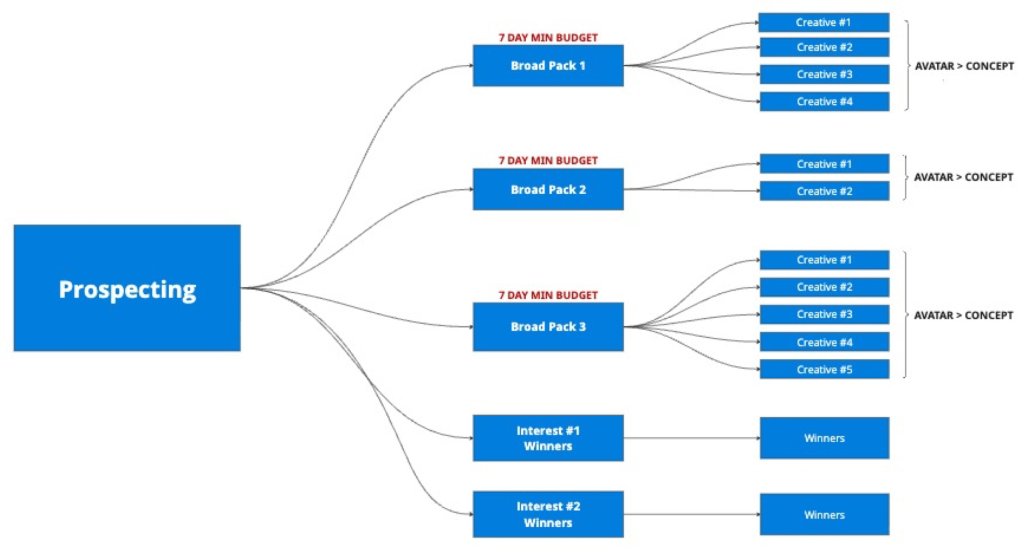
The M4 structure utilizes a single Prospecting Campaign set to Campaign Budget Optimization (CBO). Within this campaign, ads are organized into "packs"—individual ad sets dedicated to specific rounds of creative. This allows the Meta algorithm to distribute budget dynamically to the highest-performing assets. To prevent the algorithm from over-spending on "fatigued" ads, the system employs value rules and ad set budget minimums and maximums, ensuring that new, untested creative always receives a baseline of impressions.

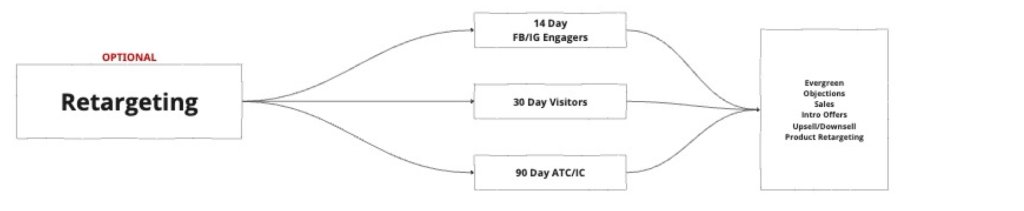
Parallel to prospecting, a Retention Campaign is established to target existing customers, while optional Retargeting and Scaling campaigns are utilized to capture engaged prospects and force spend toward proven "hits."
Stage 2: Creative as the New Targeting
Following the "Andromeda" algorithm update, Meta’s AI now uses the content of the ad itself to determine the audience. In this environment, creative is no longer just the "messaging"—it is the targeting mechanism.
The M4 Method focuses on problem-solution specific creative. Broad, generic ads ("Back pain relief") are replaced by hyper-targeted content ("Back pain relief for construction workers"). By identifying a specific customer avatar and showing talent that mirrors that demographic, the ad signals to the algorithm exactly who should see the content.
The strategy emphasizes "Semi-professional User-Generated Content (UGC)." By utilizing micro-influencers (1,000 to 20,000 followers) who follow strict scripts but provide authentic delivery, brands can produce high volumes of feed-native content for a fraction of the cost of traditional production.
Stage 3: Deep Dive Analysis and Temporal Optimization
Once the engine is running, the third stage involves identifying hidden patterns in consumer behavior. Most brands spend a flat daily budget, ignoring the reality that conversion rates fluctuate based on the day of the week, geography, and placement.
The M4 Method requires a deep dive into 90 to 180 days of "evergreen" data (excluding outliers like Black Friday). When a brand identifies a 20% to 30% variance in performance—for example, higher conversion rates on weekends for pet brands—the budget is adjusted to "hunt" that performance. Rather than cutting underperforming days entirely (which can starve the funnel), the system reallocates capital to maximize volume on high-performing days.
Stage 4: Execution of Scale
Scaling is only initiated when the account structure is stable and ROAS meets the target "King Goal." Piliero categorizes scaling into three distinct movements:
- Vertical Scaling: Increasing the budget of existing campaigns by 10% to 30% every few days.
- Horizontal Scaling: Launching short-term, separate campaigns for promotions or launches to avoid disrupting the primary prospecting engine.
- Twin Engine Scaling: The most advanced stage, where iterations of "hit" ads are injected back into the prospecting CBO while simultaneously increasing the total campaign budget.
Supporting Data: The "Hit Rate" and Iterative Success
The M4 Method defines a "hit" as any ad that performs above the target ROAS and captures at least 10% of the total account spend. Success in scaling is a numbers game; the higher the volume of creative produced, the higher the probability of finding a hit.

Data suggests that iterative creative—making slight variations to a winning ad—is significantly more efficient than starting from scratch. For instance, changing only the "hook" (the first three seconds) of a high-performing video or swapping the background color of a winning static image can extend the life of a creative asset by months. This iterative loop allows ROAS to remain stable even as spend increases, creating the compounding effect necessary for rapid growth.
Expert Perspectives and Official Responses
Sam Piliero emphasizes that the "misconception of control" is what holds most advertisers back. "Many advertisers either over-engineer their accounts with dozens of campaigns… or they do the opposite and hand everything to the algorithm," Piliero notes. The M4 Method seeks the "deliberate sweet spot" between manual oversight and algorithmic freedom.
However, Piliero offers a stern warning for supply-constrained businesses. For brands that cannot fulfill massive spikes in demand—such as boutique manufacturers or specialty food producers—scaling aggressively is counterproductive. In these instances, the "King Goal" shifts from customer acquisition volume to maximizing ROAS on a fixed volume of inventory. "The aim is efficiency per order, not raw customer growth," Piliero explains, highlighting that the system must always serve the specific operational reality of the business.
The "King Goal" philosophy, a term Piliero brought from his tenure at BarkBox, serves as the ultimate north star. Whether it is CAC (Cost Per Acquisition) or a specific ROAS, every other metric (CPM, CPC, CTR) is viewed merely as a diagnostic tool. If the King Goal is met, the noise of secondary metrics is ignored.
Implications for the eCommerce Industry
The rise of the M4 Method signals a broader shift in the digital marketing landscape. As Meta’s AI becomes more autonomous, the competitive advantage has moved from technical "button-pushing" in the Ads Manager to creative strategy and financial modeling.
- The Professionalization of UGC: The reliance on semi-professional creators suggests that the "polished" era of commercial advertising is being replaced by "authentic" performance creative. Brands that fail to build a creative production pipeline will likely see their customer acquisition costs rise.
- Profit-First Modeling: As venture capital becomes more discerning, eCommerce brands are being forced to prioritize contribution margin over "growth at all costs." The M4 Method provides a roadmap for this transition.
- Algorithmic Partnership: The success of the single-CBO structure demonstrates that the most successful advertisers are those who learn to "collaborate" with the AI, providing it with the right structure and creative signals rather than trying to outsmart it with complex targeting.
In conclusion, blowing up an eCommerce business via Facebook Ads is no longer a matter of luck or "viral" content. It is the result of a disciplined adherence to account structure, a high-volume creative engine, and a relentless focus on the financial metrics that actually drive business value. For brands willing to commit to this level of rigor, the ceiling for growth remains higher than ever before.