The M4 Blueprint: How to Architect a High-Growth eCommerce Machine on Facebook
In the volatile world of eCommerce, the difference between a brand that plateaus at $100,000 in monthly revenue and one that scales to $50 million is rarely found in a single "magic" ad. Instead, it is found in the rigor of a repeatable, data-driven architecture. Sam Piliero, a strategist behind some of the most rapid scaling stories in modern digital marketing, argues that most advertisers fail not because their product is bad, but because they are paralyzed by the wrong metrics and an undisciplined approach to campaign management.
Piliero’s solution is the M4 Method, a four-stage framework designed to move brands away from "hope-based marketing" and toward a predictable, scalable system built on structure, creative iteration, analytical depth, and calculated growth.
The Core Barriers: Why Your Ads Are Stalling
Before implementing any new strategy, advertisers must identify the "silent killers" of profitability. According to Piliero, these fall into two primary categories:
1. The Trap of Efficiency Metrics
Many marketers obsess over Return on Ad Spend (ROAS) and Cost Per Acquisition (CPA) as if they are the ultimate arbiters of success. While these are necessary guardrails, they are not the end goal. Piliero argues that the focus should be on contribution margin—the actual profit landing in the business’s coffers.
Chasing an arbitrary 10x ROAS can be a vanity metric that constrains growth. A brand achieving a 2.2 ROAS while spending aggressively to acquire thousands of customers often builds a more resilient, valuable business than one clinging to a 10x ROAS on a tiny, stagnant budget. Lifetime value (LTV) and word-of-mouth compounding are the real drivers of long-term wealth.
2. The Illusion of Control
Advertisers tend to fall into two camps: the "micromanagers" who over-engineer accounts with dozens of conflicting campaigns, and the "delegators" who abdicate all responsibility to Meta’s algorithm. True scaling occurs in the "sweet spot"—a deliberate structure where human strategy provides the boundaries, and the algorithm provides the velocity.

The M4 Method: A Four-Stage Framework
The M4 Method is a structural hierarchy. Like a house, you cannot build the roof (scale) before you have poured the foundation (account structure).
Stage 1: The Architectural Foundation (Structure)
The account structure is the conduit through which your creative communicates with the market. Piliero suggests a modular approach:
- The Prospecting Campaign: A single, centralized campaign using Campaign Budget Optimization (CBO). Inside this, you organize your ads into "packs"—grouped sets of creative that allow the algorithm to distribute budget to the highest performers.
- The Retention Campaign: A distinct campaign dedicated to existing customers. By separating this, you gain total clarity on your acquisition costs versus your retention efforts.
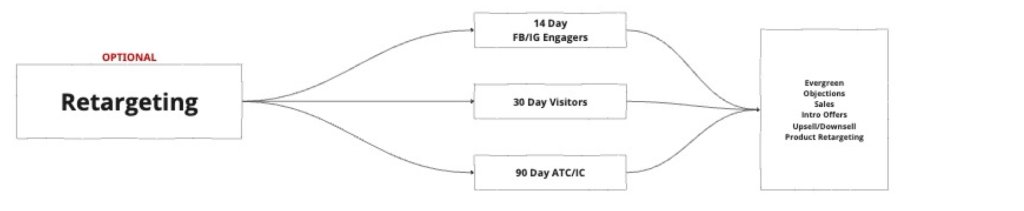
- Optional Strategic Campaigns: For brands ready to move further, a dedicated retargeting campaign (for high-intent non-purchasers) and a scaling campaign (for top-performing creative) round out the structure.
Stage 2: Creative as the New Targeting
In the era of Meta’s "Andromeda" update, targeting is no longer about checking boxes for interests or behaviors. The content of your ad is the targeting.
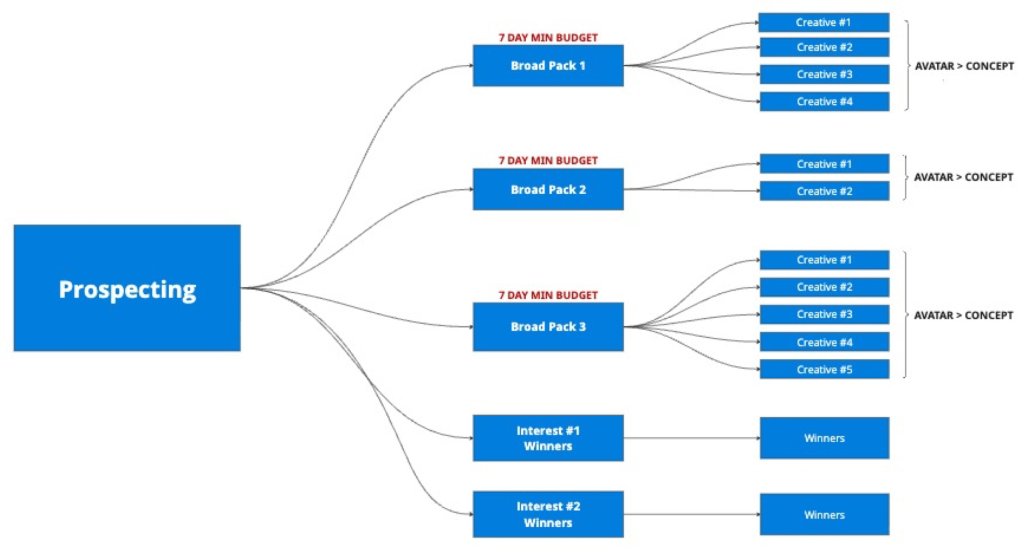
- Problem-Solution Specificity: Generic ads reach everyone and impress no one. A successful ad speaks to a specific avatar facing a specific pain point. For instance, instead of a generic "back brace for pain" ad, a brand should run a specific creative targeting "construction workers suffering from lumbar strain."
- The "Hit" Strategy: A "hit" is defined as any ad that exceeds your ROAS target while capturing at least 10% of your account spend. Since most ads won’t be hits, volume is essential.
- Iterative Evolution: You don’t need to reinvent the wheel for every campaign. If an ad works, iterate on it. Change the headline, swap the influencer, or alter the hook, but keep the core "winning" message intact.
Stage 3: Deep Dive Analysis (The Weekend Effect)
Most advertisers run their budgets on a flat, daily basis. This is a massive oversight. Every business has a rhythm—a specific cadence of consumer behavior.
Piliero draws on his tenure at BarkBox, where he discovered that ad performance consistently peaked on weekends. By analyzing 90 to 180 days of non-holiday, "evergreen" data, you can uncover these patterns.
The Strategy: Do not simply kill low-performing days. Instead, adjust your budget flow. Lower spend on days when your audience is less likely to convert, and funnel that saved capital into the high-performing windows. A 20–30% shift in performance metrics is a signal worth acting upon.

Stage 4: The Scale Loop
Scaling is only appropriate when your foundation is stable. If your ROAS is poor, scaling will only accelerate your losses. When performance is strong, Piliero recommends three types of scaling:
- Vertical Scaling: Increasing the budget of a successful campaign by 10–30% every few days to allow the algorithm to recalibrate.
- Horizontal Scaling: Launching short-term, separate campaigns for specific promotions or limited-time events to avoid disrupting the core prospecting machine.
- The "Twin Engine" Loop: The ultimate scaling mechanism. You identify a "hit" ad, create variations of it, and inject them into the main prospecting CBO while simultaneously increasing the overall budget. This keeps the algorithm fueled with fresh, high-performing content.
Supporting Data and Real-World Implications
The implications of adopting a structured, data-led framework like M4 are profound. Among The Moonlighters’ client base, five businesses transitioned from spending less than $30,000 monthly to reaching the $50 million-plus annual revenue tier in roughly a year.
These results are not universal, but they highlight the impact of shifting from "short-term firefighting" to "long-term engine building." The data suggests that when a brand commits to creative iteration and stops chasing proxy metrics (like CPC or CPM) in favor of the "King Goal"—usually a specific, profitable CAC or ROAS—the volatility of the Facebook platform becomes a manageable variable rather than an existential threat.
The "King Goal" Philosophy
To survive in the ecosystem, brands must establish a "North Star." Whether it is a specific Cost Per Acquisition (CAC) or a target ROAS, this is the King Goal.
If your King Goal is being met, you must ignore the noise of fluctuating secondary metrics. Too many advertisers panic when they see a spike in CPMs or a dip in click-through rates. If the bottom-line, profit-centric King Goal is healthy, these fluctuations are simply data points to be monitored, not triggers for reactive changes.
Conclusion: Turning Chaos into Growth
Scaling an eCommerce business on Facebook is no longer about "hacking" the system. It is about building a system that allows for constant, high-volume testing within a controlled framework. By separating prospecting from retention, treating creative as the primary targeting tool, exploiting the hidden patterns in daily conversion data, and scaling only when the foundation is secure, brands can move away from the frustration of unpredictable ad accounts.

The M4 Method serves as a reminder that behind every massive digital success story is a methodical, unglamorous process of analysis, iteration, and disciplined execution. For the modern marketer, the path to $50 million isn’t found in a new trend—it’s found in the rigorous application of these four foundational stages.