Tech Stocks Navigate Volatility: A Weekly Analysis of Market Shifts and Corporate Strategies
Main Facts: A Divergent Week for New-Age Tech
The Indian stock market’s new-age technology segment experienced a week defined by sharp stock-specific movements, contrasting with a broader recovery in the benchmark indices. As of the close of the week, the cumulative market capitalization of the 57 new-age tech companies tracked by Inc42 stood at $129.58 Bn, down from $131.94 Bn recorded in the previous week.
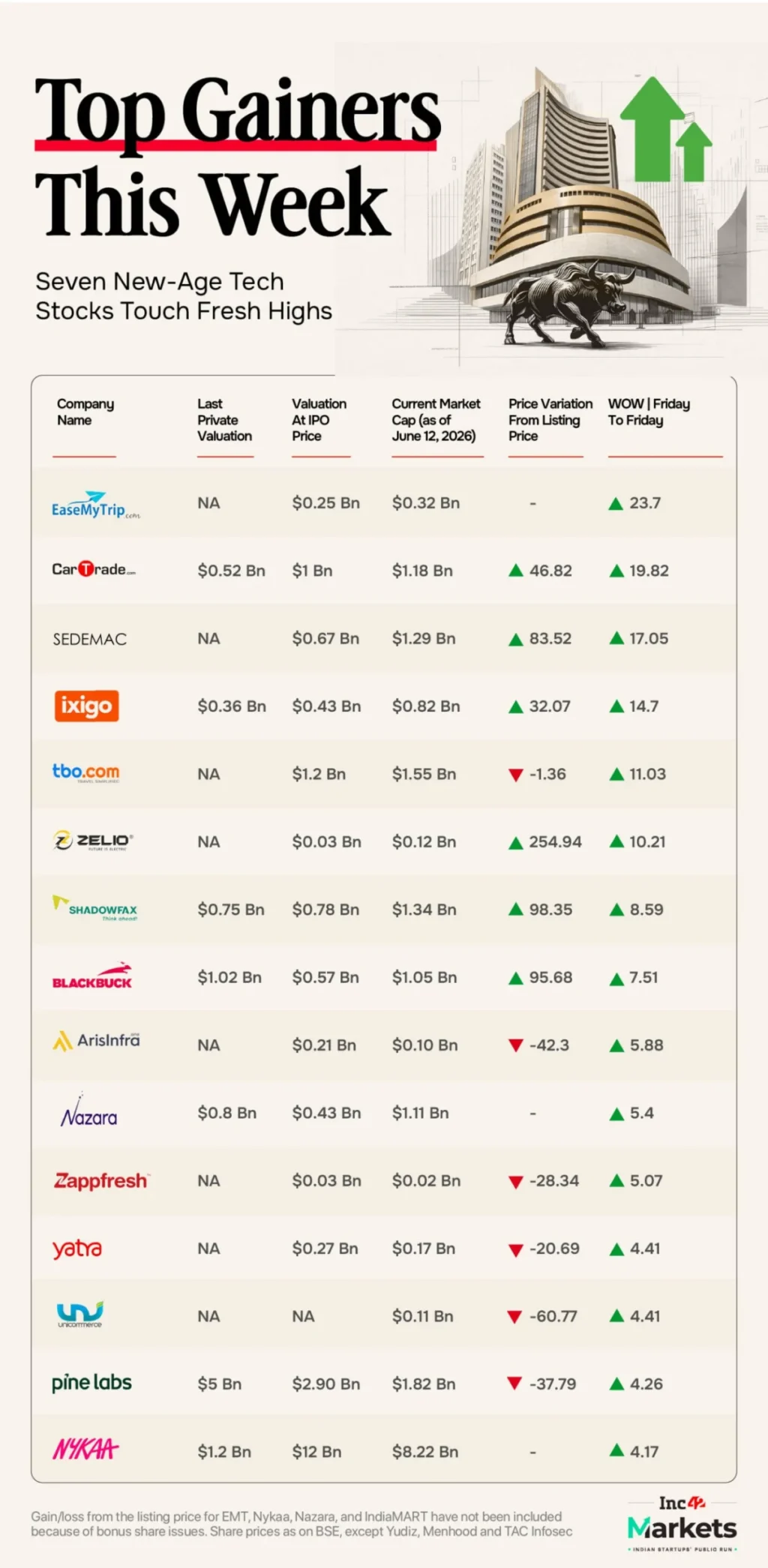
This contraction in total valuation masked a high degree of volatility within the individual stock performances. Out of the 57 tracked entities, 31 companies managed to close in the green, posting gains ranging from a marginal 0.05% to a robust 24%. Conversely, 25 stocks faced downward pressure, with losses spanning from 0.30% to nearly 15%. The standout performer of the week was EaseMyTrip, which surged 23.7% to close at ₹8.35. Despite the overall volatility, the week saw a flurry of optimism as several major players—including Kissht, Ather Energy, Honasa Consumer, Shadowfax, ideaForge, SEDEMAC, and MobAvenue—hit fresh highs. However, sustained momentum remained elusive for many of these, with only SEDEMAC, Yudiz, and Shadowfax successfully maintaining their gains to close in positive territory.
Chronology of Market Movements
The week began under the shadow of persistent geopolitical uncertainty, particularly concerning the US-Iran situation. However, mid-week reports suggesting potential progress in diplomatic talks between the two nations served as a catalyst for a market rebound.
- Monday & Tuesday: Markets remained cautious. The initial trading sessions were marked by profit-taking in high-growth tech stocks, particularly those that had recently reached record highs.
- Wednesday: Honasa Consumer, the parent company of Mamaearth, captured investor attention by unveiling an ambitious five-year growth roadmap. This triggered an immediate mid-week rally, pushing the stock to a new 52-week high of ₹437.90 on Thursday.
- Thursday: Investor focus shifted toward broader macroeconomic stability. The Reserve Bank of India’s (RBI) intervention to stabilize the rupee through forex swap facilities provided a floor for the market, preventing a deeper slide.
- Friday: As the week concluded, profit booking resumed across several sectors. Lenskart continued to face selling pressure as institutional investors offloaded stakes following the expiration of the IPO lock-in period. Meanwhile, Yudiz, listed on the NSE SME platform, emerged as the week’s biggest loser, plunging 14.81% to reach a fresh low of ₹22.15.
Supporting Data: The Changing Landscape of Tech Valuation
The divergence between the broader market performance and the tech sector’s valuation highlights the sensitivity of growth-stage companies to institutional churn.
The Macro View
While the new-age tech sector saw a valuation drop of approximately $2.36 Bn over the week, the benchmark indices told a different story. The Sensex climbed 1.7% to reach 75,527.95, while the Nifty 50 finished 1.1% higher at 23,622.90. This decoupling suggests that while general market sentiment was buoyed by easing geopolitical tensions and RBI liquidity measures, the tech segment was more influenced by internal factors—specifically, capital rotation and post-lock-in profit booking.
Institutional Activity at Lenskart
Lenskart serves as a primary case study for the volatility experienced by recent IPOs. Following the expiry of its six-month lock-in period on May 8, the company has witnessed a sustained wave of exit activity:

- ADIA: Sold shares worth ₹1,960 Cr.
- SoftBank: Executed a block deal worth ₹2,873.3 Cr on June 3.
- JP Morgan: Offloaded shares worth ₹96.4 Cr on June 5.
- Others: Prior to these, Alpha Wave Ventures, BirdsEye Holdings, and TR Capital collectively sold over ₹3,861 Cr worth of equity.
Despite this heavy selling, the stock remains a favorite among domestic mutual funds and pension funds, who have actively absorbed the supply. With a 26% gain since its November 2025 IPO and strong fundamentals—including a 69% YoY net profit growth to ₹500.9 Cr—the company’s long-term outlook remains insulated from short-term institutional exits.
Official Responses and Strategic Pivots
Honasa Consumer: The Roadmap to FY31
Honasa Consumer’s leadership used the week to articulate a vision for sustained long-term growth. The company’s disclosure outlines a strategy to more than double its revenue to ₹5,500 Cr by FY31. Central to this plan is the expansion of the "Mamaearth" and "The Derma Co" brands, alongside a push into new, high-margin categories such as nutraceuticals, fragrances, and oral care.
"Our goal is to deepen our offline presence significantly," the company stated in its investor disclosure. By increasing its retail footprint from 1.2 Lakh stores to over 3 Lakh, Honasa aims to fortify its market share. This strategic pivot, combined with a 175% surge in FY26 net profit, provides a fundamental buffer against the minor 0.6% dip seen at the close of the week.
Lenskart: Consolidating the Analytics Stack
Beyond the financial headlines, Lenskart made a strategic move in its operational architecture by acquiring the remaining 7.65% stake in its analytics subsidiary, Quantduo Technologies (GeoIQ). The acquisition, valued at ₹3.68 Cr, signals a commitment to vertical integration. By bringing GeoIQ fully in-house, Lenskart is positioning itself to leverage proprietary data analytics to optimize customer acquisition and supply chain efficiency, a move deemed essential for its scaling efforts in FY27.
Implications for Investors and the Broader Market
The week’s data provides several critical insights into the current state of the Indian tech ecosystem:
1. The End of the "Easy Money" Era
As noted by V.K. Vijayakumar, Chief Investment Strategist at Geojit Investments, while FII selling is showing signs of easing due to better macroeconomic indicators and lower Brent crude prices, a return to massive, sustained inflows is unlikely. The global "AI-driven investment cycle" continues to command capital, and until that moderates, Indian tech stocks will likely remain subject to localized liquidity shocks rather than broad-based rallies.

2. The Resilience of Fundamentals
Despite the sell-offs at Lenskart and the profit-taking at Honasa, the underlying financial performance of these companies remains robust. The market is currently in a "price discovery" phase, where investors are distinguishing between companies that offer long-term value and those that were purely riding the liquidity wave of the last two years.
3. The Role of the Central Bank
The RBI’s proactive measures—specifically the introduction of forex swap facilities for ECBs—have acted as a vital stabilizer. By easing the pressure on the rupee, the central bank has effectively prevented a wider market sell-off, providing a safe harbor for investors during periods of high geopolitical noise.
4. Sectoral Outlook
The divergence between gainers like EaseMyTrip and losers like Yudiz highlights a maturing market. Investors are becoming increasingly selective. Companies that can provide transparent growth roadmaps—such as Honasa’s five-year plan—or those that demonstrate technological differentiation, such as Lenskart’s focus on data analytics, are likely to weather the current volatility better than those lacking a clear path to sustainable profitability.
As the markets move into the next quarter, the focus will likely shift from geopolitical headlines to earnings quality and capital allocation efficiency. For the 57 companies under coverage, the coming months will test whether their operational improvements can withstand the ongoing tug-of-war between domestic institutional absorption and global investor caution.