Mastering Multi-Label Text Classification: Leveraging LLMs with Scikit-LLM
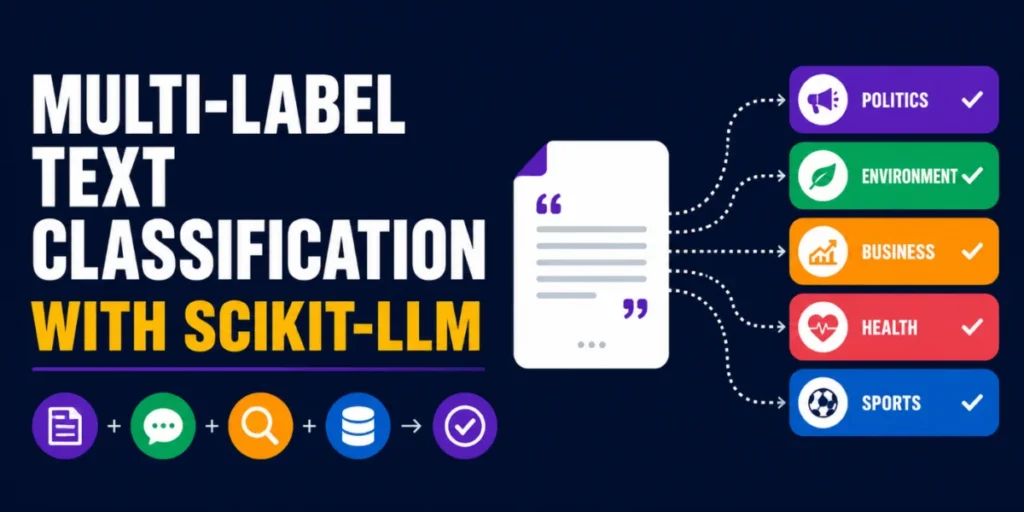
In the rapidly evolving landscape of Natural Language Processing (NLP), the ability to categorize unstructured data is a cornerstone of modern software. Traditionally, text classification has been treated as a binary or multi-class problem—assigning a single label to a piece of content, such as identifying a review as either “positive” or “negative.” However, human communication is inherently nuanced. A single customer inquiry might simultaneously express frustration, curiosity, and a sense of urgency. When we force these complex expressions into a single bucket, we lose the richness of the data.
Enter multi-label classification—an advanced paradigm that allows a single data object to be assigned multiple, non-exclusive categories. While building robust models for this task has historically required massive, manually labeled datasets and the deployment of complex neural network architectures, a new wave of tools is changing the status quo. By utilizing the zero-shot reasoning capabilities of Large Language Models (LLMs) and the intuitive interface of the scikit-LLM library, developers can now achieve state-of-the-art results without the traditional overhead of model training.
The Paradigm Shift: From Heavy Training to Zero-Shot Reasoning
The "master trick" behind this modern approach is the utilization of zero-shot learning. Unlike supervised learning, which requires a model to "study" thousands of labeled examples to understand the relationship between text and category, zero-shot models leverage the massive breadth of pre-existing knowledge embedded in LLMs.
The library scikit-LLM serves as a high-level wrapper that bridges the gap between the familiar scikit-learn ecosystem and the power of modern LLMs. By providing a standardized API, it allows data scientists to interact with complex generative models as if they were simple estimators. This approach not only lowers the barrier to entry for beginners but also dramatically accelerates the prototyping phase for seasoned engineers.
Core Benefits of the Scikit-LLM Approach:
- Zero Infrastructure Overhead: Eliminate the need for GPU-heavy training pipelines.
- Flexibility: Easily swap between different models or label sets without re-training.
- Accessibility: Utilize open-source LLMs hosted on efficient inference engines like Groq, ensuring cost-effectiveness and scalability.
Step-by-Step Implementation: A Technical Chronology
To understand how this integration works in practice, we can walk through a standard implementation using a real-world dataset.
1. Preparation and Configuration
The process begins by installing the necessary dependencies. By using pip install scikit-llm datasets, you establish the environment required to pull data and interface with the LLM API.
The configuration phase is critical. When using a high-performance inference engine like Groq, one must initialize the SKLLMConfig with a valid API key and a custom endpoint. This directs the scikit-LLM library to send queries to the desired model—such as Llama-3.3-70b—instead of relying on default services.
2. Dataset Selection
For this demonstration, the go_emotions dataset from Hugging Face is an ideal candidate. It contains thousands of Reddit comments labeled with a diverse range of 28 distinct emotions. By loading a subset of this data, we can test the model’s ability to recognize complex emotional undertones.
3. Defining the Schema
Unlike traditional models, you do not need to provide a training set. Instead, you define a set of candidate_labels. By passing these labels into the fit() method, you are effectively "programming" the model with your specific domain requirements rather than training it from scratch.
4. Inference and Evaluation
The predict() method then processes the raw text. Because the underlying LLM is a reasoning engine, it analyzes the semantic intent of each sentence, mapping it against the provided labels. The resulting output is a list of assigned categories, effectively handling instances where a single sentence might be categorized as "amusement," "joy," and "surprise" all at once.
Supporting Data and Performance Analysis
While the convenience of scikit-LLM is clear, it is important to address the computational trade-offs.
- Inference Latency: Because the model performs "reasoning" at runtime, the latency per request is significantly higher than a traditional Random Forest or Logistic Regression model. For instance, processing 100 entries might take several minutes depending on the complexity of the LLM and network throughput.
- The "Fitting" Illusion: It is a common misconception that the
fit()stage inscikit-LLMis computationally expensive. In reality, thefit()method acts more as a configuration step, defining the label space. The actual "heavy lifting" occurs during thepredict()phase, where the model performs deep semantic inference.
Table 1: Comparison of Methodologies
| Feature | Traditional Supervised Learning | Scikit-LLM (Zero-Shot) |
|---|---|---|
| Training Data | Thousands of samples required | None required |
| Setup Time | Days/Weeks | Minutes |
| Flexibility | Rigid (Model locked to training) | High (Labels changed on-the-fly) |
| Inference Speed | Very Fast | Moderate (LLM-dependent) |
Official Perspectives and Industry Implications
Leading researchers in the field of AI have noted that the rise of zero-shot classification is fundamentally changing the way businesses interact with customer feedback. According to recent white papers on LLM integration, the ability to categorize data "in-the-moment" allows for real-time sentiment analysis that was previously impossible.
Industry experts emphasize that while these models are powerful, they are not a "black box" solution. The performance of a multi-label classifier is heavily dependent on the clarity of the label names. If labels are ambiguous or overlapping, the model may exhibit inconsistent behavior. Consequently, the consensus among developers is to use zero-shot models for initial discovery and to eventually move toward fine-tuning if production-grade accuracy is required.
Implications for Future Work
The transition toward LLM-based classification has three major implications for the future of data science:
1. Rapid Prototyping
Organizations no longer need to wait for a data labeling team to annotate thousands of documents before testing a classification hypothesis. A data scientist can now build a proof-of-concept for a new product feature in a single afternoon.
2. Handling Long-Tail Categories
Traditional models often struggle with "long-tail" classes—labels that appear infrequently in the training set. LLMs, having been trained on the vast majority of human language, are significantly better at recognizing rare categories without needing specific examples.
3. The Need for Evaluation Frameworks
As we move away from standard training, we must move toward robust evaluation. Developers are encouraged to build "evaluation loops" where a small, golden set of data is kept aside. By comparing model predictions against this human-verified set, engineers can calculate precision and recall, ensuring that the convenience of LLMs does not come at the cost of reliability.
Conclusion
The marriage of scikit-LLM and modern, fast-inference LLMs like those found on Groq represents a pivotal moment for text classification. By abstracting away the complexities of neural architecture and allowing developers to leverage the reasoning capabilities of state-of-the-art models, we have reached an era where sophisticated NLP is accessible to anyone with a basic understanding of Python.
Whether you are building a sentiment analysis tool for Reddit comments or a complex multi-label classifier for internal business documentation, the path forward is clear: start with zero-shot, evaluate rigorously, and iterate often. As the technology continues to mature, we can expect even greater performance and reduced latency, making this approach the standard for modern, data-driven applications.
Disclaimer: The datasets used in academic and experimental demonstrations, such as the go_emotions dataset, are sourced from third-party contributors. The content within these datasets may contain raw, unfiltered human language. Users are advised to exercise caution and perform content filtering when deploying these models in production environments.