Architects of Memory: Decoding the Stateful vs. Stateless Dilemma in AI Agent Design
In the rapidly maturing field of Large Language Model (LLM) engineering, the transition from simple chat interfaces to robust, autonomous AI agents has brought a fundamental architectural debate to the forefront: How should an agent handle its state?
Whether an agent is "stateless" or "stateful" is not merely a coding preference; it is a structural decision that dictates the scalability, cost-efficiency, and reliability of an entire AI-driven ecosystem. As developers look to move beyond prototyping and into high-traffic production environments, understanding these two paradigms—and the trade-offs they necessitate—is the difference between a resilient system and a fragile, bottlenecked application.
The Architecture of Context: Defining the Paradigms
At the core of the debate is the concept of "memory." An AI agent’s state represents the accumulated history of a conversation or the current progress of a multi-step task.
The Stateless Paradigm: The "Fire and Forget" Model
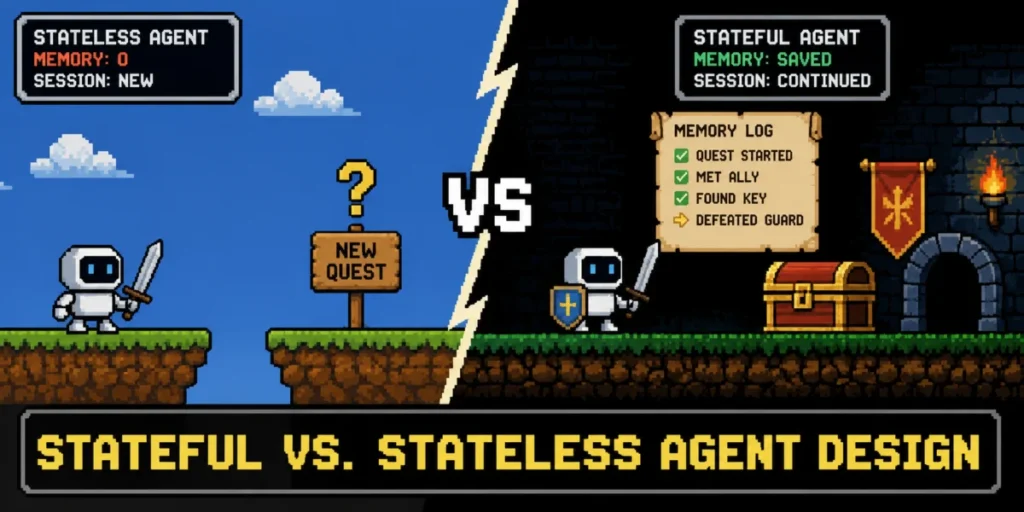
Stateless agents are designed to be ephemeral. Every request sent to the agent is treated as an isolated event, devoid of any knowledge of previous interactions. In this model, the "brain" (the LLM) is purely reactive. If a user asks a follow-up question, the client—the application frontend—must bundle the entire history of the dialogue and transmit it alongside the new prompt.
The Stateful Paradigm: The "Context-Driven" Model
Conversely, stateful agents act as curators of their own history. The agent maintains a persistent connection to a storage layer—a database or cache—where the conversation context resides. When a request arrives, the agent autonomously retrieves the session’s background data, integrates the new prompt, processes the logic, and saves the updated result back to the database.
Chronology of Development: From Simple Queries to Persistent Agents
The evolution of these paradigms mirrors the growth of the AI industry itself.
- Phase 1: The API Era (2022–2023): Initially, developers relied heavily on stateless interactions. This was largely due to the simplicity of early LLM APIs, which were built to emulate RESTful services. Developers pushed the "state" burden onto the client-side code, resulting in simple but often limited chatbots.
- Phase 2: The Rise of Frameworks (2023–2024): With the introduction of LangChain, LlamaIndex, and native agent frameworks, the demand for "persistent" memory grew. Developers realized that to build agents capable of using tools—such as browsing the web or querying SQL databases—the agent needed a way to track its internal progress across asynchronous steps.
- Phase 3: The Production Scalability Era (2025–Present): Today, we are in the era of high-concurrency deployment. Engineers are moving away from monolithic state management toward distributed, high-performance caches like Redis to support stateful agents that can handle thousands of simultaneous users without sacrificing the coherence of the conversation.
Supporting Data: Infrastructure Tradeoffs
The choice between these two architectures is governed by technical constraints. To illustrate, we consider the llama-3.1-8b-instant model on the Groq platform, which provides an efficient, low-latency environment ideal for testing.
Stateless Performance Metrics
- Scalability: High. Because nodes do not store session data, load balancers can distribute requests across any available compute instance.
- Token Overhead: Significant. Because the full context window is transmitted with every single prompt, the "token snowball" effect can cause latency and costs to spike during long, multi-turn conversations.
- Complexity: Low. The backend remains simple, and the risk of "state corruption" (where an agent gets confused by stale data) is virtually non-existent.
Stateful Performance Metrics
- Scalability: Moderate. Requires sophisticated infrastructure, such as sticky sessions or centralized Redis clusters, to ensure that the session state is accessible regardless of which server handles the request.
- Token Efficiency: Optimized. The system only sends the "missing piece" of the conversation, keeping the context window concise and predictable.
- Complexity: High. Developers must handle database transactions, handle race conditions, and implement cleanup routines to manage database size.
Implementation: The Practical Divide
To understand how these paradigms manifest in code, we examine two implementations using the Groq API.
Implementing a Stateless Agent
In a stateless design, the agent is a function that accepts both a prompt and an optional history object. If the history is missing, the agent is effectively "amnesiac."
def stateless_agent(prompt: str, provided_history: list = None) -> str:
    messages = ["role": "system", "content": "You are a helpful, concise assistant."]
    if provided_history:
        messages.extend(provided_history)
    messages.append("role": "user", "content": prompt)

    response = client.chat.completions.create(
        model="llama-3.1-8b-instant",
        messages=messages
    )
    return response.choices[0].message.content.strip()
Implementing a Stateful Agent
The stateful approach shifts the responsibility. The agent is now an "active" participant that communicates with a database, ensuring that it remains the source of truth for the conversation.
def stateful_agent(session_id: str, new_prompt: str) -> str:
    # 1. Retrieve historical context from SQLite/Redis
    conversation_history = db.get_history(session_id)

    # 2. Append new user input
    conversation_history.append("role": "user", "content": new_prompt)

    # 3. LLM Inference
    response = client.chat.completions.create(..., messages=conversation_history)

    # 4. Persistence
    db.save_history(session_id, updated_history)
    return response
Implications for Future AI Systems
The architectural choice between stateless and stateful design has profound implications for the next generation of AI agents.
1. The Cost of "Context Bloat"
As models increase their context windows, the stateless approach becomes increasingly expensive. Sending a 100,000-token history with every request is not only slow but fiscally irresponsible. Stateful architectures that implement "summarization" or "vector memory" are becoming the industry standard for enterprise agents that need to operate over long time horizons.
2. The Bottleneck of Latency
Stateless systems are generally faster at the individual request level because they don’t wait for database I/O. However, they suffer at the network level due to the massive payloads being transferred. Stateful systems introduce database latency but offer a more seamless, conversational "flow" that feels natural to the end user.
3. Reliability and Fault Tolerance
Stateful agents are inherently more complex to debug. If a database transaction fails or a session is improperly cleared, the user’s experience is broken. Conversely, stateless agents are easy to restart; if an instance fails, the next one simply receives the full history and resumes the task without interruption.
Expert Commentary: Where the Industry is Heading
Leading AI infrastructure engineers currently advocate for a Hybrid Architectural Model.
"The best production systems don’t choose one or the other," notes a lead architect at a major cloud provider. "They use a Stateless Execution Layer for the heavy lifting of inference, paired with a Stateful Caching Layer that injects only the relevant context into the request. This provides the horizontal scalability of stateless systems with the deep, long-term memory of stateful agents."
Conclusion: Making the Right Choice
For developers at the early stages of building an AI application, the advice is clear:
- If you are building a simple Q&A bot or a tool for one-off tasks, stick to a stateless design. It is faster to deploy, easier to manage, and cheaper to maintain.
- If you are building complex, multi-step autonomous agents that need to maintain context over hours or days, you must embrace a stateful architecture. You will need to invest in a robust database layer, but the payoff is a significantly more capable and "intelligent" user experience.
As the landscape of AI agentic systems continues to evolve, the distinction between these two models will only grow more pronounced. Choosing the right path today will ensure your system is capable of growing alongside the rapidly accelerating capabilities of LLMs.