The Era of Private, Client-Side AI: Building Multimodal Capabilities with Transformers.js
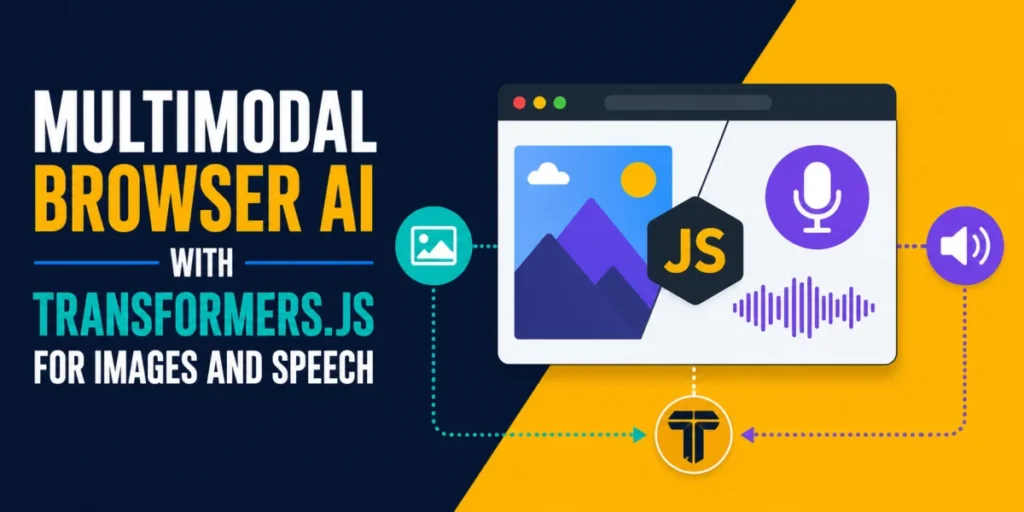
The landscape of artificial intelligence is shifting. For years, the paradigm of AI development has been tethered to the cloud—requiring massive GPU clusters, expensive API tokens, and, most importantly, the transmission of potentially sensitive user data to third-party servers. Today, a new movement is emerging, one that places the power of state-of-the-art neural networks directly into the user’s browser. By leveraging Transformers.js, developers are now able to deploy complex multimodal AI—ranging from image classification and captioning to automatic speech recognition (ASR)—that runs entirely on the client’s device.
This approach offers a trifecta of benefits: absolute data privacy, as no data leaves the browser; zero server costs for the developer; and the ability to function seamlessly in offline environments.
Main Facts: The Power of Local Inference
The core of this revolution is Transformers.js, a library that brings the power of Hugging Face’s popular Transformers ecosystem to the browser. By utilizing WebAssembly (WASM) and the WebGPU API, the library allows deep learning models to execute directly on the client’s CPU or GPU.
The fundamental shift here is the move from "Request-Response" cycles to "Local Execution." When a user uploads a photo to be classified or records a voice memo for transcription, the processing happens on their own machine. This eliminates the latency inherent in network requests and removes the privacy barriers that often prevent enterprises from adopting AI solutions.
The models are typically converted to the ONNX (Open Neural Network Exchange) format, which is highly optimized for performance in browser environments. Once the initial model weights are downloaded and cached in the browser’s IndexedDB, subsequent runs are near-instantaneous.
Chronology: From Text to Multimodal Intelligence
The evolution of browser-based AI began with simple text-processing tasks, such as sentiment analysis or basic language translation. However, the true utility of AI lies in its ability to understand the world as humans do: through sight and sound.
- The Foundation (Text): Early browser AI focused on NLP. Tokenization and vectorization were performed in JavaScript, but the compute power limited these to small, distilled models.
- The Vision Expansion (2023–2024): With the optimization of Vision Transformers (ViT), the community began porting image-centric models to the web. These models allowed browsers to identify objects in photos with high confidence scores.
- The Multimodal Present (2025–2026): We have now reached a stage where we can run "pipelines." A pipeline is an abstraction that handles the complex preprocessing (resizing images, normalizing audio) and post-processing (decoding tokens into text) automatically. Today, a developer can combine an image captioner with a speech transcriber in a single, cohesive application, as demonstrated in the latest implementations of Transformers.js.
Supporting Data: Model Specifications
Running AI locally requires a careful balance between model accuracy and performance. The following table outlines the current standard models used for browser-based tasks:
| Task | Model | Pipeline | First-run Size |
|---|---|---|---|
| Image Classification | Xenova/vit-base-patch16-224 | image-classification | ~88 MB |
| Image Captioning | Xenova/vit-gpt2-image-captioning | image-to-text | ~246 MB |
| Speech Transcription | Xenova/whisper-tiny.en | automatic-speech-recognition | ~78 MB |
The total footprint for a multimodal suite is roughly 400 MB. While this is significant, it is a one-time cost. Modern browser caching ensures that the user only pays this "tax" once, after which the application remains fully functional without an internet connection.
Technical Implementation and Official Workflow
Building these capabilities requires three distinct stages: model selection, environment configuration, and inference execution.
Setting Up the Environment
One of the most appealing aspects of Transformers.js is the lack of complex build chains. You do not need Node.js, npm, or heavy bundlers. Using a simple CDN import allows the library to run directly in an HTML file. A basic local server (using Python’s http.server or the Node serve package) is sufficient to handle the cross-origin isolation requirements of modern browsers.
The Pipeline Architecture
The pipeline() function is the engine room. By calling pipeline('task', 'model-id'), the developer initiates the downloading and caching process. A key best practice is the use of progress_callback. Because these models can reach several hundred megabytes, informing the user of the download status is a non-negotiable UX requirement.
Handling Audio Input
Speech transcription is perhaps the most impressive feat of browser-based AI. The process involves:
- Capturing Audio: Using the
MediaRecorderAPI orAudioContext. - Resampling: Whisper requires a 16,000 Hz sample rate. The
AudioContextconstructor handles this resampling automatically, converting input audio into aFloat32Array. - Inference: The array is passed to the
transcriberpipeline, which returns the text.
Implications for the Future of Web Development
The shift toward client-side AI has profound implications for the industry.
Privacy-First Compliance
For industries like healthcare, law, or finance, the "zero-data-transfer" model is a game changer. Compliance with GDPR or HIPAA becomes significantly easier when you can prove that user data never leaves the client’s browser. This effectively democratizes AI by allowing developers to build sophisticated tools that would otherwise be blocked by security departments due to data privacy concerns.
Reducing Infrastructure Costs
Server-side GPU inference is expensive. By offloading the compute to the user’s device, companies can scale their applications to millions of users without a linear increase in cloud hosting costs. The user effectively provides the compute, turning the browser into a powerful distributed inference engine.
Limitations and Challenges
While the potential is massive, developers must be realistic. Browser-based AI is constrained by:
- The "First-Load" Penalty: A 400 MB download is not ideal for mobile users on limited data plans. Developers must implement smart lazy-loading to ensure models are only fetched when needed.
- CPU vs. GPU: While WebGPU is making massive strides, not all devices have hardware-accelerated browsers. On older hardware, inference can be slow, which may degrade the user experience.
- Model Size Limits: Large Language Models (LLMs) like GPT-4 or Llama 3 are far too large for standard browser usage. We are currently limited to "Small Language Models" (SLMs) and highly optimized quantized variants.
The Path Forward: WebGPU and Web Workers
The immediate future of this technology lies in two areas: WebGPU and Web Workers.
WebGPU allows the browser to tap into the device’s graphics card, often resulting in performance gains of 3x to 5x compared to standard WebAssembly. Developers should adopt a "feature detection" strategy, where the application checks for WebGPU support and falls back to WASM only if necessary.
Furthermore, moving inference tasks into Web Workers is essential for production-grade apps. By running the AI in a separate background thread, the user interface remains fluid. If the main thread is blocked by a heavy tensor calculation, the UI freezes, resulting in a poor user experience. Offloading these tasks ensures the browser remains responsive even during complex model operations.
Conclusion
We are witnessing the end of the "cloud-only" era for artificial intelligence. With libraries like Transformers.js, the browser has evolved from a simple document viewer into a sophisticated AI platform.
Whether you are building an accessibility tool that describes images for the visually impaired, a voice-controlled interface for an offline productivity app, or a secure document processor that handles sensitive information locally, the tools are ready. The barrier to entry is lower than it has ever been: a single HTML file, a few lines of JavaScript, and the latent power of the user’s own hardware. As hardware continues to improve and WebGPU becomes the standard, the gap between what we can run in the browser and what we can run on a dedicated server will continue to shrink, ushering in a new generation of private, high-performance, and truly decentralized web applications.