The AI Revolution: Transforming the Digital Landscape and Empowering Modern Business
Artificial intelligence (AI) has moved far beyond the realm of science fiction, cementing its position as the cornerstone of contemporary professional and personal productivity. As the technology matures, its applications have diversified at an unprecedented pace, shifting from experimental academic interest to an essential utility for survival in the digital marketplace. Whether you are an entrepreneur looking to scale an online store, a creative professional, or a curious observer, understanding the AI ecosystem is no longer optional—it is a competitive necessity.
The State of the Industry: A Statistical Overview
The rapid integration of AI into global business operations is not merely a trend; it is a fundamental shift in how value is created. According to recent data from AuthorityHacker, approximately 35% of companies have already fully integrated AI into their core operational processes. Even more telling is the sentiment among corporate leadership: 90% of organizations now view AI assistance as a definitive competitive advantage.
This shift is mirrored in consumer technology, where 77% of devices now incorporate AI functionalities, from the predictive text in our smartphones to the complex algorithms powering personalized e-commerce recommendations. This ubiquity signals that the "AI era" has arrived, and the organizations that fail to adapt risk becoming obsolete.
A Brief Chronology of the AI Surge
To understand where we are, we must look at how we arrived here. The journey of modern AI has been defined by distinct, rapid-fire stages:
- 2012–2016: The Deep Learning Awakening. The rise of powerful GPUs enabled neural networks to process massive datasets, leading to breakthroughs in image recognition and early natural language processing.
- 2017–2020: The Transformer Era. Google’s introduction of the "Transformer" architecture changed everything. This allowed AI to process context in language more effectively, paving the way for the Large Language Models (LLMs) we use today.
- 2021–2022: The Generative Explosion. Tools like DALL-E and the release of ChatGPT brought AI to the mainstream. For the first time, non-technical users could interact with complex systems using simple, natural language.
- 2023–2024: The Era of Integration. We are currently in a phase where AI is being "baked into" existing software suites, such as Adobe Creative Cloud, Microsoft 365, and Shopify, making these tools accessible to every business owner, regardless of their technical proficiency.
Strategic Pillars: Where AI is Reshaping E-commerce
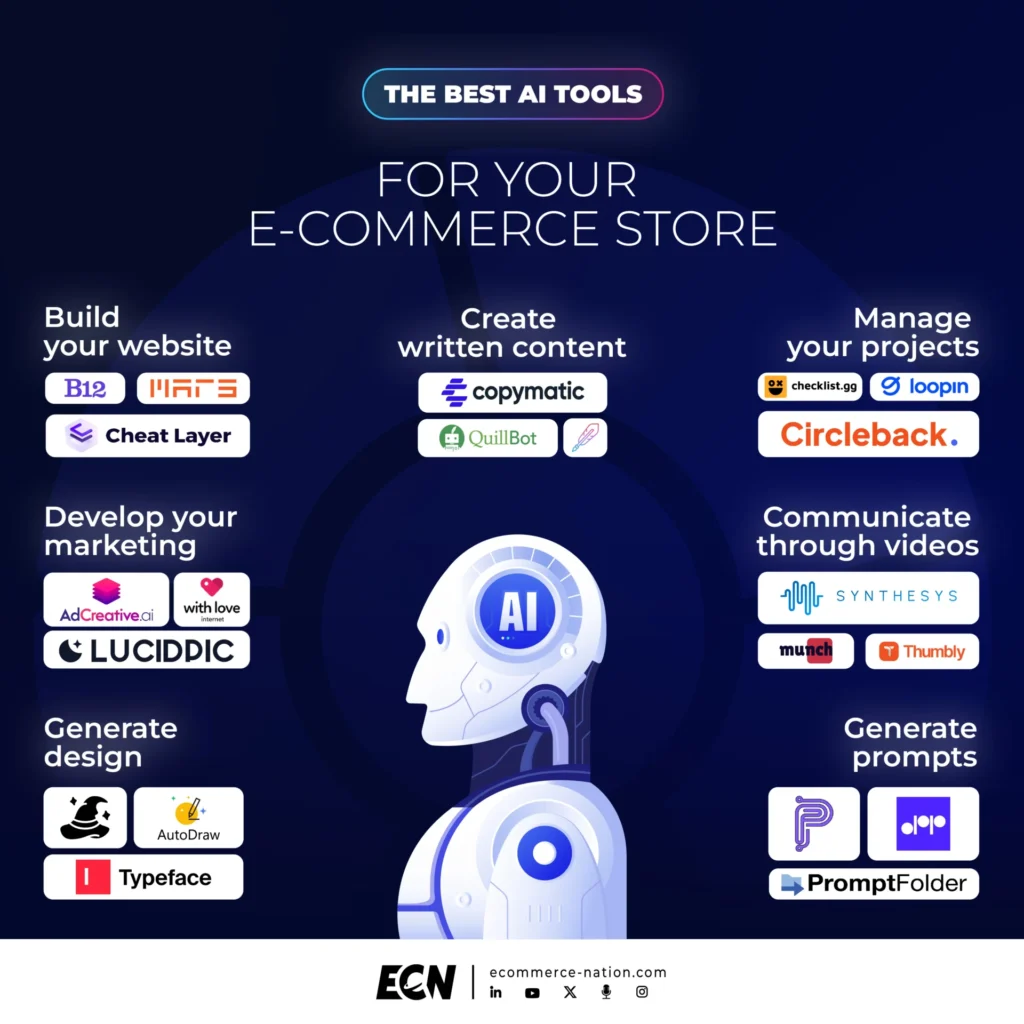
For online merchants, AI represents a multifaceted toolkit that can handle repetitive tasks, generate creative assets, and provide deep analytical insights. Below, we categorize the core areas where AI is providing the most significant impact.
1. Website Development and Infrastructure
Building a digital storefront no longer requires a degree in computer science. Modern AI-driven website builders use intuitive interfaces to design, code, and optimize layouts based on your specific industry needs. By utilizing AI, companies can iterate on UI/UX designs in minutes rather than weeks, allowing for rapid A/B testing of storefront elements.
2. Marketing and Brand Strategy
AI-driven marketing platforms allow for "hyper-personalization." Rather than blasting generic emails to a list, AI analyzes customer behavior to deliver the right message at the right time. Tools can now predict customer churn, suggest optimal price points, and even automate the management of complex advertising campaigns across social media channels.
3. Video Production and Content Communication
Video is the highest-converting medium, but it is historically expensive and time-consuming to produce. New AI tools now allow for the creation of professional-grade video content, including AI avatars and voice synthesis, which can explain products or conduct training sessions without the need for a full film crew.
4. Project Management and Operational Efficiency
The administrative burden of running a business—scheduling, resource allocation, and tracking milestones—can be managed by AI project management software. These tools act as a "digital project manager," identifying bottlenecks, automating status reports, and ensuring teams remain aligned with project timelines.
5. Prompt Engineering: The New Literacy
Perhaps the most crucial skill in the modern workplace is "prompt engineering"—the art of communicating effectively with an AI model. Specialized tools have emerged to help users refine their prompts, ensuring that the output they receive from LLMs is accurate, brand-aligned, and actionable.
6. Content Creation and SEO Strategy
AI has revolutionized content marketing. While human oversight remains essential for brand voice, AI can assist in drafting blog posts, creating SEO-optimized meta-tags, and conducting keyword research. By automating the research and outlining phases, content teams can focus on high-level strategy and editorial excellence.
7. Generative Design
Visual identity is critical for e-commerce. AI-powered design tools can generate product photography backgrounds, promotional banners, and social media graphics in seconds. This allows small businesses to maintain a high-end visual aesthetic that was previously only achievable by well-funded creative agencies.
Implications for the Future of Work
The integration of AI into daily workflows has profound implications for the labor market and business strategy.
Official Perspectives on Productivity: Industry leaders, including those from major tech firms, argue that AI is not a "job killer" but a "job enhancer." By offloading the "drudgery" of data entry, basic drafting, and routine scheduling to machines, human employees are freed to focus on high-value tasks: empathy, complex decision-making, and strategic creative thinking.
The Ethical Imperative: With great power comes the responsibility of ethical usage. Companies must ensure that the AI tools they adopt comply with data privacy regulations like GDPR. Furthermore, there is an ongoing conversation regarding the bias of training data; businesses must be vigilant in verifying AI outputs to ensure they do not perpetuate harmful stereotypes or misinformation.
The Competitive Landscape: For small to medium-sized enterprises (SMEs), AI serves as a "great equalizer." A boutique online shop can now utilize the same level of marketing automation, data analytics, and design quality as a multinational corporation. This democratization of technology means that the market will become increasingly competitive, placing a premium on brand storytelling and customer experience—the two areas where humans still hold a distinct advantage over machines.
Conclusion: Preparing for the Next Wave
The statistics are clear: 90% of companies believe AI is a competitive advantage for a reason. Whether you are managing an online store, drafting a marketing campaign, or optimizing your internal operations, the tools discussed in this article are designed to help you reclaim your time and scale your efforts.
As we look toward the future, the integration of AI will only deepen. The winners in this new environment will not necessarily be those with the most capital, but those who are the most agile—those who learn to embrace AI not as a replacement for human talent, but as a force multiplier for it.
We invite you to explore the infographic provided alongside this article as a starting point for your journey. By identifying one or two areas of your business where AI can provide immediate relief, you can begin the transition into a more efficient, creative, and profitable future. The technology is ready; the question is, are you ready to implement it?