The 3D Frontier: Mastering Cross-Document View Transitions in Modern Web Development

In the evolving landscape of web development, the View Transitions API has emerged as a transformative tool for developers seeking to provide app-like, seamless navigation experiences. However, as developers push the boundaries of this API—specifically when attempting to implement sophisticated 3D effects between pages—they often encounter a frustrating technical impasse. A common hurdle is the discovery that traditional CSS 3D transformation techniques, which function flawlessly on standard DOM elements, seem to fall flat when applied to cross-document transitions.
This article explores the mechanics of this limitation, the underlying rendering behavior of the View Transitions API, and the elegant, albeit non-intuitive, workaround required to bring high-fidelity 3D motion to your web projects.
The Core Concept: Why 3D Transitions Should Work
To understand the problem, one must first look at how 3D space is established in CSS. When we animate elements—such as images, which are "replaced elements"—we rely on the perspective property. This property creates a 3D context for child elements. By applying perspective to a parent container (often styled as a .scene), we define the distance between the user’s viewpoint and the z=0 plane. Without this, a rotateY transformation remains a flat, two-dimensional skewing rather than a true 3D rotation.
Typically, the implementation is straightforward:
.scene
  perspective: 1200px;

.card
  transform: rotateY(0deg);
  transition: transform 0.5s;
When we move to the View Transitions API, the expectation is that this behavior should translate seamlessly. Since the API captures snapshots of the "old" and "new" states of the document, developers naturally assume these snapshots function like any other DOM node. If a card can flip, surely an entire webpage snapshot can perform the same animation.
Chronology of a Technical Impasse
For many developers, the journey toward implementing 3D transitions begins with high expectations. In the early stages of testing cross-document transitions, the implementation follows a standard pattern:
- Opt-in: Enabling the feature via the
@view-transition navigation: auto;rule. - Targeting: Identifying the root element for the transition.
- Animation: Applying CSS keyframes to the
::view-transition-old(root)and::view-transition-new(root)pseudo-elements.
Initially, developers attempt to set the perspective on the html or :root elements, expecting the pseudo-elements to inherit this 3D context. However, upon execution, the visual result is consistently underwhelming. The animation triggers, but the 3D depth is absent. The element simply rotates as if it were a flat plane in a 2D environment.
Through extensive testing, it becomes clear that this is not a syntax error or a misunderstanding of keyframes, but a fundamental conflict between how the browser renders View Transition pseudo-elements and how it calculates the perspective property.
Supporting Data: The Rendering Layer Conflict
The technical root of this issue lies in the W3C specification regarding the rendering of View Transitions. When a transition is initiated, the browser creates a new, independent layer that exists outside the standard HTML flow. This layer, containing the ::view-transition tree, is effectively "top-level" in its rendering context.
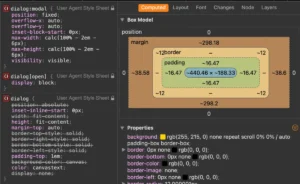
Because this tree is generated dynamically and sits above the DOM, it does not inherit the perspective context defined on the html or body elements. Furthermore, the browser’s User Agent (UA) styles for these pseudo-elements often apply specific position and transform overrides to manage the snapshot capturing process. These overrides explicitly prevent the propagation of perspective from the parent document to the transition snapshots.
As confirmed by technical documentation and industry experts like Bramus Van Damme, these CSS properties often create "flat trees" that are inherently resistant to traditional inheritance. The attempt to force a 3D space by setting perspective on the root node is essentially targeting a container that the transition layer ignores.
Implications for Web Design
The implications of this limitation are significant for UI/UX designers aiming for high-end, immersive interfaces. If 3D transitions cannot be easily implemented, developers are forced to rely on simpler, 2D fade-ins or slide transitions, limiting the creative potential of cross-document navigation.
Moreover, this issue highlights a growing gap between "standard" CSS behavior and the behavior of browser-native APIs. As the web platform matures, developers are increasingly tasked with understanding not just how to write CSS, but how the browser’s internal rendering pipeline handles complex, state-managed transitions.
The Solution: Rethinking the Perspective Function
After weeks of trial and error, the solution reveals itself to be a pivot in strategy: stop treating perspective as a property of the parent, and start treating it as an attribute of the transformation itself.
The perspective() function, when applied directly within the transform property of the keyframes, bypasses the need for a parent container. Because the transformation is applied to the element directly, it creates a self-contained 3D coordinate system.
Correct Implementation
Instead of setting perspective in the CSS rule, integrate it directly into your keyframe definitions:
@keyframes flip-out
  0%
    transform: perspective(1100px) rotateY(0deg);
    opacity: 1;

  100%
    transform: perspective(1100px) rotateY(-90deg);
    opacity: 0;


@keyframes flip-in
  0%
    transform: perspective(1100px) rotateY(90deg);
    opacity: 0;

  100%
    transform: perspective(1100px) rotateY(0deg);
    opacity: 1;
By placing the perspective(1100px) inside the transform value, you are essentially telling the browser to calculate the depth relative to the element currently being transformed, regardless of its position in the document tree. This effectively "unlocks" 3D capabilities for the View Transition snapshot.
Conclusion: A New Standard for Transitions
The discovery that perspective() resolves this issue is a testament to the importance of deep-diving into browser rendering behaviors. While the View Transitions API is designed to simplify complex state changes, it requires developers to unlearn some of the habits formed by years of working within the standard DOM.
By shifting from the property-based approach to the function-based approach, developers can now achieve the "wow" factor that 3D transitions provide, creating navigation experiences that feel truly fluid and modern. As the web continues to move toward more interactive, application-like behavior, these lessons in low-level CSS mechanics will become increasingly vital. The transition from "flat" to "3D" is no longer a matter of browser support, but a matter of understanding the specific tools available within the View Transition lifecycle.