The Fall of ‘Dort’: Inside the Collapse of the Kimwolf Botnet Empire
In a high-stakes cross-border law enforcement operation, Canadian authorities have arrested 23-year-old Ottawa resident Jacob Butler, ending the reign of one of the most prolific and disruptive cybercriminals of the modern era. Butler, known online by the handle "Dort," is accused of architecting and operating "Kimwolf," a massive Internet-of-Things (IoT) botnet that enslaved millions of connected devices to orchestrate record-shattering distributed denial-of-service (DDoS) attacks.
Following a coordinated investigation involving the Ontario Provincial Police (OPP), the U.S. Department of Justice (DOJ), and the FBI, Butler now faces a dual-nation legal reckoning. While he remains in custody in Canada awaiting an extradition hearing, the unsealing of a criminal complaint in an Alaska district court has shed light on a campaign of digital terror that included not only global infrastructure attacks but also targeted swatting and doxing campaigns against security researchers.
The Architect of Chaos: Who is Jacob Butler?
For months, the cybersecurity community lived under the shadow of the Kimwolf botnet. Unlike traditional botnets that target servers or personal computers, Kimwolf was specifically engineered to exploit the "firewalled" underbelly of the modern home: digital photo frames, web cameras, and other smart-home devices that often lack robust security protocols.
The man identified as the mastermind, Jacob Butler, operated with a brazen lack of operational security. Investigators and independent security journalists, most notably at KrebsOnSecurity, were able to trace the "Dort" persona back to Butler by cross-referencing email addresses, cybercrime forum registrations, and footprints left on Telegram and Discord servers.
Despite being identified publicly in February 2026, Butler remained defiant. Rather than retreating into the shadows, he escalated his activities, launching a volley of retaliatory DDoS attacks and violent swatting incidents against those who dared to track his movements. This arrogance ultimately became his undoing, as the intensity of his attacks drew the focused attention of federal agencies, including the Department of Defense’s Defense Criminal Investigative Service (DCIS).
Chronology of a Cyber-Insurgency
The rise and fall of Kimwolf represents a rapid, aggressive arc of criminal activity that pushed the limits of global network stability.
The Rise of the Botnet (Late 2025)
Kimwolf emerged as a dominant force in the IoT landscape, rapidly outpacing its competitors—botnets known as Aisuru, JackSkid, and Mossad. By exploiting a critical security vulnerability in common IoT firmware, Kimwolf was able to propagate at an unprecedented speed, turning millions of residential and commercial devices into "zombie" nodes.
The Confrontation (January–February 2026)
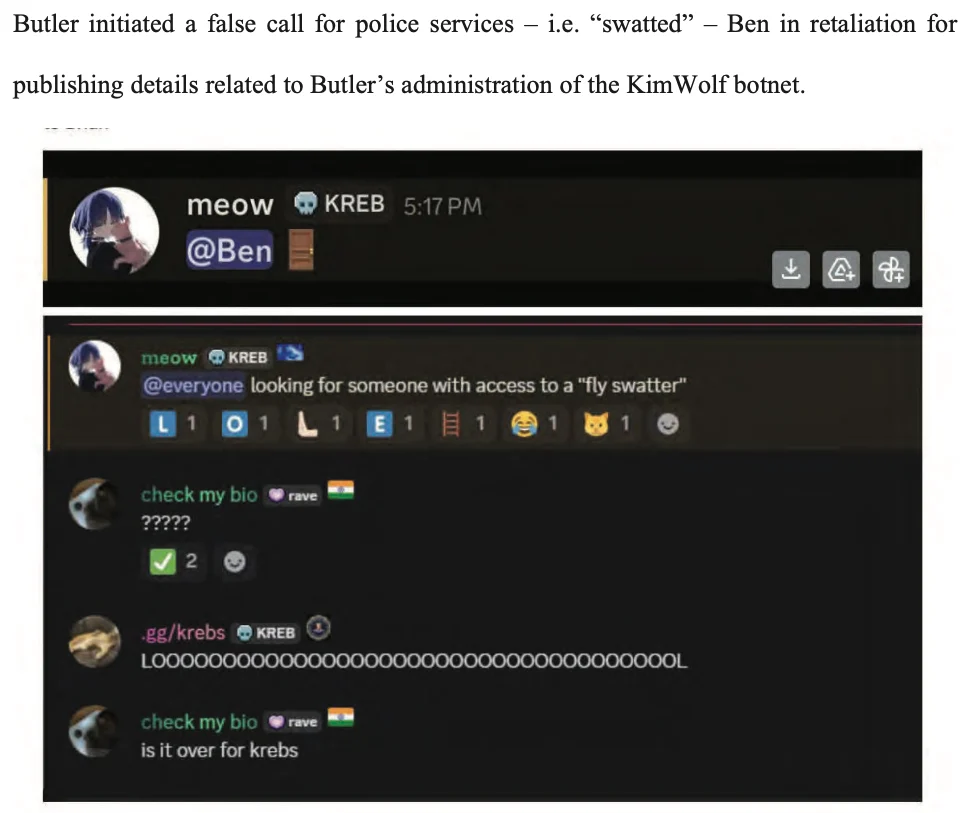
As security researchers, including Ben Brundage of the startup Synthient, began to reverse-engineer Kimwolf to patch the vulnerability it was exploiting, the botnet’s activity shifted. Kimwolf began specifically targeting security researchers with harassment, doxing, and physical intimidation via "swatting"—the dangerous practice of reporting a fake emergency to lure armed police to a victim’s home.
The Investigative Net Tightens (March 2026)
On March 19, a decisive blow was dealt to the infrastructure of the botnet. In a global coordinated action, law enforcement seized the technical command-and-control infrastructure for Kimwolf, along with the three competing botnets. Concurrently, the Ontario Provincial Police executed a search warrant at Butler’s Ottawa residence, seizing digital evidence that would confirm his role as the primary administrator.
The Arrest and Aftermath (May 2026)
Following the collection of digital evidence—including IP address logs, transaction records, and incriminating online communications—the U.S. Department of Justice unsealed its complaint. Butler was arrested by the OPP in Ottawa, setting the stage for his potential extradition to the United States.
Supporting Data: The Scale of the Destruction
The technical specifications of the Kimwolf operation illustrate the terrifying potential of modern IoT botnets. According to the U.S. Department of Justice, the botnet reached a peak volume of nearly 30 Terabits per second—a figure that represents a new world record for DDoS intensity.
To put this in perspective, such volume is capable of overwhelming the largest commercial and governmental data centers on the planet. The impact was not merely theoretical; the botnet was used to assault IP address ranges belonging to the U.S. Department of Defense, prompting the involvement of federal criminal investigators.
Further data from the DOJ indicates:
- Command Volume: The Kimwolf infrastructure issued over 25,000 distinct attack commands during its operation.
- Economic Impact: Many victims reported financial losses exceeding $1 million per incident, stemming from service downtime and the costs associated with incident response.
- Market Dynamics: Kimwolf was not just a weapon; it was a service. Butler allegedly rented the botnet’s power to other cybercriminals, creating a lucrative "DDoS-for-hire" business model that incentivized the constant expansion of the enslaved device pool.
Official Responses and Legal Implications
The arrest of Butler has been hailed as a significant victory for international cyber-law enforcement.
"The Kimwolf case demonstrates the critical importance of public-private partnerships," stated an official familiar with the investigation. "Without the cooperation of technology firms like Synthient, who identified the underlying vulnerabilities, the scale of this disruption would have been significantly higher."
Ben Brundage, whose security startup was a primary target of Butler’s harassment, expressed relief following the news of the arrest. "Hopefully, this will end the harassment," Brundage noted. "It is a clear message to those who think they can hide behind a keyboard while terrorizing researchers and organizations: your identity is not as protected as you believe."
Charges and Penalties
In Canada, Butler is currently charged with:
- Unauthorized use of a computer.
- Possession of a device to obtain unauthorized use of a computer system.
- Mischief in relation to computer data.
In the United States, if extradited, he faces one count of aiding and abetting computer intrusion. While the U.S. charge carries a potential sentence of up to 10 years, legal experts note that the final outcome will depend on the U.S. Sentencing Guidelines. Factors such as the defendant’s age, lack of a prior criminal record, and the level of cooperation provided to investigators will likely play a significant role in the court’s final determination.
Implications for Global Cybersecurity
The Kimwolf saga is a watershed moment for the "Internet of Things" security paradigm. It has exposed a fundamental weakness in the global digital ecosystem: the proliferation of cheap, unpatched, and easily enslaved smart devices.
The fact that a single 23-year-old in Ottawa could, through relatively rudimentary exploitation techniques, command the power to potentially cripple critical government infrastructure highlights the need for a "security-by-design" approach for all manufacturers of internet-connected hardware.
Furthermore, the coordinated seizure of dozens of DDoS-for-hire services in April, in conjunction with the Kimwolf investigation, marks a shift in law enforcement strategy. Rather than simply chasing individual "script kiddies," international agencies are now systematically targeting the "backend" infrastructure of the cybercrime economy. By dismantling the command-and-control servers and the payment mechanisms that support these botnets, authorities are attempting to make the cost of running such operations prohibitively high for future botmasters.
As Jacob Butler awaits his next court date on May 26, the global cybersecurity community remains on high alert. The fall of Kimwolf has created a power vacuum in the illicit DDoS market, and security researchers are already watching closely to see which threat actors will attempt to step into the void. For now, however, the "Dort" persona—and the chaos he unleashed—has been silenced.