The Great Calibration: Decoding the FY26 Financial Performance of India’s Startup Ecosystem
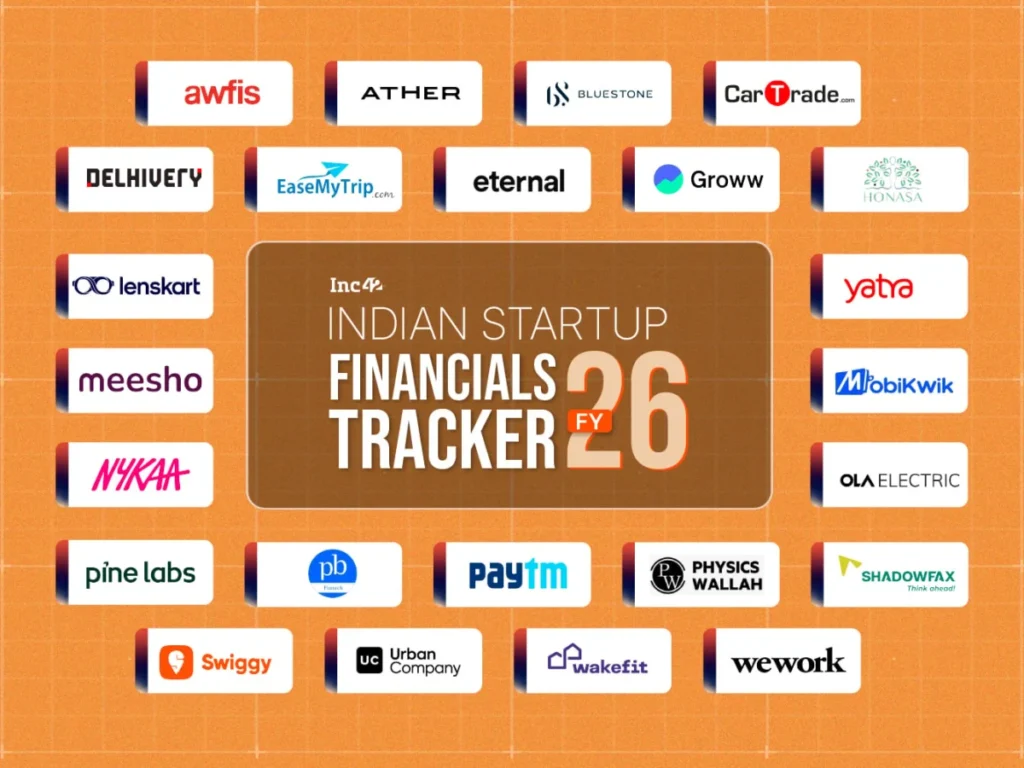
The Indian startup ecosystem reached a pivotal juncture in Fiscal Year 2026 (FY26). Moving past the hyper-growth-at-all-costs mandate that defined the post-pandemic era, the industry shifted gears toward a more disciplined, capital-efficient model. This transition, born out of necessity due to global geopolitical headwinds and the tightening of funding pipelines, has begun to yield tangible results.
In FY26, the Indian tech startup landscape demonstrated remarkable resilience and maturation. A total of 22 new-age tech companies made their public market debut, a significant jump from the 13 recorded in FY25. Perhaps more importantly, the narrative has shifted from "growth" to "sustainability." While challenges persist, the sector is increasingly defined by firms that are either profitable or demonstrably closer to the bottom-line threshold.
The State of Play: Key Financial Metrics
The aggregate data paints a picture of a robust, albeit uneven, recovery. Inc42’s comprehensive FY26 Financial Tracker reveals that out of 34 major startups tracked, 24—or approximately 70%—reported net profits. Collectively, these profitable entities generated a net profit of ₹8,347.3 Cr.
However, the divergence between the "profitable cohort" and the "loss-making cohort" remains sharp. The remaining 10 companies in the tracker posted a cumulative loss of ₹14,339.6 Cr, highlighting that for the heavy-hitters in quick commerce and rapid delivery, the path to black ink remains steep and expensive. Despite these losses, the scale of the ecosystem has ballooned: the 34 companies generated a combined operating revenue of ₹2.16 Lakh Cr in FY26, a staggering 53% increase from the ₹1.4 Lakh Cr reported in FY25.
Chronology of Market Maturity: From Growth to Stability
The fiscal year was characterized by three distinct phases.
- Q1-Q2 (The Cost Rationalization Phase): Following the turbulent Q4 of FY25, companies aggressively cut overheads, optimized marketing spends, and consolidated teams.
- Q3 (The Operational Efficiency Phase): This period saw the fruition of these cost-cutting measures, with many companies reporting improved EBITDA margins despite lower topline growth in specific segments.
- Q4 (The Strategic Expansion Phase): By the final quarter, market leaders began reinvesting in growth, albeit with a more cautious approach to cash burn, as evidenced by the performance of giants like Eternal (Zomato) and Nykaa.
Deep Dive: Sectoral Performance and Trends
The Logistics and Delivery Wars
The logistics sector saw a tale of two extremes. Delhivery, despite a 17.6% jump in operating revenue to ₹10,508 Cr, saw its profit dip slightly by 6% to ₹152.5 Cr. Conversely, Shadowfax showcased an extraordinary turnaround, with its net profit surging 1,758% YoY to ₹115.2 Cr.
However, the quick commerce segment remains a capital-intensive battleground. Swiggy reported a loss of ₹4,154 Cr, largely attributed to the aggressive expansion of its Instamart arm. Similarly, Zepto saw its revenue double to ₹22,623.6 Cr, yet its net loss widened by 25.6% to ₹5,905 Cr, underscoring the massive infrastructure and acquisition costs required to win the "10-minute delivery" game.
The Fintech Surge
Fintech companies emerged as the bedrock of profitability. Paytm marked a significant milestone by posting its first full year of profitability, reporting a net profit of ₹552 Cr against a loss of ₹663 Cr in the previous year. Groww also continued its dominance, with profits crossing the ₹2,000 Cr mark, growing 14% YoY. Zaggle and Pine Labs both posted healthy profit growth, indicating that B2B fintech and SaaS-led payment solutions are currently the most stable business models in the Indian tech sector.
Consumer Brands and Retail
The retail segment showed signs of mature scaling. Lenskart saw its profit jump 69% to ₹500.9 Cr, driven by strong operating leverage. Honasa (Mamaearth) recorded a profit of ₹200.2 Cr, a massive 175% increase YoY, proving that a multi-brand strategy (The Derma Co., Aqualogica, etc.) can effectively hedge against market volatility. BlueStone achieved its first-ever profitable year, a testament to the success of its omnichannel jewellery strategy.
Financial Disclosures: A Comparative Overview
| Company | Revenue FY26 (₹ Cr) | Profit/Loss FY26 (₹ Cr) | YoY Change (Rev) |
|---|---|---|---|
| Eternal (Zomato) | 54,364 | 366 | +168.6% |
| Meesho | 12,626.3 | -1,357.7 | +34.5% |
| Delhivery | 10,508.3 | 152.5 | +17.7% |
| Nykaa | 10,022.3 | 203.9 | +26.1% |
| Lenskart | 8,814 | 500.9 | +32.5% |
(Note: The above is a subset of the data; full disclosures are available in the official FY26 Tracker.)
Official Responses and Strategic Pivot
Industry leaders have been vocal about the necessity of this financial recalibration. Many companies, including Ather Energy and FirstCry, have cited supply chain bottlenecks and inflationary pressures as reasons for the moderate pace of their profit growth.
Ather Energy, which trimmed its losses by 36% to ₹517.2 Cr, specifically pointed to the impact of the global supply chain crisis regarding rare earth magnets. Meanwhile, Urban Company has adopted a more transparent stance regarding its temporary move into the red. Management stated that the loss of ₹234.8 Cr was a deliberate investment in their new "Insta Help" service, which is projected to become a key revenue driver in FY27.
Implications: What This Means for the Ecosystem
The FY26 data offers three critical takeaways for investors and stakeholders:
- The End of the "Growth at All Costs" Era: The market is now penalizing companies that cannot show a clear path to profitability. The divergence between companies that have mastered unit economics and those that have not is becoming the primary metric for valuation.
- The Rise of Operational Efficiency: Companies like CarTrade and Fractal have proven that revenue growth does not always require proportional growth in expenses. By keeping expense growth in the single digits or low double digits, these firms have managed to significantly expand their bottom lines.
- The Resilience of Consumer Internet: Despite geopolitical uncertainty, consumer spending remains high. The consistent performance of companies like Info Edge and PB Fintech proves that essential services—insurance, recruitment, and real estate tech—remain insulated from the broader market volatility.
Conclusion: Looking Ahead to FY27
As we move into FY27, the focus for the Indian startup ecosystem will likely shift from "survival and rationalization" to "sustainable scaling." The companies that have successfully cleaned up their balance sheets in FY26 are now better positioned to deploy capital into R&D, AI, and international expansion.
However, the "quick commerce" paradox remains the most significant risk to the ecosystem’s overall profitability metrics. Whether firms like Swiggy and Zepto can achieve the same operational efficiency as the fintech or SaaS players will define the next chapter of India’s digital economy. For now, the verdict is clear: Indian startups are no longer just dreamers; they are becoming disciplined, profit-focused enterprises.
Editor’s Note: This list is not a ranking. Companies are placed alphabetically for reference. This is a running tracker and will be updated periodically as more companies release their audited financial statements for the fiscal year.