Engineering the Future: 5 Essential Python Concepts for Production-Grade AI Systems
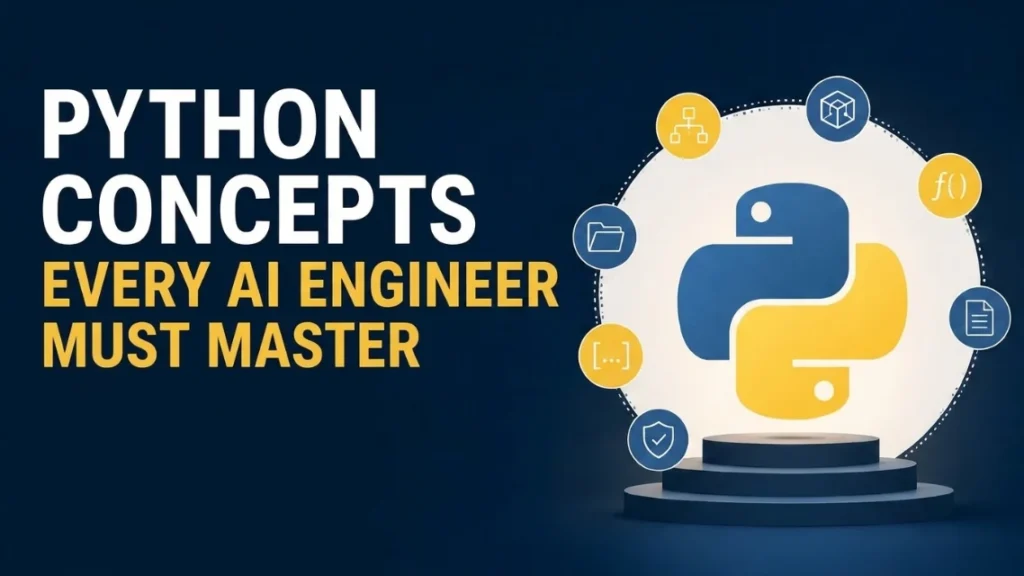
The transition from a Jupyter notebook experiment to a production-grade AI system is often where the most ambitious projects stall. While Python’s ease of use makes it the lingua franca of machine learning, the same features that facilitate rapid prototyping—dynamic typing, memory-heavy data handling, and synchronous execution—can become significant liabilities when scaling to real-world environments.
For the modern AI engineer, success is no longer defined solely by model accuracy. It is defined by latency, memory efficiency, resource management, and the robustness of the software architecture surrounding the model. To build systems that can withstand the rigors of high-traffic production environments, engineers must move beyond basic scripting and master five critical Python concepts that form the bedrock of professional AI engineering.
1. Generators and Lazy Evaluation: Managing Large-Scale Data
One of the most common pitfalls for developers moving into AI is the "Memory Wall." Standard Python lists are eager; they load every element into RAM simultaneously. When working with datasets consisting of millions of high-resolution images or massive text corpora for Large Language Models (LLMs), an eager approach will inevitably trigger OutOfMemory (OOM) errors.
The Mechanism of Efficiency
Generators represent a paradigm shift through "lazy evaluation." By utilizing the yield keyword, a generator creates an iterator that computes and returns elements one at a time, only when requested. This keeps memory consumption flat regardless of the total dataset size.
Implications for Production
In production pipelines, memory-efficient data streaming is not just an optimization; it is a necessity. Whether you are batch-processing feature vectors or streaming logs from a vector database, generators ensure that your application’s memory footprint remains predictable. By streaming data batch-by-batch, you decouple your processing logic from the physical constraints of your hardware, allowing for more stable training and inference runs.
2. Context Managers: The Guardrails for Hardware Resources
AI applications are inherently state-bound. They interact with GPUs, manage memory caches, and maintain persistent connections to vector stores. A failure to properly clean up these resources—due to an uncaught exception or a forgotten shutdown command—can lead to resource leaks that degrade system performance over time.
Automating Teardown Logic
Context managers, invoked via the with statement, provide an elegant solution to resource management. They guarantee that setup and teardown logic execute regardless of whether the primary operation succeeds or crashes. By defining __enter__ and __exit__ methods, engineers can create robust wrappers that handle complex state transitions—such as moving a PyTorch model into evaluation mode and subsequently clearing the CUDA cache—automatically.
Strategic Impact
The use of context managers is a hallmark of professional software engineering. In an AI context, they serve as the safety net for your infrastructure. When a pipeline fails, a context manager ensures that the system returns to a clean state, preventing "zombie" processes from hogging expensive GPU memory and ensuring that telemetry data is captured accurately, even in the event of a runtime error.
3. Asynchronous Programming: Eliminating I/O Bottlenecks
In the era of agentic workflows and LLM-powered applications, the primary bottleneck is rarely the model’s compute power; it is the network I/O. When an agent needs to call multiple external APIs or query remote databases, sequential processing forces the application to sit idle, waiting for responses.
The Power of Concurrency
Asynchronous programming with asyncio allows Python to manage multiple concurrent tasks without waiting for each one to finish. By using await, an engineer can dispatch a set of network requests simultaneously. The event loop then handles the I/O, allowing the program to process results as they arrive.
Scaling Multi-Agent Systems
For applications like autonomous agents or RAG (Retrieval-Augmented Generation) pipelines, the difference between sequential and asynchronous execution is often an order of magnitude in speed. By mastering asyncio, developers can transform sluggish, linear scripts into high-concurrency systems that remain responsive under heavy load, effectively scaling the agent’s capabilities to handle complex, multi-step tasks in parallel.
4. Pydantic and Data Validation: Ensuring Structural Integrity
Machine learning models are notoriously sensitive to input formats. A single malformed hyperparameter or an unexpected data type in a JSON payload can lead to silent failures, where the system continues to run while producing garbage outputs.
From Dictionaries to Schema-Driven Design
While native Python dictionaries are flexible, they lack the rigor required for production environments. Pydantic introduces a layer of strict validation, enforcing type constraints and range limits at runtime. Beyond simple validation, Pydantic automates the generation of JSON schemas, which is a critical requirement for modern LLM tool-calling and function-calling APIs.
Implications for Reliability
Implementing Pydantic models ensures that configuration errors are caught at the point of ingestion rather than deep within the training loop. This "fail-fast" approach is essential for maintaining high-quality production pipelines. By formalizing the interface between your code and your models, you create a self-documenting, type-safe environment that is significantly easier to debug and maintain.
5. Magic Methods: Integrating with the Python Ecosystem
Professional AI tools, such as PyTorch or TensorFlow, rely on specific protocols to interact with user-defined code. If you are building a custom data loader or a unique inference engine, you want it to behave like a native Python object. This is where "magic methods" (dunder methods) become indispensable.
Building Intuitive Abstractions
By implementing methods like __len__, __getitem__, and __call__, you enable your custom classes to integrate seamlessly with the broader Python ecosystem. For example, overriding __call__ allows an instance of your model class to be executed like a function, which is the standard protocol for deep learning frameworks to handle hooks and gradient tracking.
Maintaining Ecosystem Compatibility
Directly calling a .forward() method in PyTorch, for instance, bypasses the framework’s hooks, which can lead to catastrophic errors in gradient computation. By leveraging magic methods to conform to these established protocols, engineers ensure their code is compatible with the optimization and deployment tools used across the industry. This is not just about syntactic sugar; it is about writing code that aligns with the internal logic of the libraries you rely on.
Conclusion: The Path to Production
The shift from experimental scripting to production-grade engineering is characterized by a transition from "getting it to work" to "ensuring it stays working." By mastering these five concepts—Generators for memory efficiency, Context Managers for resource safety, Asynchronous programming for speed, Pydantic for structural integrity, and Magic methods for ecosystem compatibility—AI engineers can build systems that are as robust as they are intelligent.
As AI models continue to grow in complexity, the engineering surrounding them must evolve in parallel. The ability to handle vast datasets, manage volatile hardware, and ensure the reliability of every API call is what separates a successful AI product from a failing prototype. Ultimately, the true value of an AI engineer lies in their ability to bridge the gap between cutting-edge research and the rigorous demands of production infrastructure. By embracing these software engineering fundamentals, you move closer to building the next generation of scalable, reliable, and high-performance AI systems.