Financial Crisis and Corruption Allegations: The Political Storm Brewing in Bihar
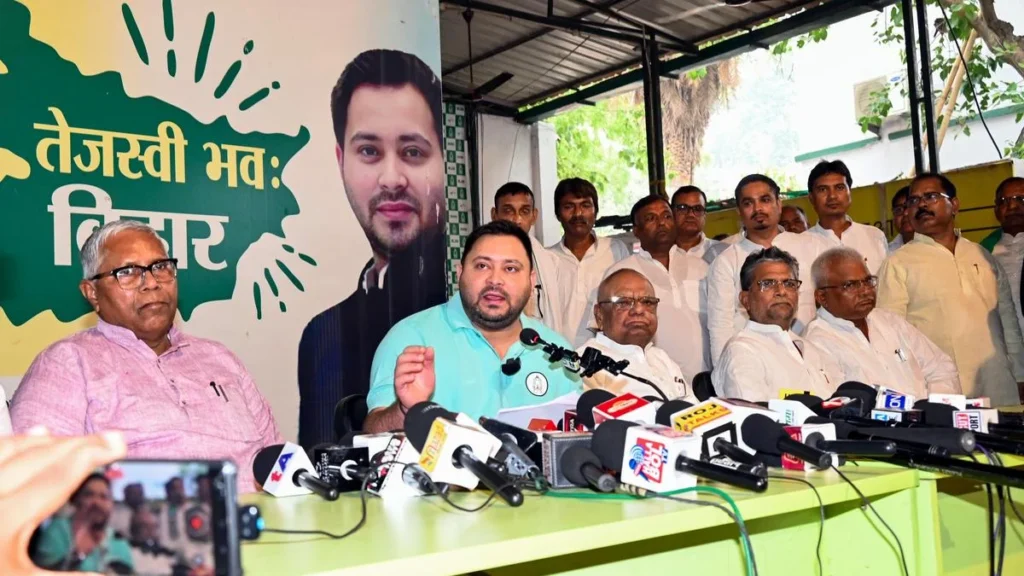
PATNA: The political landscape of Bihar is witnessing a fresh eruption of hostility between the ruling National Democratic Alliance (NDA) and the Rashtriya Janata Dal (RJD). On Sunday, June 28, 2026, Leader of the Opposition Tejashwi Yadav launched a scathing attack on the administration led by Chief Minister Samrat Choudhary, painting a bleak picture of the state’s fiscal health while simultaneously accusing the government of shielding high-level officials involved in a brazen tender scam.
As the RJD intensifies its pressure on the government, the discourse has shifted from governance to allegations of systemic bankruptcy and institutional corruption, leaving the state administration scrambling to defend its track record.
The Core Accusations: A State on the Brink?
In a press conference held in Patna, the former Deputy Chief Minister did not mince words. He characterized the current state of Bihar’s exchequer as being “on the verge of bankruptcy.” According to Mr. Yadav, the fiscal mismanagement under the current NDA regime has reached a tipping point, where the government is struggling to meet its most fundamental obligations.
“The state treasury is effectively empty,” Mr. Yadav stated. “We are seeing a scenario where the government cannot pay employee salaries on time, student scholarships have been halted, pensions remain unpaid, and farmers are being denied their rightful dues. It is a total collapse of fiscal discipline.”
Mr. Yadav pointed specifically to the government’s recent decision to withdraw ₹3,660 crore from the state’s Contingency Fund as evidence of a liquidity crisis. He claimed that the Bihar government has been forced to repeatedly approach the Union government for financial bailouts, only to be rebuffed. “They keep begging and pleading before the Centre, even as the Centre has expressed its inability to help,” he added, suggesting that Bihar’s economic autonomy is being compromised by a lack of financial planning.
Chronology of the ‘Tender Scam’
While the fiscal claims have captured headlines, the legal and ethical scandal surrounding a major tender scam has provided the RJD with significant political ammunition. The controversy centers on the alleged manipulation of government contracts in exchange for kickbacks.
Timeline of Events:
- Late May 2026: Investigative agencies and the Bihar General Administration Department begin looking into irregularities within the tender allocation process for specific departmental projects.
- May 30, 2026: The Bihar General Administration Department formally suspends two senior IAS officers, Yogesh Sagar and Abhilasha Kumari Sharma. Simultaneously, a departmental inquiry is launched into their conduct.
- June 2026: Evidence surfaces suggesting that the officers accepted bribes to ensure that contracts were awarded to a specific contractor, identified as Rishu Ranjan Sinha (alias Rishu Shree).
- Mid-June 2026: All three individuals—the two IAS officers and the contractor, Rishu Shree—are arrested by state authorities as the investigation gains momentum.
- Late June 2026: The police file a chargesheet in the matter. However, the move triggers immediate backlash from the opposition, who claim the document is incomplete and designed to protect political masters.
Deep Dive: The Anatomy of the Tender Scam
The "Tender Scam" is not merely about administrative corruption; it is increasingly being framed as a case of political cronyism. Tejashwi Yadav alleges that digital evidence recovered during the investigation—specifically chat transcripts—proves that Rishu Shree was not acting alone.
“Chats revealed during the investigation show that Rishu Shree enjoyed the protection of those in power,” the LoP claimed. “The police have filed a chargesheet, but it is a classic case of saving the ‘big fish.’ The individuals named in the chargesheet are merely pawns. The real architects of this scam, who have the political clout to influence departmental tender processes, remain untouched and outside the ambit of the law.”
The RJD leadership is demanding a higher-level probe, potentially by central agencies, arguing that the state police cannot be expected to investigate a case where the ruling party’s leadership may have a vested interest.
The BJP’s Counter-Offensive
The Bharatiya Janata Party (BJP), the primary driver of the current NDA government in Bihar, has responded with equal fervor, dismissing Mr. Yadav’s allegations as a diversionary tactic.
Bihar BJP spokesperson Niraj Kumar hit back at the former Deputy CM, attempting to turn the narrative on its head. “All these scams involving Rishu Shree date back to the time when Tejashwi was the Minister of the department concerned,” Mr. Kumar asserted. He argued that the corruption network was established under the RJD’s watch and that the current administration is merely cleaning up the mess left behind by the previous government.

“The RJD is desperate to create a narrative of instability because they know their own skeletons are being unearthed,” Mr. Kumar added. “We are committed to a zero-tolerance policy against corruption. If we weren’t, would we have suspended and arrested two IAS officers? That is proof of our commitment to accountability.”
Official Stance: Choudhary’s ‘Zero-Tolerance’ Policy
Chief Minister Samrat Choudhary has maintained a firm stance throughout the week. Addressing the concerns regarding law and order and corruption, he asserted that his government is moving aggressively to purge the system.
“Our approach is one of zero tolerance,” Mr. Choudhary stated on Sunday. Regarding the broader issue of crime and governance, he claimed that the government’s efforts have been successful enough that many of the state’s “notorious elements” have fled across the border into Nepal to escape the reach of Bihar’s law enforcement agencies.
However, critics point out that while arrests have been made, the public perception of the government remains fragile. The juxtaposition of the Chief Minister’s claims of “zero-tolerance” against the opposition’s claims of “systemic bankruptcy” presents a polarized political environment for the citizens of Bihar.
The Implications: A State at a Crossroads
The ongoing conflict holds significant implications for the future of governance in Bihar.
1. Fiscal Stability and Public Trust
If the state is indeed forced to rely on the Contingency Fund to pay salaries and pensions, the fiscal health of the state is in a precarious position. Failure to manage this could lead to widespread protests from state employees and a general decline in the quality of public services.
2. The Credibility of the Bureaucracy
The arrest of two IAS officers sends a chilling message through the state’s administrative machinery. While it signals accountability, it also risks paralyzing decision-making processes, as bureaucrats may become increasingly hesitant to sign off on tenders or contracts for fear of future investigation.
3. The Political Battleground
With the next election cycle looming, the narrative of "corruption vs. clean governance" will define the political discourse. For Tejashwi Yadav, the goal is to paint the NDA as a government that is both incompetent in fiscal management and complicit in corruption. For the NDA, the goal is to portray the RJD as a relic of a corrupt past that is now trying to obstruct the current administration’s reformist agenda.
4. Need for Transparency
The demand for a more transparent investigation into the tender scam is growing. Independent observers suggest that unless the government allows for a truly impartial audit of the tender processes—or perhaps subjects the case to an investigation by an agency outside the control of the state’s executive branch—the allegations will continue to erode public trust.
Conclusion
As of June 2026, the situation remains fluid. The RJD has promised to take its protest to the streets if the government does not address the fiscal crisis and initiate a deeper probe into the tender scam. Meanwhile, the NDA government continues to rely on its "zero-tolerance" rhetoric to deflect the criticism.
For the people of Bihar, the current standoff is a reminder of the deep-seated structural challenges the state faces. Whether these allegations represent the final breakdown of institutional integrity or merely the heat of partisan politics, one thing is certain: the political temperature in Patna is rising, and the government’s next few moves will be critical in determining whether it can maintain its mandate and restore fiscal confidence.