Market Volatility and Strategic Shifts: A Deep Dive into New-Age Tech Stocks
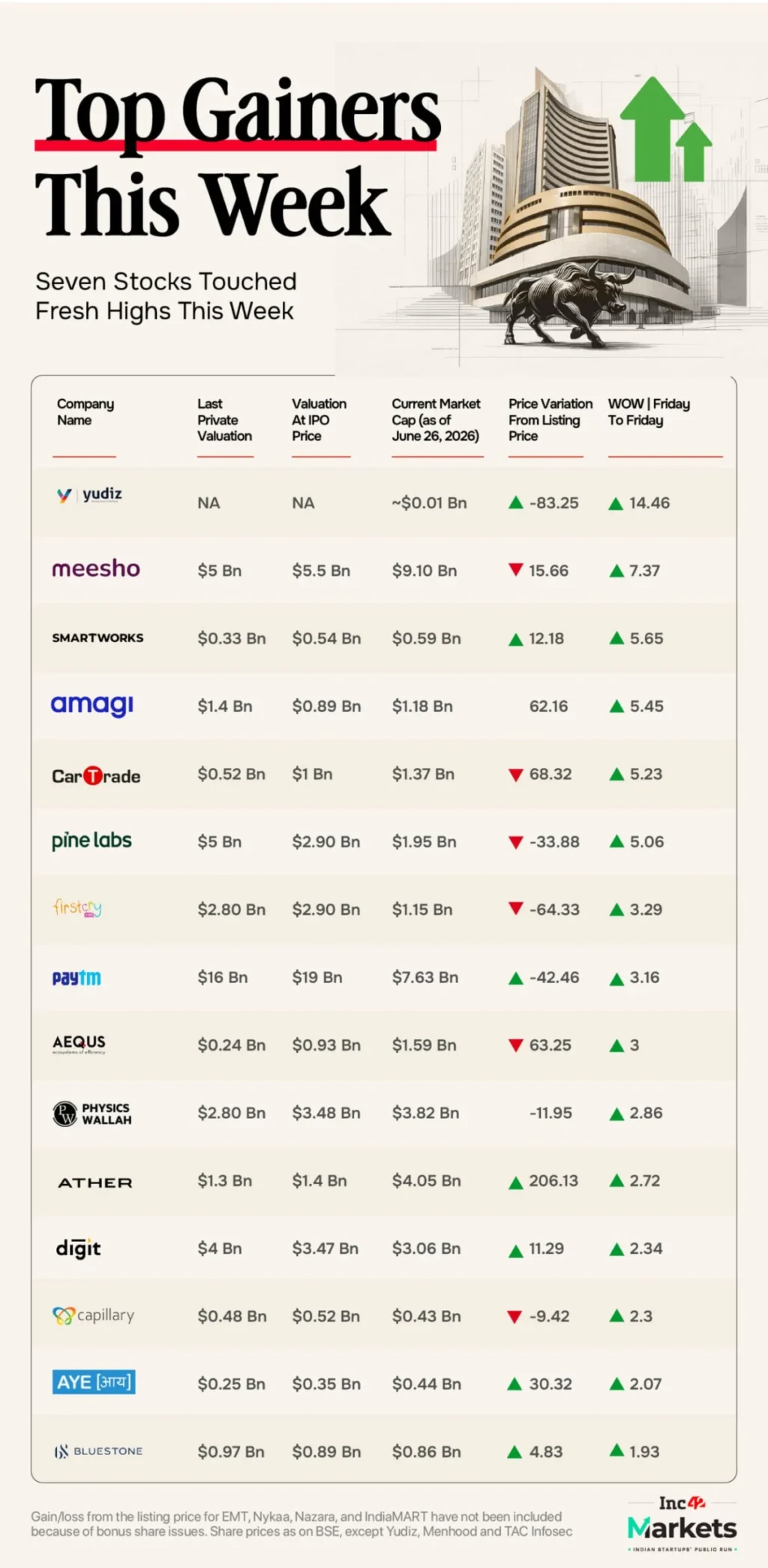
The landscape for India’s new-age technology sector remained in a state of flux this past week, characterized by a distinct "mixed-bag" performance. As global macroeconomic signals fluctuated and domestic market sentiment reacted to easing geopolitical tensions, the 57 tracked new-age tech companies saw a moderate uptick in their collective valuation. However, underneath the surface of this aggregate growth lay a period of intense volatility, defined by aggressive profit booking and strategic leadership realignments.
The State of the Market: Aggregate Growth Amidst Individual Volatility
At the close of the week, the cumulative market capitalization of the 57 tracked new-age tech entities stood at $135.92 Bn, up from $134.52 Bn in the previous week. While this $1.4 Bn gain suggests a bullish undertone, the micro-level data reveals a different narrative. Of the 57 companies, 23 managed to post gains ranging from a marginal 0.01% to a robust 15%, while 34 companies faced downward pressure, with losses ranging from 0.15% to 11.75%.
Notably, the week was marked by a lack of "new lows," suggesting that while profit-taking is prevalent, long-term investor conviction in these firms remains intact. Conversely, the "new highs" list was populated by several prominent names, including Amagi, Aequs, Nykaa, Kissht, Shadowfax, and SEDEMAC. These companies, having hit fresh peaks, faced subsequent cooling-off periods, underscoring a market prone to rapid profit realization in a holiday-shortened trading window.
Chronology of Market Dynamics
Early Week Optimism and SME Resilience
The week began with a notable surge in interest surrounding smaller, agile players. NSE SME-listed Yudiz led the charge, jumping 14.46% to close at ₹28.10, signaling a potential revival in sentiment for smaller tech stocks that had faced an extended period of bearish pressure. Meesho and Smartworks followed closely, recording gains of 7.37% and 5.65%, respectively.
Mid-Week Profit Booking
As the week progressed, the sentiment shifted toward consolidation. Investors, looking to lock in gains after the early-week rally, began exiting positions in companies that had touched record highs. This trend was particularly visible in stocks like Nykaa, Kissht, Shadowfax, and SEDEMAC, which ended the week in the red despite their earlier performance milestones. The list of laggards was topped by ideaForge, which saw its share price decline by 11.75% to ₹822.35, reflecting concerns over valuation sustainability in the drone manufacturing segment.
Broader Market Context: The West Asia Influence
The performance of the new-age tech sector was inextricably linked to the broader Indian equity market, which ended the week on a positive note. Benchmark indices, despite intraday volatility, showed resilience. The Sensex climbed 0.39% to 77,100.47, while the Nifty 50 posted a modest gain of 0.18%, closing at 24,056.

The primary catalyst for this stability was the cooling of crude oil prices. As tensions in West Asia showed signs of de-escalation and shipping lanes through the Strait of Hormuz returned to normal, the risk premium on oil dropped significantly. This provided a crucial tailwind for domestic equities, easing fears surrounding imported inflation and the nation’s current account deficit.
Sectoral Analysis: The Smartworks Expansion
A standout performer this week was the coworking giant Smartworks, which gained 5.65% to close at ₹489.2. The company’s stock movement was driven by its aggressive international expansion strategy.
Strategic Acquisition in Singapore
Smartworks’ board approved the acquisition of Singapore-based flex-workspace startup WorkStudio. This move, executed through a wholly-owned subsidiary, represents a significant footprint expansion. While financial details remain confidential, the deal will grow Smartworks’ Singapore portfolio to four centers, covering approximately 76,000 sq ft. This is a bold continuation of its recent regional momentum, following the launch of its third managed office in Singapore’s Central Business District just two weeks prior.
Domestic Dominance
Beyond international borders, Smartworks continues to entrench itself in the Indian market. Recent successes include a five-year contract to lease 400 seats to a Japanese NBFC subsidiary in Mumbai, projected to generate ₹35 Cr in revenue, and a significant expansion in Bengaluru with a 4.92 Lakh sq ft campus. With a current footprint of 16.1 Mn sq ft across 66 centers serving over 770 enterprise clients, Smartworks is positioning itself as a leader in the enterprise-grade flexible office space market.
The Quick Commerce Conundrum: The Case of Swiggy
While Smartworks enjoyed the fruits of expansion, Swiggy faced a challenging week, with its shares plunging 5.31% to ₹240.70. This decline reflects the mounting pressure on the quick commerce sector as legacy e-commerce giants intensify their battle for market share.
The Intensifying Competitive Landscape
The narrative for Swiggy was marred by announcements from industry behemoths. Flipkart signaled a massive expansion for "Flipkart Minutes," aiming for 1,500 centers across 180 cities, reporting a five-fold growth in volume. Simultaneously, Amazon announced it is earmarking ₹2,800 Cr to expand its Amazon Now fulfillment network to 300 cities. These moves have spooked investors, who fear that incumbents like Swiggy’s Instamart, Zomato’s Blinkit, and Zepto will face severe margin erosion as they fight to retain customers against heavily funded players.

Leadership Exits and Structural Hurdles
Adding to the competitive pressure were the high-profile departures of Swiggy Instamart’s COO Ankit Jain and CBO Hari Kumar. These exits occur at a delicate juncture for the firm, which is attempting to pivot toward an Indian-owned and controlled company (IOCC) status.
This transition is not merely administrative; it is a strategic requirement for moving Instamart toward an inventory-led model, which would allow the company to procure goods directly rather than relying on a pure marketplace model. With shareholders having rejected a previous special resolution to enable this shift, Swiggy remains in a complex dialogue with its investors. The outcome of these negotiations will be critical in determining whether Swiggy can effectively compete with the inventory-heavy models of its rivals.
Macroeconomic Outlook and Investor Sentiment
Looking ahead, the market remains cautious. While the easing of oil prices provided a much-needed reprieve, softer domestic macroeconomic data—including moderating PMI readings and slower core sector growth—suggests that the economy may have lost some momentum in June.
Key Factors to Monitor:
- Trade Negotiations: Progress regarding the potential India-US trade agreement will be a key determinant of foreign investor interest.
- FII Flows: Investors are looking for a resumption of selective buying by Foreign Institutional Investors (FIIs) to provide long-term support to the index levels above 24,000.
- Global Indicators: With the US economic climate remaining a primary driver of global risk sentiment, domestic markets will continue to track interest rate expectations from the Federal Reserve.
Conclusion
The week was a microcosm of the current state of India’s new-age tech sector: resilient but undergoing a period of rigorous transition. The divergence between companies like Smartworks, which are successfully scaling via strategic acquisitions, and those like Swiggy, which are grappling with competitive intensity and internal structural pivots, highlights the selective nature of the current market.
As we move into the next week, the ability of Nifty 50 to sustain its position above the 24,000 mark will serve as a barometer for the broader market’s health. For tech investors, the focus remains on companies with robust, defensible models that can navigate both the headwinds of intense retail competition and the shifting tides of the global macroeconomic environment. The "mixed-bag" performance of the last seven days is a reminder that in the high-stakes world of new-age tech, growth must be balanced with operational agility and strategic foresight to survive the volatility of the public markets.