Mastering the Infinite: 5 Strategic Approaches to Context Window Management in Autonomous AI Agents
In the rapidly evolving landscape of artificial intelligence, we are witnessing a fundamental shift in how large language models (LLMs) are deployed. We have moved beyond the era of simple "prompt-response" engines—where a user asks a question and receives a static answer—into the age of autonomous, long-running agents. These systems are designed to operate over extended periods, executing multi-step tasks, maintaining complex state, and interacting with diverse digital environments.
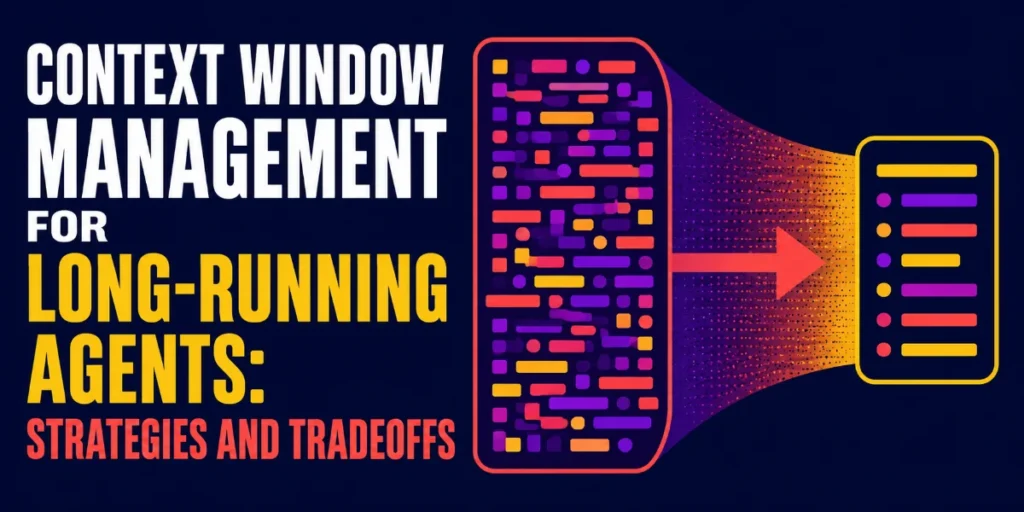
However, as these agents operate, they face a critical architectural bottleneck: the context window. As information snowballs during an agent’s lifecycle, the memory limits of the underlying LLM become a primary constraint. Without sophisticated management, an agent’s performance inevitably degrades as it hits the "context wall." This article explores the engineering methodologies required to maintain agentic longevity and the inherent tradeoffs that accompany each design choice.
1. The Core Challenge: Why Context Windows Break Agents
To understand the necessity of context management, one must first recognize the nature of the "context window." In current LLM architecture, the context window is the finite amount of text (tokens) a model can "see" at any single moment. For a long-running agent, every interaction, tool execution, and intermediate thought is a token. If the agent is not pruned or managed, it will eventually exceed its capacity, leading to truncated instructions, forgotten goals, or system crashes.
The transition from a stateless model to a stateful agent requires treating memory as a finite resource. Developers must now act as "digital architects," deciding not just what the agent does, but what it retains, what it compresses, and what it relegates to long-term storage.
2. Sliding Windows: The "Short-Term Memory" Approach
The most straightforward, albeit primitive, method for managing agentic memory is the Sliding Window. This strategy functions much like a human’s short-term auditory memory: it focuses exclusively on the most recent events while allowing older information to naturally fade away.
Operational Mechanics
In a sliding window architecture, the system enforces a strict "token budget." As new messages arrive, the oldest messages are dropped from the prompt sent to the LLM. Typically, developers implement a "locked" system prompt—a persistent set of core instructions—at the very top of the context to ensure the agent does not lose its persona or fundamental objective while the conversation history rotates beneath it.
Tradeoffs and Implications
- Advantages: This approach is computationally inexpensive, requires minimal latency, and is incredibly easy to implement at the application layer.
- Disadvantages: It suffers from "digital amnesia." If an agent encounters a problem it resolved two hours ago, it will have no recollection of that success. This can lead to circular reasoning, where an agent repeatedly attempts the same failed strategy, stuck in a loop of forgotten context.
3. Recursive Summarization: The "Lossy Compression" Strategy
For developers who need to maintain a "long-term narrative" without burning through the context budget, Recursive Summarization offers a compelling alternative. This methodology treats the history of an agent’s operation like a compressed file.
Chronology of Operation
As the conversation or execution trace reaches a certain threshold, the system triggers a background task—often using a smaller, cheaper model—to condense the existing history into a succinct summary. This summary is then injected into the context window, replacing the raw, verbose logs.
Supporting Data and Tradeoffs
- The "Blurry" Effect: Much like a JPEG image, each compression step results in a loss of granular detail. While the agent retains the "mission and plot," specific identifiers, precise numeric data, or nuance in user requests can become obfuscated over time.
- Efficiency: It is superior to sliding windows for long-running processes, as it preserves the intent of previous sessions, though it introduces minor latency due to the periodic summarization calls.
4. Structured State Management: The "Scratchpad" Paradigm
As agents move toward more complex workflows, the reliance on natural language transcripts becomes inefficient. Structured State Management moves away from raw conversation history entirely, favoring a "scratchpad" approach.
Implementation Strategy
In this model, the agent maintains a formal JSON object—a "world state"—that tracks key variables, completed goals, identified errors, and pending tasks. At every step of the execution:
- The previous conversation is discarded.
- The agent is provided with the core system prompt, the current JSON state, and the latest user input.
- The agent returns its chosen action and an updated version of the JSON state.
Implications for Engineering
This is the most token-efficient method available. However, it requires a rigid, well-defined schema. If the developer fails to account for a specific type of information in the JSON structure, that information effectively does not exist for the agent. It is a powerful, yet brittle, strategy that demands high-quality prompt engineering.
5. Ephemeral Context via Retrieval-Augmented Generation (RAG)
When an agent needs access to a vast "library" of past experiences without overwhelming its active memory, RAG-based systems provide the solution. By offloading history to a vector database, the agent can perform a "semantic search" to pull only the most relevant pieces of past context into its current prompt.
The Mechanism of Retrieval
Instead of keeping the entire history in the context window, the system embeds past events into a vector space. When the agent faces a new query, the system performs a search based on relevance. This allows for "infinite" memory, as the context window is only occupied by the currently relevant information.
The "Retrieval Blind Spot"
The primary risk here is the "blind spot." A vector search might retrieve information that is semantically similar to the current query, but it may fail to retrieve "connective tissue"—the obscure, seemingly unrelated pieces of data that, when combined, would lead to a creative solution. This reliance on the retriever’s policy is a significant point of failure for complex problem-solving.
6. Dynamic Context Routing: The Hybrid Model
The most sophisticated approach, Dynamic Context Routing, recognizes that not all tasks require the same level of cognitive power. This strategy employs a tiered model architecture.
The Two-Tier System
- The Executor: A fast, cheap model manages the day-to-day, high-frequency tasks within a small context window.
- The Architect: A powerful, high-context model acts as a "supervisor." When the Executor hits a wall (e.g., three failed attempts or an ambiguity flag), the full history is escalated to the Architect. The Architect analyzes the big picture and resets the Executor with a refreshed, optimized instruction set.
Implications
This strategy is the gold standard for cost-effectiveness and performance, but it is notoriously difficult to maintain. Developing the logic that governs the "hand-off" between models requires rigorous testing and fine-tuning to prevent the system from becoming overly complex or "chatty."
Conclusion: Designing for Intentional Forgetting
Managing context in long-running AI agents is not about achieving the illusion of infinite memory. It is about architectural discipline. Whether through the surgical precision of structured state management or the broad reach of RAG, the goal is to provide the agent with exactly what it needs, exactly when it needs it.
As we look toward the future of autonomous systems, the most successful agents will be those that prioritize "intentional forgetting"—the ability to prune irrelevant data while retaining the core logic and state necessary to complete the mission. Developers who master these five strategies will find themselves at the forefront of a new generation of AI, one where agents are not just prompt-responders, but persistent, capable collaborators in the digital workspace.