The Scalability Crisis in AI Agents: Mastering Tool Selection for Production Reliability
In the rapidly evolving landscape of Large Language Model (LLM) applications, the transition from a "demo-ready" prototype to a production-grade AI agent is where most projects stumble. When an agent is first developed, it might be equipped with five core tools. It performs flawlessly, executing commands with precision. However, as the business requirements evolve—adding file operations, CRM integration, messaging platforms like Slack, and various specialized APIs—the agent’s tool catalog grows.
When the agent reaches 40 or 50 tools, a common phenomenon occurs: the agent begins to call the wrong tool, hallucinates parameter schemas from irrelevant tools, or stalls indefinitely. The underlying model has not changed; the complexity of the input has. This is not an edge case; it is the default trajectory of every scaling agent. Research indicates that agent accuracy degrades measurably once tool counts exceed 15. To bridge the gap between prototype and production, engineers must move away from "flat" tool lists and adopt architectural strategies that prioritize what the model sees before it acts.
The Anatomy of Failure: Why Scaling Breaks Agents
The core issue lies in the "lost in the middle" effect. Every tool definition—including its name, description, and complex JSON schema—is injected into the model’s context window on every request. When a catalog grows beyond a certain point, these definitions can consume 5% to 7% of the available context before the user’s actual query is even processed.
Because LLMs are statistically less reliable at processing information buried in the middle of a long prompt compared to the beginning or end, the correct tool often falls into a "dead zone." This is compounded by the "noise" created by dozens of similar-sounding tool definitions. The model becomes prone to tool hallucination, where it may invent non-existent functions or attempt to pass arguments from a file_read tool into a send_slack_message function.
While platforms like OpenAI suggest a ceiling of 128 tools per agent, the practical failure point is significantly lower. Achieving reliability at scale requires a shift from a "send-everything" approach to a "context-filtered" architecture.
Six Pillars of Scalable Tool Orchestration
To maintain performance, developers must implement a tiered architecture that limits the model’s exposure to the total tool catalog.
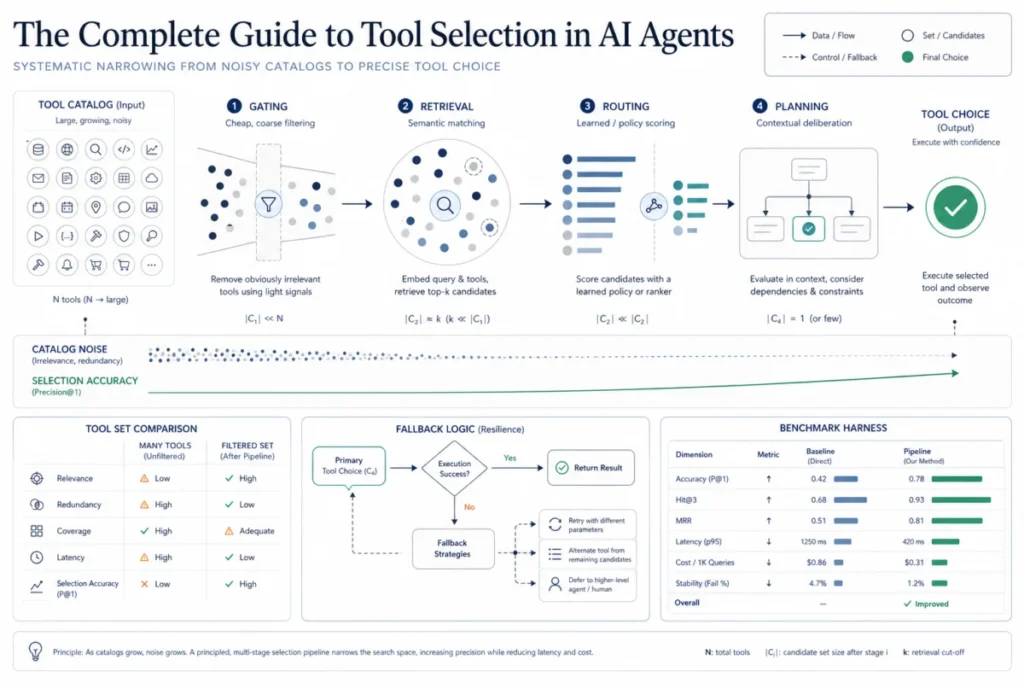
1. Gating: The Cheap Pre-Filter
Before an agent performs the expensive task of tool selection, it should first perform a "gating" check. A significant portion of user interaction consists of conversational filler: "Thanks," "What do you mean by that," or "Good morning." Running a high-end reasoning model to determine if a tool is needed for these interactions is a waste of latency and capital.
Implementing a lightweight classifier—using regex or a small, fast model—allows the agent to short-circuit the pipeline. If the input is deemed purely conversational, the agent bypasses the tool-selection logic entirely. For teams where 20% to 30% of turns are conversational, this optimization pays for itself immediately.
2. Retrieval-Based Tool Selection
The most robust solution to catalog bloat is Retrieval-Augmented Generation (RAG) applied to tool definitions. Instead of providing the full list, the agent treats the tool catalog as a vector database. When a query arrives, the system embeds the user’s intent and retrieves only the top-K most relevant tool descriptions.
The RAG-MCP paper (May 2025) provides the industry standard for this approach. By filtering the catalog before the model sees it, researchers saw tool selection accuracy jump from 13.62% to 43.13%, while simultaneously reducing prompt tokens by more than 50%. This demonstrates that the model doesn’t need a larger context window; it needs a more focused view of its capabilities.
3. Semantic Routing: Organizing the Toolbox
While retrieval finds the right tool, routing organizes the "toolbox." If an agent has 50 tools, they likely cluster into domains: Data/SQL, Communication, and Scheduling. Semantic routing allows the agent to identify the category of the request first. Once the "Communication" category is selected, the system loads only the tools relevant to that domain, significantly reducing the probability of selecting an incorrect tool from a different category.
4. Planner-Based Tool Selection: The "God Agent" Antidote
A common architectural flaw is the "God Agent," where one agent is expected to handle every tool and every step of a multi-part task. This leads to brittle performance. The solution is to introduce an intermediary "Planner" step.
The planner decomposes a complex user request into a series of sub-tasks. Each sub-task is assigned a specific "capability tag." The agent then executes each step by retrieving only the tools associated with that specific tag. By narrowing the context to a few tools at each step, the system avoids the systemic failure that occurs when one bad step ruins the entire workflow.
5. Fallback Logic: Designing for Graceful Degradation
Even with sophisticated retrieval and routing, errors are inevitable. A robust system must treat the "I don’t know" response as a first-class citizen. Rather than forcing a tool call based on a low-confidence match, the system should implement a three-tier fallback:
- High Confidence: Execute the top-ranked tool.
- Low Confidence: Reformulate the query (using an LLM to restate the intent) and retry.
- Escalation: If the second attempt fails, explicitly ask the user for clarification.
This prevents the agent from entering a "hallucination loop," where it repeatedly attempts to use the wrong tool.
6. Rigorous Benchmarking: The Quantitative Proof
Finally, none of these architectural changes should be deployed without empirical validation. The standard for this is a "Gold Set" of labeled (query, expected_tool) pairs. By running this set against both the baseline (full catalog) and the optimized pipeline (retrieval/routing), teams can measure improvements in accuracy, p95 latency, and token consumption.
The Broader Implications for AI Infrastructure
The shift toward modular, context-aware tool selection mirrors the evolution of database management in the 1990s—the transition from raw data scanning to indexed retrieval.
As enterprises move to integrate more internal APIs and private knowledge bases into their AI agents, the "phone book" approach to tool definitions will become a significant liability. The industry is reaching a consensus: the quality of an agent is defined not by how many tools it has access to, but by how effectively it ignores the tools that don’t matter.
Official Industry Stances
While major model providers continue to increase context window sizes (often reaching into the millions of tokens), developers are finding that "context stuffing" is an anti-pattern. Industry leaders, including those contributing to the MCP (Model Context Protocol) ecosystem, argue that developers should treat their tool catalogs as a searchable, indexed database. The focus is shifting from "how much can the model hold" to "how much can the model process effectively."
Future Outlook
The next phase of agent development will likely involve automated tool-catalog management. Just as compilers optimize code, we will see middleware that automatically monitors tool usage and re-indexes the catalog based on which tools are actually providing utility versus those that remain dormant or cause confusion.
For the modern engineer, the path forward is clear. By implementing gating, retrieval, and structured planning, you are not just optimizing for cost—you are building a system that can scale without losing its intelligence. The goal is to create an agent that mimics a human professional: it doesn’t try to solve every problem at once; it identifies the nature of the task, selects the right tool from a focused set, and asks for help when it reaches the edge of its expertise.