Constitutional Clash: India’s Tech Giants Challenge Karnataka’s Landmark Gig Workers Act
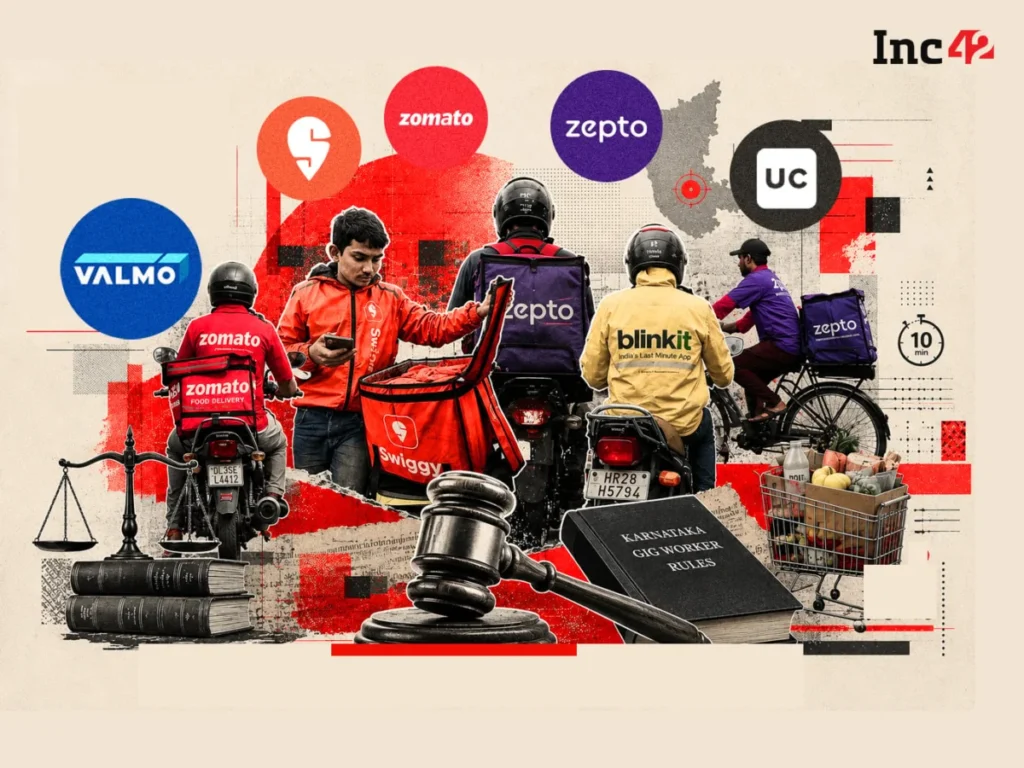
The delicate balance between innovation-driven labor models and social security mandates has reached a boiling point in India’s Silicon Valley. In a high-stakes legal confrontation, a consortium of India’s most prominent consumer internet platforms—including Zomato (via Eternal), Swiggy, Zepto, Urban Company, and Meesho’s logistics arm Valmo—have mounted a formidable challenge against the Karnataka Platform-Based Gig Workers (Social Security and Welfare) Act, 2025.
Represented by the Internet and Mobile Association of India (IAMAI), these platforms are seeking to strike down the state’s pioneering legislation. At the core of their argument is a claim of legislative overreach: the companies contend that the Karnataka law overlaps with the Central government’s Code on Social Security (COSS), 2020, creating a redundant, burdensome, and potentially unconstitutional regulatory framework.
The Legal Battlefield: High Court Proceedings
The tension culminated in a hearing at the Karnataka High Court in early July 2026. While the court declined to issue an immediate stay on the enforcement of the Act, it granted crucial interim protection to the petitioners. This shield prevents the state government from taking "coercive action" against these platforms, provided they fulfill specific financial obligations.
The court’s relief is conditional: the platforms must deposit the welfare contributions accrued during the April–June quarter with the High Court within three weeks. This ensures that while the legal battle over the validity of the law continues, the funding for gig worker welfare is temporarily ring-fenced. The court has scheduled further deliberations for August 14, 2026, directing the state government to file formal objections by July 30.
Chronology of a Regulatory Collision
To understand the severity of this conflict, one must look at the timeline of the state’s aggressive push toward gig worker regulation:
- September 2025: Karnataka notifies the Platform-Based Gig Workers (Social Security and Welfare) Act, 2025, officially becoming the first state in India to implement a dedicated legal framework for the gig economy.
- February 2026: The state government details the fiscal burden, introducing a 1% welfare fee on platform transactions, with specific caps ranging from ₹0.50 to ₹1.50 per transaction, depending on the service and vehicle category.
- June 22, 2026: The state issues formal notices to platforms, mandating the deposit of welfare fees by July 5 and requiring extensive compliance disclosures.
- June 29, 2026: A consortium of tech unicorns, led by IAMAI, files a writ petition in the Karnataka High Court, challenging the Act’s constitutional validity.
- July 3, 2026: The Karnataka High Court grants interim protection to the platforms, setting the stage for a protracted legal battle.
The Core Argument: Federalism vs. State Autonomy
The petition filed by the tech giants rests on several pillars of constitutional law. First, the platforms argue that the Union government’s Code on Social Security (COSS), 2020, already provides a comprehensive national framework for identifying gig workers and managing aggregator contributions. By creating a parallel state-level system, the Karnataka government is accused of encroaching upon the legislative domain of the Parliament.
Furthermore, the petitioners allege that the Act and its associated rules are "arbitrary" and infringe upon fundamental rights under Part III of the Constitution. Specifically, the companies challenge the notifications establishing the Karnataka Platform Based Gig Workers Welfare Board, arguing that the powers granted to this board—such as demanding internal data and enforcing compliance through show-cause notices—are excessive and lack a clear statutory basis that aligns with national standards.
Decoding the Welfare Fee Structure
The primary friction point, however, remains the financial levy. The Karnataka government has structured the welfare fee to be both granular and broad-based. The fee is categorized by sector:
- Food and Grocery Delivery: Capped at ₹0.50 per transaction.
- Ride-Hailing: Fees are tiered at ₹0.50 for two-wheelers, ₹0.75 for three-wheelers, and ₹1 for four-wheelers.
- Logistics (e.g., Porter): Fees range between ₹0.50 and ₹1.50 depending on the vehicle.
- Professional Services (e.g., Urban Company): Subject to the highest cap of ₹1.50 per transaction.
The proceeds are earmarked for the Karnataka Platform Based Gig Workers’ Fund, intended to finance life and accident insurance, disability coverage, maternity benefits, and old-age protections. The state claims that approximately 12 lakh gig workers are active in the state, though officials have admitted that data scrubbing is required to account for duplicate registrations across multiple platforms.
Implications for the Gig Economy
The outcome of this case will set a profound precedent for India’s digital economy. If the Act is upheld, it will signal a new era of state-led intervention in business operations, potentially leading to a fragmented regulatory landscape where every state imposes its own unique welfare levies and grievance redressal mechanisms.
1. Operational Complexity and Compliance
Platforms are currently required to maintain Internal Dispute Resolution Committees (IDRCs). These committees are mandated to handle complaints regarding payouts, deductions, and account deactivations. The law also enforces a 14-day turnaround time for grievances, failing which the worker can escalate the issue to the Welfare Board. For companies operating across 28 states, the prospect of managing 28 different versions of these compliance regimes is a significant operational hurdle.
2. Algorithmic Transparency
Beyond the welfare fee, the Act seeks to curb "arbitrary suspensions" of gig workers. Platforms are required to provide written justifications for deactivating a worker’s account, except in "specified emergency situations." This requirement touches upon the "black box" nature of platform algorithms, which has long been a point of contention between tech firms and labor advocates.
3. Financial Burden and Pricing
While the per-transaction fee might appear nominal, the cumulative impact on thin-margin businesses is substantial. Delayed payments carry a 12% annual interest penalty, and repeated violations could lead to fines of up to ₹1 Lakh. For platforms that rely on high-volume, low-margin transactions, this added cost could potentially be passed on to consumers or result in reduced earnings for workers, ironically undermining the very welfare the Act intends to provide.
The Path Forward: A National Solution?
The central government’s COSS 2020 remains the most logical venue for a standardized approach. By opting to legislate at the state level, Karnataka has forced a confrontation that highlights the vacuum left by the delay in fully implementing the national labor codes.
Industry analysts suggest that the court’s decision in August will be a watershed moment. If the Karnataka High Court rules against the state, it will likely prompt the Union government to accelerate the national implementation of social security for gig workers to prevent a patchwork of state-level laws. Conversely, if the Act is upheld, it may encourage other states—such as Rajasthan or Delhi, which have also explored similar labor protections—to follow suit, permanently altering the cost-benefit analysis of operating gig platforms in India.
For now, the industry remains in a state of watchful waiting. While the interim protection provides a reprieve, the legal and financial uncertainty persists. As the hearing on August 14 approaches, both the Karnataka government and the tech sector are preparing for a battle that will define the future of labor rights in the digital age.