Beyond "More with Less": A Strategic Blueprint for Pipeline-Driven Marketing
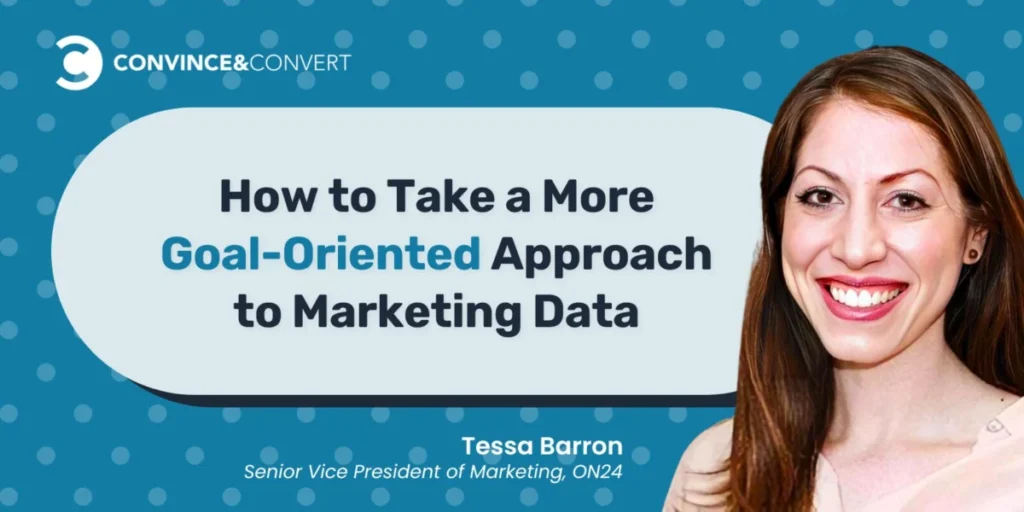
In the modern marketing landscape, the phrase "do more with less" has become a pervasive, if not exhausting, mantra. As corporate budgets tighten and economic uncertainty lingers, marketing teams are simultaneously facing the paradox of shrinking resources and swelling pipeline targets. For many, the knee-jerk reaction is to double down on existing tactics—cranking out more webinars, flooding the social channels with content, and hoping that increased volume will yield proportional returns.
However, Tessa Barron, formerly the Senior Vice President of Marketing at ON24, argues that this "more is more" approach is fundamentally flawed. In a recent appearance on the Data-Driven Decisions podcast, Barron challenged the marketing status quo, suggesting that the path to sustainable growth isn’t about working harder; it’s about a total shift in philosophy from being "tactic-oriented" to becoming "goal-oriented."
The Mindset Shift: Abandoning Legacy Tactics
The primary obstacle to modern marketing success is often institutional inertia. Many organizations continue to execute the same playbooks they used three or four years ago—pre-pandemic, pre-AI revolution, and pre-current economic shift. Barron posits that if a marketer’s strategy hasn’t evolved since 2020, they are likely wasting precious resources on methods that no longer resonate with an increasingly sophisticated and guarded consumer base.
The Danger of Tactic-First Thinking
Marketing departments often fall into the trap of planning by channel: "We need four webinars, two whitepapers, and a podcast series this quarter." This is tactic-first thinking. It assumes that the volume of content equals the depth of engagement.
Barron advocates for a complete reversal: start with the business objective. Instead of committing to four webinars, the goal should be, "We need a 10% uplift in our pipeline target for Q1." By framing the objective around business outcomes—such as account acquisition or meeting conversion rates—marketers are forced to evaluate which channels actually move the needle. If the data shows that prospects only engage deeply with complex technical topics, the webinar becomes a surgical tool to drive that specific conversion, rather than just another item on a content calendar.
The Science of Signals: Cutting Through the Data Noise
In the age of big data, the challenge is no longer a lack of information, but an overabundance of it. Marketers are often paralyzed by vanity metrics—clicks, page views, and impressions—that look good on a dashboard but offer little insight into purchase intent.
Defining "Signal" Over "Noise"
Barron introduces a crucial distinction: "noise" is the aggregate of all customer interactions, whereas "signal" is the specific behavior that indicates a buyer is moving toward a conversion. Identifying these signals is the cornerstone of her strategy.
Once a marketer identifies a high-intent signal, the next step is to engineer "traps" for that data. Using ON24’s interactive platform as a case study, she highlights how subtle, high-value interactions—such as polls, targeted Q&A, and real-time surveys—can transform a passive content experience into a data-gathering engine.
Real-World Application: Two Case Studies
The power of this strategy is best illustrated through specific industry applications:
- The Cloud Provider Strategy: A technology company aimed to recapture market share. Their data showed that prospects already using a specific cloud provider were 10 times more likely to convert into an opportunity. Rather than casting a wide net, they integrated a single, targeted poll into their webinars: "Which cloud provider do you currently use?" This immediately bifurcated the audience, allowing the sales team to prioritize the high-intent prospects who identified as users of that specific cloud provider.
- The Pharmaceutical Risk Assessment: A firm sought to connect with physicians treating high-risk patients. They hosted an educational webinar on the latest drug therapies and included a simple question: "How would you rate the risk level of your patient base (High, Medium, Low)?" Those who answered "High" were not just content consumers; they were qualified prospects signaling an immediate need for the company’s intervention.
These examples underscore that data capture is not about collecting everything; it is about collecting the right things that map directly to the end-goal of the pipeline.
Bridging the Chasm: Aligning Marketing and Sales
A common point of friction in B2B organizations is the misalignment between marketing’s lead generation efforts and sales’ pipeline expectations. Barron argues that the disconnect often stems from marketing asking the wrong questions.
The Frontline Perspective
Marketers often build lead forms and surveys designed to measure the quality of their own content—asking questions like "How would you rate this webinar?" While this provides feedback for the creative team, it does nothing for the sales team.
Barron suggests that marketers should step out of their silos and shadow the sales team. By asking, "What questions do you ask a prospect to determine if they are qualified?" or "What are the common points of hesitation during a discovery call?" marketers can mirror these questions in their digital interactions.
Defining the Hand-off
Crucially, Barron emphasizes that marketing does not "create" the pipeline; they "develop the net" to catch the prospects that lead to the pipeline. Salespeople own the front lines where the deal is ultimately forged. Therefore, the marketer’s job is to provide the sales team with the clearest, most comprehensive picture of a prospect before they ever make a discovery call. When marketing successfully gathers signals, the sales team isn’t calling a stranger; they are calling a prospect whose needs, pain points, and preferences are already documented.
The Optimization Framework: Turning Dials for Maximum Impact
To operationalize this, organizations must look at the "hidden" steps between the initial lead and the eventual pipeline opportunity. This is where marginal gains can result in exponential growth.
The Optimization Checklist
- Audit the Friction: Are lead forms unnecessarily long? Do they ask for redundant information?
- Tailored Messaging: Is the content personalized based on the data already collected? If a user has identified as a "high-risk" doctor, are they receiving follow-up content that addresses that specific need?
- Content-to-Conversion Pathing: Ensure that every piece of content provides a clear path to an interaction. If a prospect engages with a whitepaper, there must be a follow-up mechanism—a poll, a webinar invite, or a direct outreach—that allows them to move to the next stage.
Barron notes that these small, structural tweaks are often more effective than launching a massive new campaign. It is about "controlling the dials"—adjusting the messaging and the interaction points to see what drives the highest conversion rate at each micro-stage of the journey.
Implications for Corporate Stakeholders
The final challenge for the modern marketer is communication. When budgets are being scrutinized, the ability to present data to executive stakeholders is a core competency.
Visualizing Success
Barron suggests that "noisy" data is the enemy of executive buy-in. Stakeholders do not need to see every metric; they need to see the trend line. Are we moving up or down? How does our current strategy impact the bottom line? By presenting data in a visually simple, goal-aligned manner, marketers can build a compelling case for their strategy. When a CMO can show that a specific campaign drove a 10% increase in qualified pipeline—not just "1,000 views"—the conversation shifts from budget cutting to budget investment.
Conclusion: A New Era of Intentionality
The "do more with less" era is not a mandate to increase output; it is a mandate to increase intelligence. By moving away from tactic-first planning and embracing a strategy built on high-intent signals, alignment with sales, and rigorous optimization of the lead-to-pipeline journey, marketers can transform their departments from cost centers into revenue engines.
As Barron concludes, the goal is to stop being a "content factory" and start being a "data-informed partner." When the entire organization is aligned on what a "signal" looks like, the path to the pipeline becomes significantly clearer, regardless of the size of the budget.
For more in-depth analysis on these strategies, readers are encouraged to listen to the full episode of the Data-Driven Decisions podcast, part of an eight-part series designed to navigate the complexities of modern marketing.