The Connectivity Revolution: Standardizing AI with the Model Context Protocol (MCP)
In the rapidly evolving landscape of artificial intelligence, a silent crisis has been brewing in the developer community: the "Integration Bottleneck." As large language models (LLMs) transition from static chatbots to active, agentic systems capable of executing complex tasks, they face a fundamental limitation—they are effectively trapped in a vacuum. A model’s knowledge is frozen at the moment of its training, leaving it blind to the dynamic, real-time data residing in private databases, internal enterprise systems, and personal workflows.
For years, bridging this gap has been a labor-intensive, bespoke endeavor. Developers have spent countless hours writing custom "glue code"—one-off adapters for every model-to-service combination. This fragmented approach has hindered scalability and introduced significant technical debt. Enter the Model Context Protocol (MCP), an open-standard initiative spearheaded by Anthropic. By creating a universal language for AI-to-tool communication, MCP promises to do for AI agents what HTTP did for the early web: transform a collection of isolated silos into a cohesive, interoperable ecosystem.
Main Facts: The Architecture of Connectivity
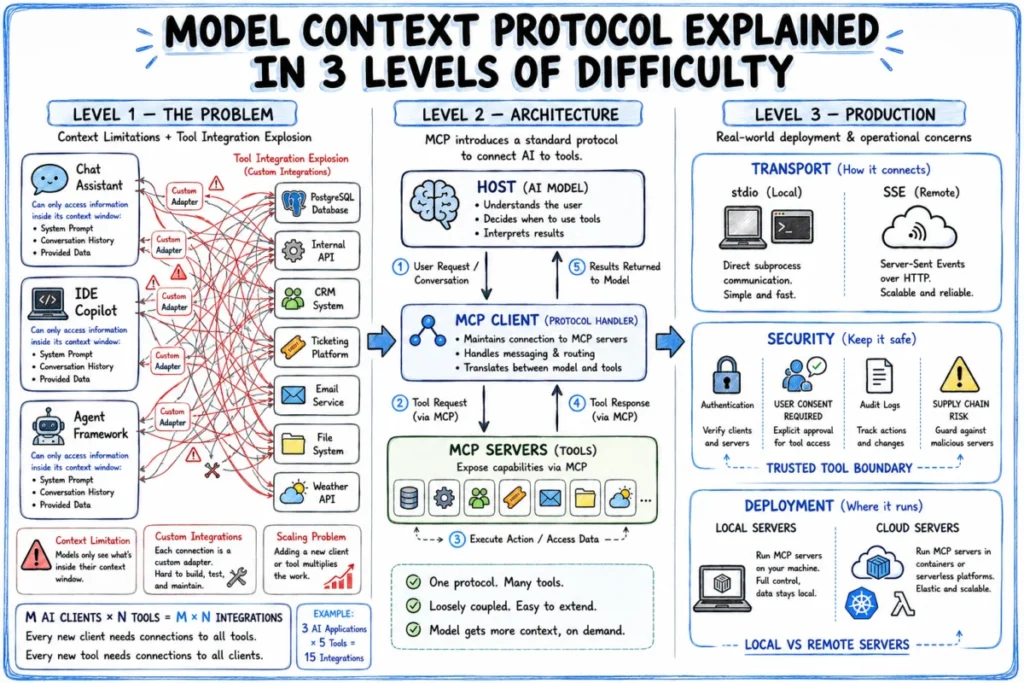
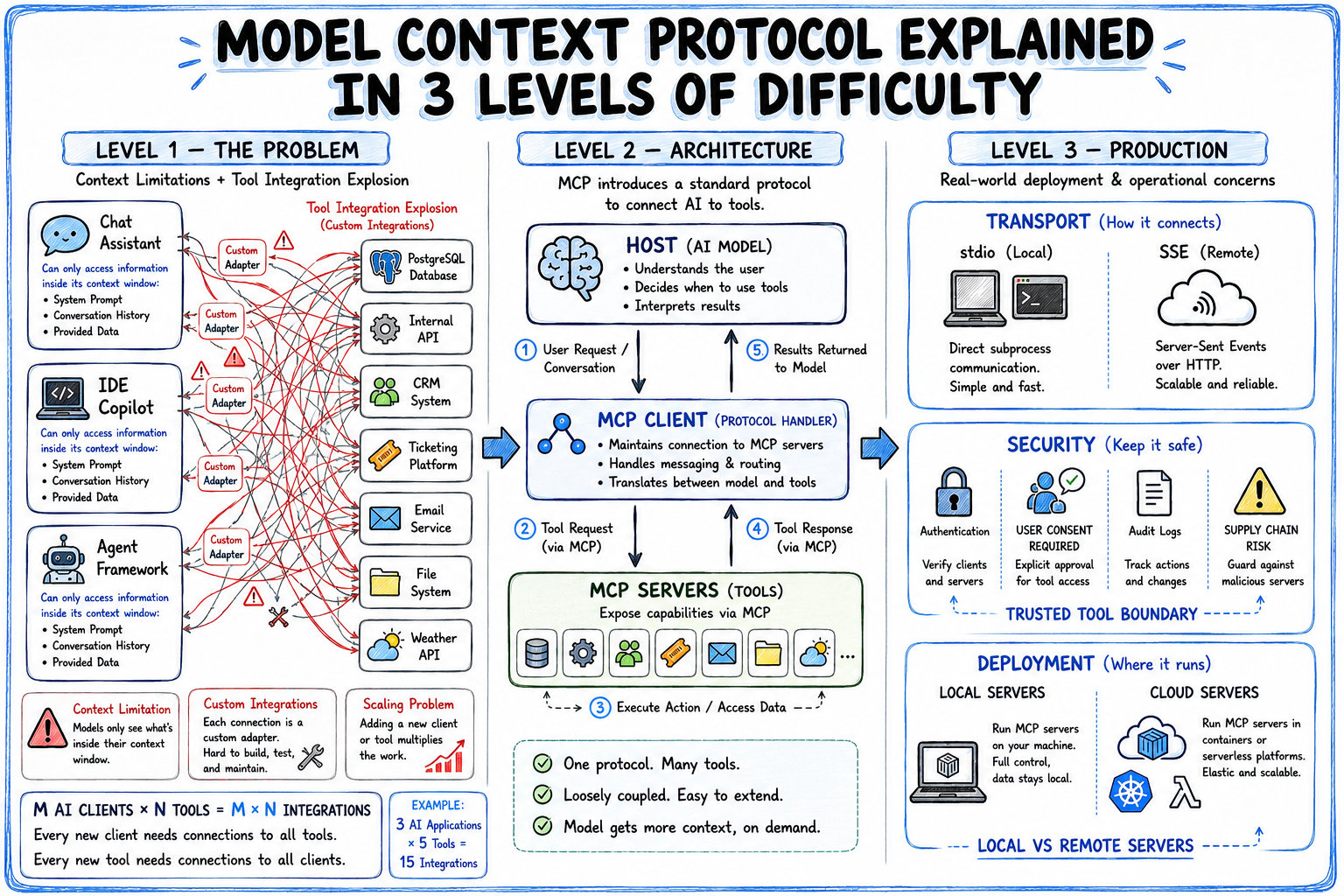
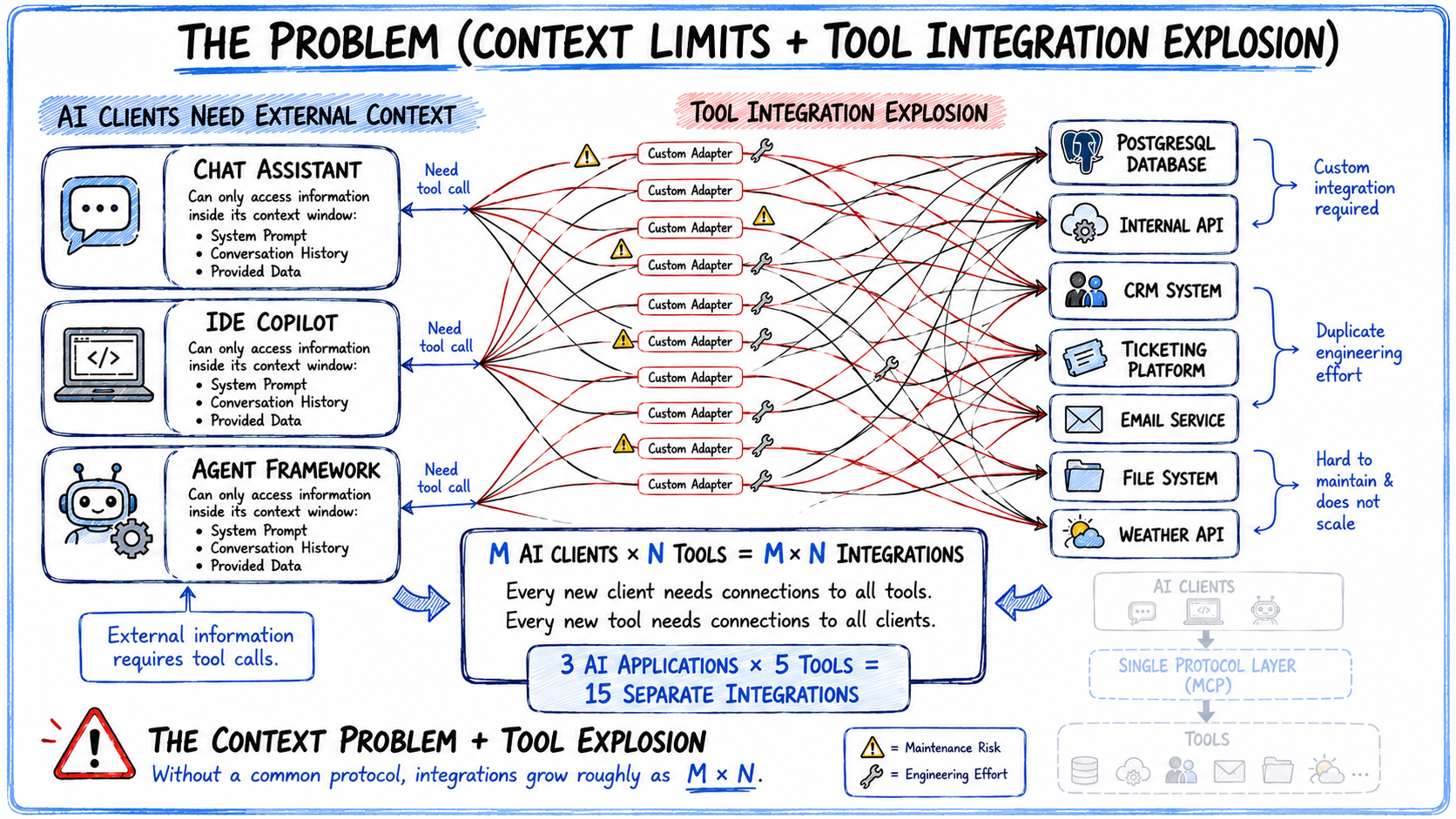
At its core, the Model Context Protocol is an open-source standard designed to solve the $M times N$ integration problem. In the current paradigm, if an organization wants to connect three distinct AI assistants to five unique internal data sources, they must build and maintain 15 separate, custom-coded integrations. Each integration brings its own authentication logic, schema definitions, and failure modes.
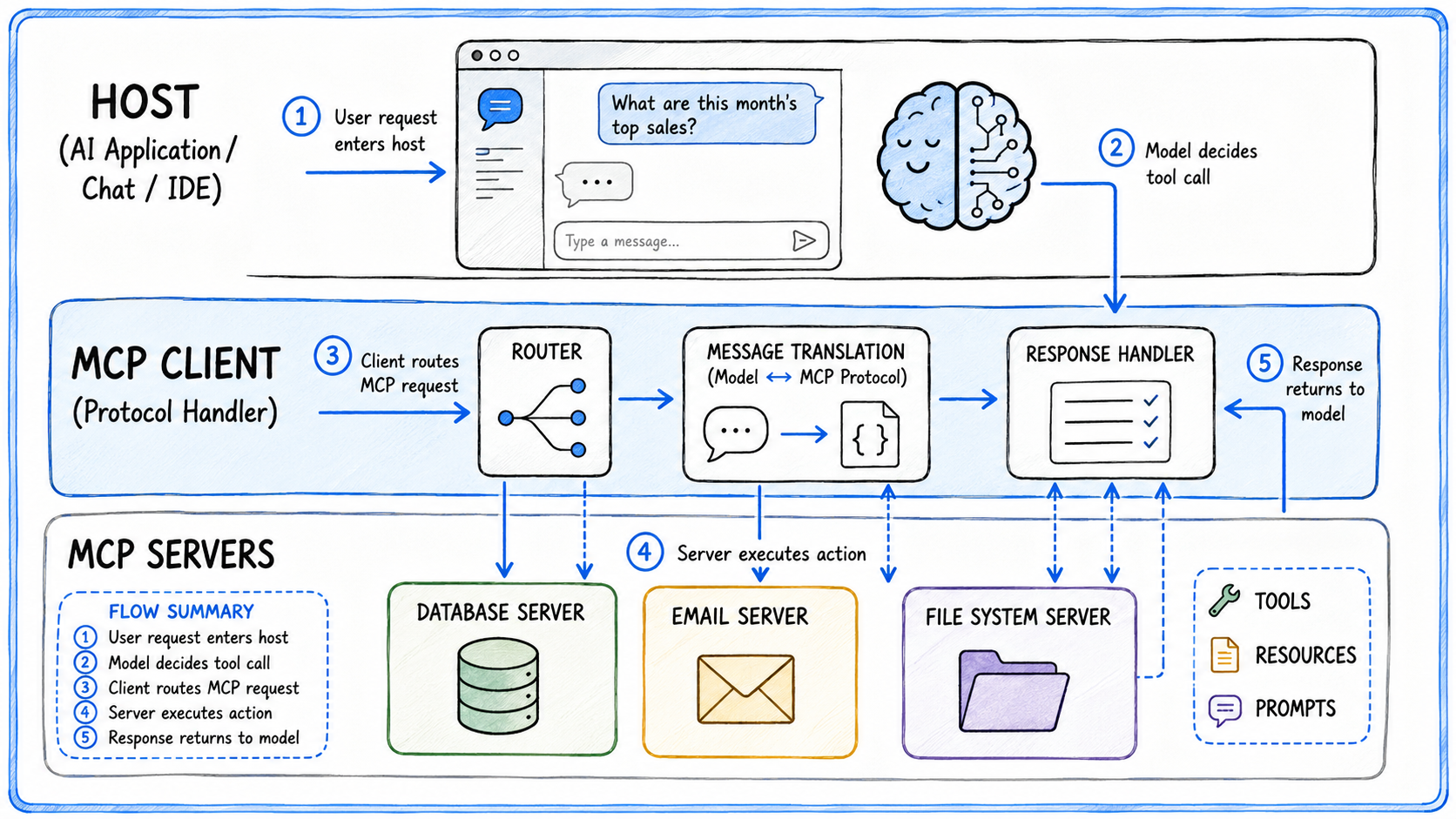
MCP fundamentally shifts this architecture from a matrix of custom adapters to a standardized interface of "Clients" and "Servers."
- The Host: The application the user interacts with (e.g., an AI-powered IDE or a chat interface).
- The Client: The component within the host that handles the protocol mechanics, translating the LLM’s intent into standardized requests.
- The Server: A lightweight, specialized bridge that exposes specific data or tools to the client, following the MCP standard.
By adopting this protocol, an MCP-compliant server (such as one for a PostgreSQL database or a GitHub repository) can be "plugged into" any MCP-compliant client. The result is a dramatic reduction in complexity: developers build the server once, and it becomes instantly compatible with any AI application that supports the standard.
Chronology: From Custom Adapters to Global Standards
The emergence of MCP is the natural conclusion of the "Agentic Turn" in AI.
- 2023 – Early 2024: As LLMs began incorporating function calling, the industry saw an explosion of proprietary, framework-specific integrations. Developers relied on tools like LangChain or LlamaIndex to build these connections, but each framework had its own way of defining tools.
- Late 2024: The industry reached a tipping point. The overhead of maintaining custom connectors for every new model version became unsustainable for enterprises.
- November 2024: Anthropic officially introduced the Model Context Protocol, open-sourcing the specification. The goal was explicitly stated: to create a "USB-C port for AI applications," allowing any assistant to connect to any data source with minimal configuration.
- 2025 and Beyond: The ecosystem has seen rapid adoption, with major IDEs like Cursor and VS Code, as well as enterprise agent frameworks, integrating MCP natively. The shift has moved from "experimental" to "production-ready," with a growing registry of pre-built servers for common enterprise tools like Slack, Jira, and Salesforce.
Supporting Data: Efficiency and Scalability
The quantitative impact of adopting a standard like MCP is significant. According to internal developer metrics reported by early adopters, moving to an MCP-based architecture reduces the "time-to-integration" by approximately 60–70%.
In a traditional setup, adding a new tool—such as a proprietary internal CRM—requires:
- Defining the API schema for the LLM.
- Writing the authentication handling (OAuth, API keys).
- Managing error state and retries.
- Testing against every AI client that needs access to that data.
With MCP, steps 1 through 3 are standardized. Because the protocol defines a uniform way for servers to advertise their capabilities (Tools, Resources, and Prompts), the "handshake" between the AI and the tool is automated.
Consider the "Compositional Advantage": If a company maintains 20 different AI agents and 10 distinct data systems, the custom-adapter approach requires 200 distinct integration points. Under the MCP model, this is reduced to 30 implementations (20 clients + 10 servers). This linear growth pattern is what allows startups and large enterprises alike to scale their AI infrastructure without exponential increases in maintenance costs.
Official Perspectives and Security Implications
Anthropic and other major contributors have been vocal about the security trade-offs inherent in granting AI access to live systems. Because an MCP server can be configured to read files or execute database queries, it is a high-value target for security audits.
The Security Framework
To address these risks, the MCP specification emphasizes three pillars:
- Strict Authentication: MCP requires that all servers implement robust identity verification. Just because a server is "connected" does not mean it has permission to execute every tool.
- Scope Limitation: Developers are encouraged to use the "Principle of Least Privilege." An MCP server for a read-only database should never be granted a write-enabled tool definition.
- Local vs. Remote Sandboxing: Security best practices dictate that sensitive local MCP servers (e.g., those with access to the local filesystem) should be run in isolated containers or virtual environments, preventing a malicious or "hallucinating" agent from inadvertently deleting system files.
As Google and other cloud providers have noted, the future of MCP will likely include "Policy-as-Code" layers, where organizations can inject their own security guardrails into the MCP communication stream, auditing every request before it hits the underlying data source.
Implications for the AI Ecosystem
The adoption of MCP is not just a technical upgrade; it is a catalyst for a new "App Store" economy for AI.
1. Commoditization of Integrations
We are moving toward a world where developers no longer sell "AI for Jira" or "AI for GitHub." Instead, they will publish "Jira MCP Servers." This allows any AI assistant—whether it is a custom enterprise agent or a public chatbot—to instantly gain "Jira capabilities" simply by pointing to the server.
2. The Rise of "Agentic Interoperability"
Previously, AI agents were islands. They couldn’t share information easily because their "contexts" were locked in proprietary formats. With MCP, different agents can potentially consume the same standardized resources, leading to multi-agent workflows where a coding agent and a project-management agent can coordinate through the same protocol-compliant interface.
3. Lowering the Barrier to Entry
For small businesses and individual developers, the cost of building sophisticated AI systems has historically been high. By providing a library of ready-made, open-source MCP servers for common platforms, the protocol allows developers to focus on the "logic" of their agents rather than the "plumbing" of data connectivity.
Conclusion: A Standard for the Long Haul
The Model Context Protocol represents a maturation point for generative AI. By solving the integration bottleneck, it moves the industry away from the chaotic, fragmented era of "custom everything" and toward a professional, scalable architecture.
As we look toward the future, the success of MCP will likely be measured by the breadth of its ecosystem. With SDKs now available for Python, TypeScript, and other major languages, the barrier to contributing to this ecosystem is lower than ever. For developers, the message is clear: stop building one-off adapters. Standardize your connections now, and ensure that as your AI applications grow in capability, your infrastructure remains robust, secure, and infinitely composable.
The era of the "siloed agent" is coming to an end. The era of the "connected, interoperable agent" has officially begun.
Recommended Resources for Further Study
- The Official MCP Documentation: modelcontextprotocol.io – The primary source for the specification and implementation guides.
- MCP Server Registry: mcpservers.org – A community-driven directory of pre-built servers for popular services.
- Security Best Practices: Review the official security guidelines to ensure your implementations adhere to industry standards regarding data access and user consent.