The Rise of the Browser-Based AI Agent: Bridging the Gap Between Code and the Web
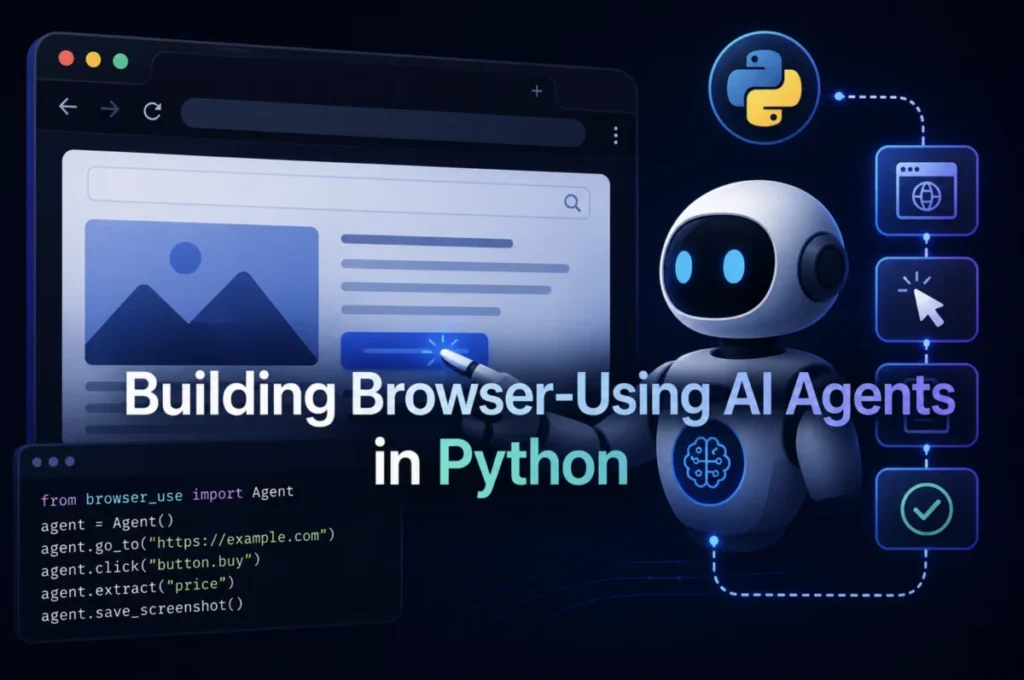
In the rapidly evolving landscape of artificial intelligence, the most significant breakthroughs are no longer confined to chat interfaces or API-integrated backend services. A new paradigm has emerged: the browser-capable AI agent. As the global AI market surges toward a projected $50.31 billion valuation by 2030, enterprises are shifting their focus from simple LLM wrappers to autonomous agents capable of navigating the 1.1 billion websites that make up the modern internet.
Historically, AI agents were limited to structured environments—APIs that provide clean, predictable data. However, the vast majority of human digital labor—filing government forms, competitive intelligence gathering, and researching legacy portals—occurs in environments that have no public API. These tasks "only speak browser." The emergence of sophisticated libraries like Playwright, LangGraph, and browser-use is closing this gap, allowing developers to build agents that interact with the web exactly as a human would.
The Technological Shift: Why Playwright Has Replaced Selenium
For years, Selenium was the undisputed king of web automation. While it remains a functional tool, its architecture is increasingly viewed as a relic of the past. For modern AI agents, the industry standard has decisively shifted to Playwright.
The distinction is practical rather than theoretical. Selenium communicates via individual HTTP requests for every action, creating significant latency. Playwright, by contrast, maintains a persistent WebSocket connection. This architecture results in independent benchmarks showing Playwright to be 30–50% faster than Selenium. In an agentic loop—where an AI might execute dozens of clicks, scrolls, and inputs to complete a single task—that latency gap compound, making Playwright the only viable choice for high-performance agentic workflows.
Beyond raw speed, Playwright bundles its own browser binaries, eliminating the "it works on my machine" syndrome caused by version mismatches between WebDriver and local browser installations. Its built-in auto-waiting mechanism—which ensures an element is visible, enabled, and not animating before interaction—removes the need for brittle, manual time.sleep() commands. For AI agents designed to mimic human behavior, Playwright’s ability to fire native mouse and keyboard events provides a critical advantage, making these agents significantly harder to distinguish from genuine human users.
Chronology: From Static Scraping to Autonomous Reasoning
The evolution of browser-based automation has followed a clear, three-stage trajectory:
- The Scripting Era (2015–2020): Dominated by static scrapers and simple Selenium scripts. These were fragile, required constant manual updates to CSS selectors, and broke the moment a website updated its layout.
- The Headless Browser Era (2020–2024): The introduction of Playwright and Puppeteer allowed for better handling of dynamic, JavaScript-heavy sites (React, Vue, Next.js). This era focused on reliability but still required developers to hardcode the "logic" of the navigation.
- The Agentic Era (2025–Present): The current frontier. By integrating LLMs with browser drivers, we have moved from "if-this-then-that" scripts to autonomous agents that can reason about a page’s content. If a website changes its structure, the LLM adapts on the fly, identifying the "Submit" button by its semantic purpose rather than its specific DOM ID.
Supporting Data: The Enterprise Landscape
The transition to agentic browsing is not merely a hobbyist trend; it is a core business strategy. According to recent industry reports, 27.7% of enterprises are now running agentic browsers in production, a dramatic increase from near-zero adoption just two years ago.
The shift is driven by the realization that API-limited agents handle roughly 5% of a human worker’s daily tasks. By granting an agent a browser, that coverage expands to nearly 100% of web-based workflows. This productivity multiplier is the primary driver behind the projected growth of the AI agents market, which currently stands at $10.91 billion and is expected to grow at a CAGR of roughly 45% through the end of the decade.
Implementation: Building the Modern Agent
Building these systems requires an orchestration layer. The current gold standard involves a three-part stack:
- Playwright: The engine for browser interaction.
- LangGraph: The state machine that manages the agent’s reasoning loop.
- Browser-use: A high-level abstraction layer that allows the LLM to interact with the DOM without the developer needing to write custom CSS selectors.
The "Smart Waiting" Mandate
One of the most critical lessons for developers is the abandonment of arbitrary delays. Instead, professional-grade agents utilize specific wait strategies:
- Element Readiness: Waiting for a specific DOM node to appear.
- Network Synchronization: Using
networkidlestates to ensure the page has finished fetching dynamic assets. - Event-Driven Triggers: Using
wait_for_functionto monitor JavaScript variables within the page, signaling that the page’s internal state is fully loaded.
Implications: The Future of Digital Labor
The ability to deploy autonomous agents that can "see" and "act" on the web has profound implications for the global economy.
1. The Democratization of Automation
Previously, automating complex web tasks was the domain of highly skilled QA and automation engineers. Today, an agentic framework allows a business analyst to describe a task—"Log into our competitor’s portal, extract their daily pricing, and save it to a spreadsheet"—in plain English, and have the system execute it.
2. Resilience and Maintenance
Traditional scrapers are notoriously high-maintenance. A site redesign often required hours of manual debugging. Agentic browsers are self-healing; because they rely on the LLM’s understanding of user interfaces, they can navigate a redesigned login form just as easily as the previous version.
3. Ethical and Security Considerations
With great power comes the necessity for robust security. As agents become more autonomous, they must be deployed with strict "guardrails." Developers must account for anti-bot detection systems that look for synthetic interaction patterns. The use of stealth headers, realistic user-agent strings, and browser fingerprint management is now a prerequisite for any agent intended for production use. Furthermore, the handling of session tokens and cookies must be secured with the same rigor as any other sensitive authentication credential.
Conclusion: Reaching for the Full Potential
The browser is the universal interface for the modern digital economy. By mastering the integration of Playwright and autonomous reasoning loops, developers are no longer merely "scraping" the web; they are building digital employees capable of performing complex, multi-step workflows.
The barrier to entry has never been lower. With a foundational setup in Docker, an OpenAI API key, and a firm grasp of the LangGraph reasoning loop, developers can transition from fragile scripts to resilient, agentic systems. As we look toward 2030, it is clear that the agents winning the market share will not be those that simply call APIs, but those that can navigate the web, interpret what they see, and execute complex goals in the browser. The tools are ready; the only remaining task is to define the workflow.