The Architect’s Dilemma: Tools vs. Subagents in AI System Design
In the rapidly evolving landscape of AI engineering, developers are moving beyond simple chatbot interfaces toward complex, autonomous agentic systems. As these agents gain the ability to navigate digital environments and interact with external systems, a fundamental architectural crossroads emerges: Should a specific capability be implemented as a tool or a subagent?
Making the wrong choice can be the difference between a high-performing, scalable AI system and a fragile, overengineered mess. Get it wrong, and you either overwhelm your primary agent’s context window with irrelevant noise or bury your system under a mountain of coordination overhead, latency, and debugging nightmares. This article explores the strategic framework for navigating this decision, ensuring your agent architecture remains robust and efficient.
The Core Distinction: Execution vs. Reasoning
To build effective AI agents, one must first master the distinction between execution and reasoning.
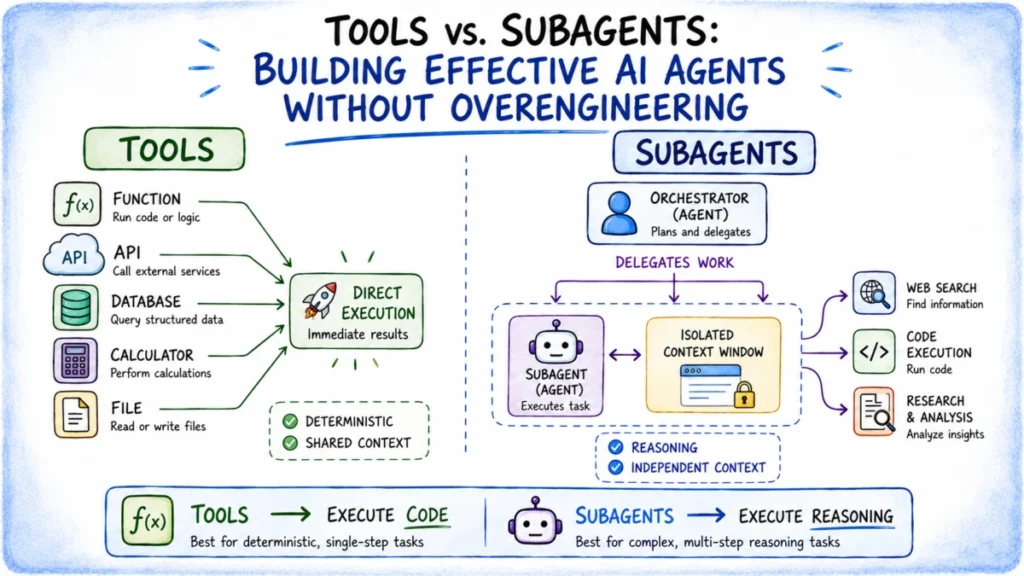
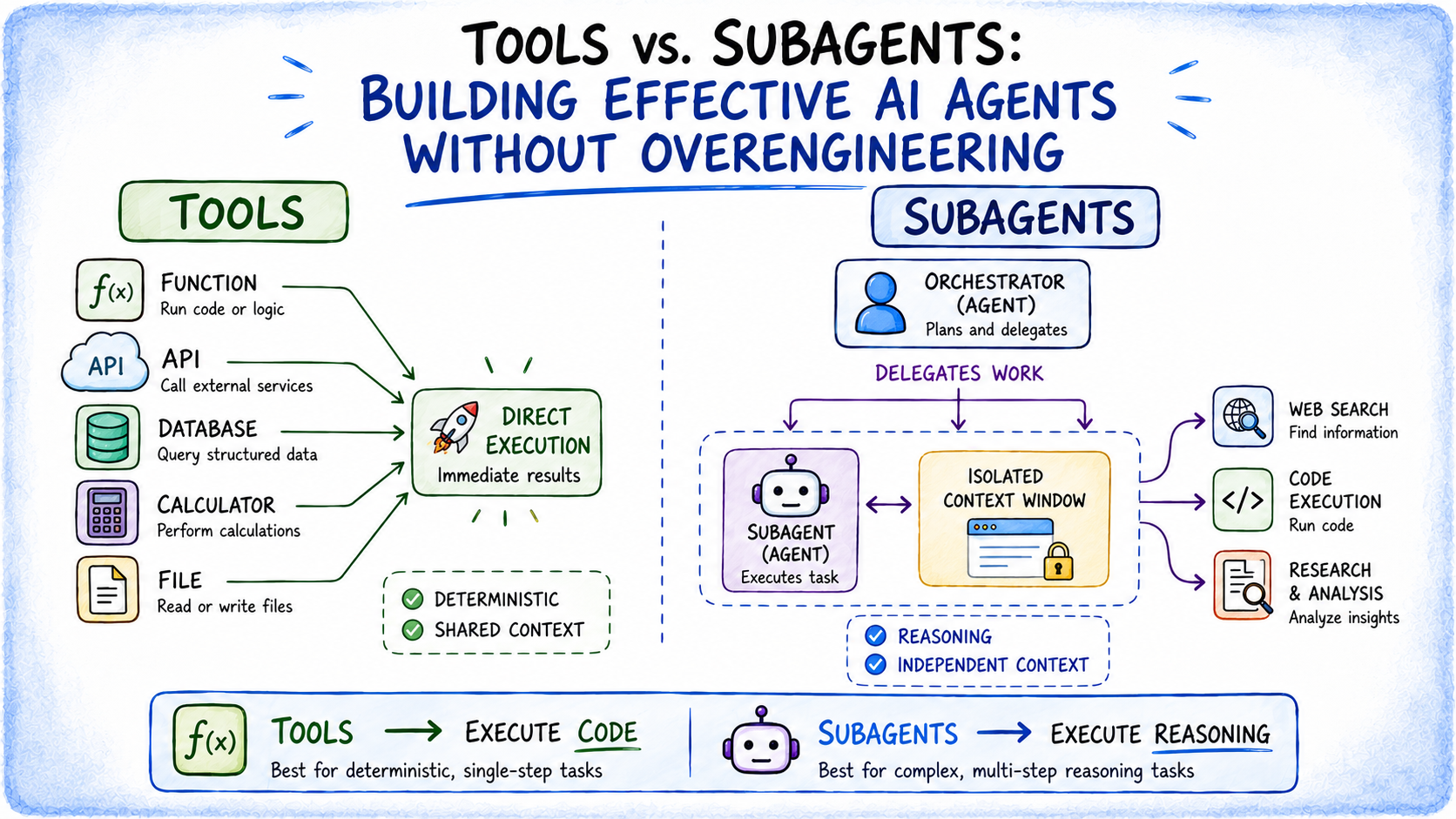
A tool is a programmatic extension of an agent—essentially a function, API endpoint, or database query that the agent can invoke to perform a specific, deterministic task. Tools do not "think." They execute code and return data. The primary agent retains full control over the planning, interpretation, and synthesis of that information.
A subagent, conversely, is a specialized, autonomous unit—essentially another LLM instance—tasked with a high-level goal. It possesses its own system prompt, its own context window, and its own unique set of tools. When an orchestrating agent calls a subagent, it is essentially delegating a portion of the cognitive workload. The orchestrator does not oversee the "how"; it only evaluates the "what" upon completion.
The Trade-off Matrix
| Aspect | Tools | Subagents |
|---|---|---|
| Primary Driver | Deterministic Code | Probabilistic LLM Reasoning |
| Context | Shared with Orchestrator | Isolated/Encapsulated |
| Execution Path | Direct function call | Independent inference cycle |
| Cost | Negligible (CPU/Network) | High (Input/Output Tokens) |
| Latency | Low (Millisecond response) | High (Multiple seconds/minutes) |
| Failure Mode | API/Schema errors | Hallucination/Coordination loss |
Chronology of the Decision: When to Scale
For developers, the journey from a simple agent to a multi-agent system should be a deliberate, incremental process rather than a premature design choice.
Phase 1: The "Tool-First" Default
Every project should begin by exhaustively mapping required functionalities to tools. If a task is repeatable, predictable, and requires no ambiguity, it belongs in a Python script. Whether it is fetching a user’s profile from a CRM, calculating a sum, or searching a vector database, these operations provide the highest ROI for your system’s performance.
Phase 2: Identifying the "Reasoning Ceiling"
As you layer functionality, you will inevitably encounter tasks that involve "non-obvious" branching. For example, if your agent needs to perform a competitive analysis, it must first decide what to search, interpret the results, discard irrelevant findings, synthesize the remaining data, and finally format the output. If you try to jam this entire multi-step loop into the primary agent, you will hit the context window limit and see a degradation in reasoning quality. This is the moment to promote the task to a subagent.
Phase 3: The Parallelization Imperative
Once your system matures, you may find that certain tasks—such as processing ten different long-form documents—can happen simultaneously. A tool-based approach would process these sequentially, causing high latency. A subagent-based approach allows the orchestrator to spin up ten specialized instances to handle the work in parallel, drastically reducing the total system response time.
Supporting Data: Why Complexity Breeds Failure
Research in agentic behavior consistently demonstrates that "tool overload" is a primary cause of system degradation. When an LLM is presented with a massive list of potential tools, its ability to select the correct one diminishes—a phenomenon known as the "choice paralysis" of the context window.
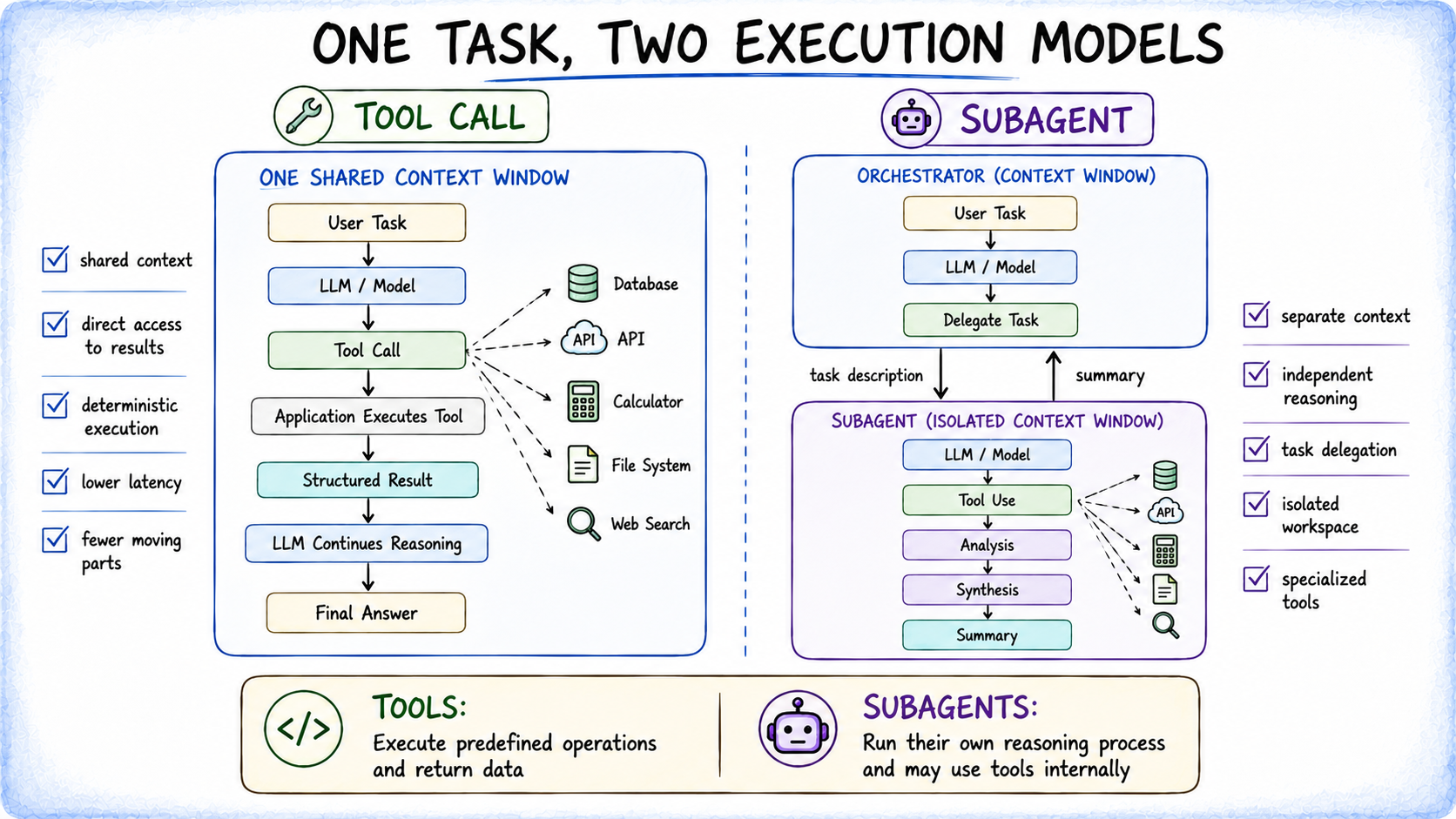
Furthermore, empirical testing suggests that subagent isolation yields higher reliability. By stripping away the history of the orchestrator’s conversation, the subagent can operate in a "clean room" environment. For tasks requiring high precision—such as generating executable code or extracting complex financial data into JSON—this isolation prevents the subagent from being distracted by the "noise" of the orchestrator’s previous, unrelated conversation threads.
Official Industry Perspectives: The Case for Modularity
Industry leaders, including teams from Microsoft (via AutoGen) and Anthropic (via recent developments in agentic coding), advocate for a "clean handoff" architecture. The prevailing consensus is that the interface between agents should resemble a strict API contract: Input a task, output a summary.
When subagents are permitted to share mutable state or report back partial, messy thoughts mid-task, the system becomes nearly impossible to debug. A "black box" subagent that simply returns a concise, structured answer is far more maintainable than one that floods the orchestrator with intermediate logs. This architectural discipline is what separates production-grade AI from experimental prototypes.
Implications for Future Agent Architecture
The shift toward subagent architectures has profound implications for how we build and maintain AI systems:
- Debugging as a Contract: If a subagent fails, you don’t need to debug the entire system. You only need to verify the input task and the expected output schema. This turns debugging into a standard software engineering practice.
- Specialization: We are moving toward a future where "generalist" agents are rare. Instead, we see ecosystems of specialized subagents—one for research, one for code, one for data validation—each optimized for their specific niche.
- The Rise of Orchestration Layers: As the number of subagents grows, the focus shifts from building the agents themselves to building the orchestrators that govern them. This is where the true competitive advantage will lie in the coming years.
Avoiding the Overengineering Trap
The most frequent mistake made by AI architects is the premature adoption of complex multi-agent frameworks. Before adding a subagent, ask yourself the "Buy-in Question": What does this subagent actually buy me?
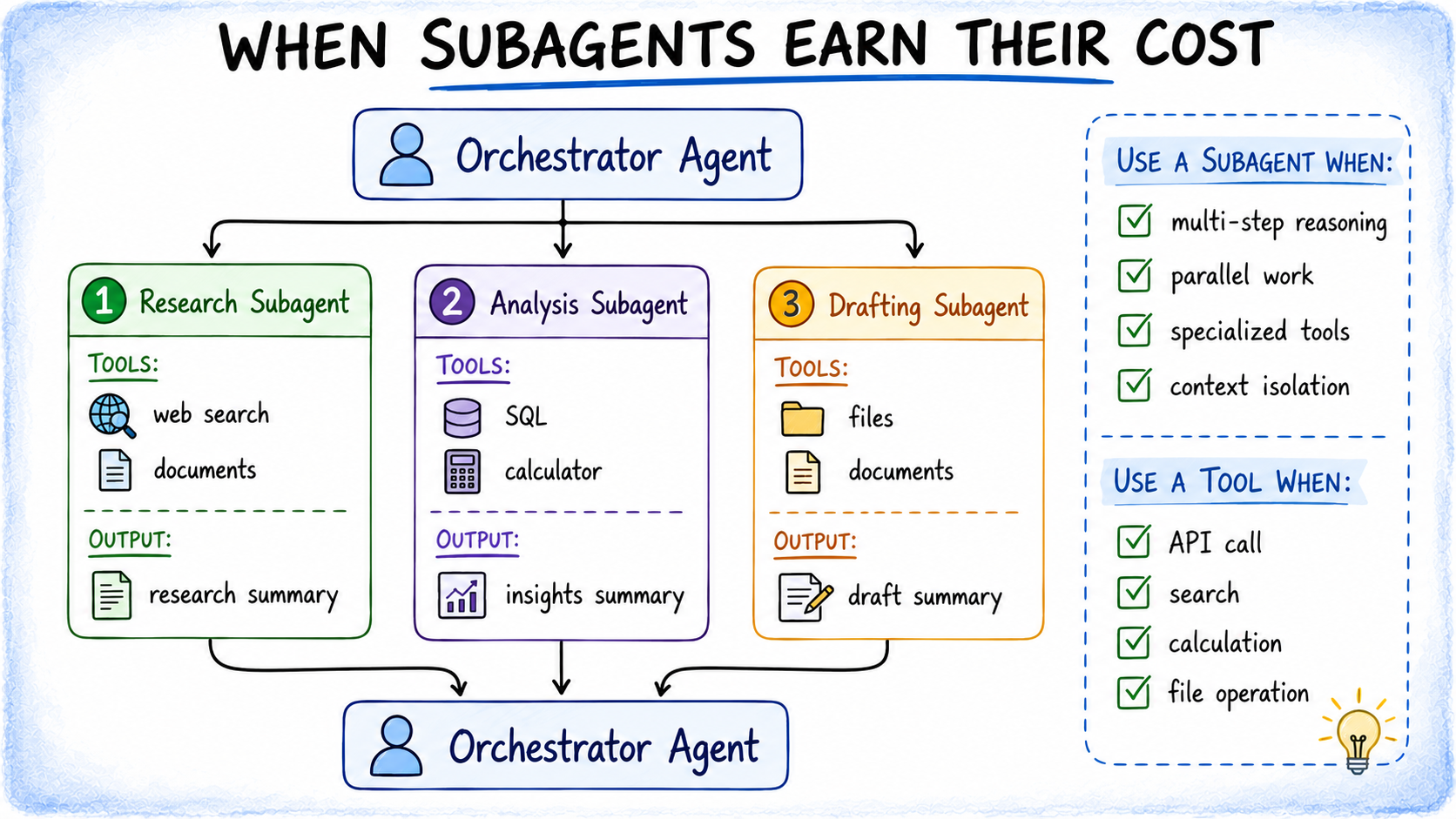
- Does it reduce the orchestrator’s context load?
- Does it allow for parallelization that I couldn’t achieve with a simple loop?
- Does it isolate a complex, multi-step reasoning task that would otherwise clutter the main prompt?
If the answer to all three is "no," stick with a tool. Tools are faster, cheaper, and fundamentally more reliable because they are deterministic. Only introduce the complexity of an additional LLM call (the subagent) when the problem demands cognitive depth that a function cannot provide.
The Final Rule of Thumb
Pass tasks down; pass conclusions back up.
By keeping your boundaries clean, your interfaces typed, and your reasoning isolated, you build a system that is not only powerful but also scalable and maintainable. In the race to build autonomous agents, the winners will not be those with the most complex web of agents, but those with the most disciplined architecture. Start simple, build with tools, and scale with purpose.