Sailing Into a New Era: How ‘Assassin’s Creed: Black Flag Resynced’ Reclaims the Golden Age of Piracy
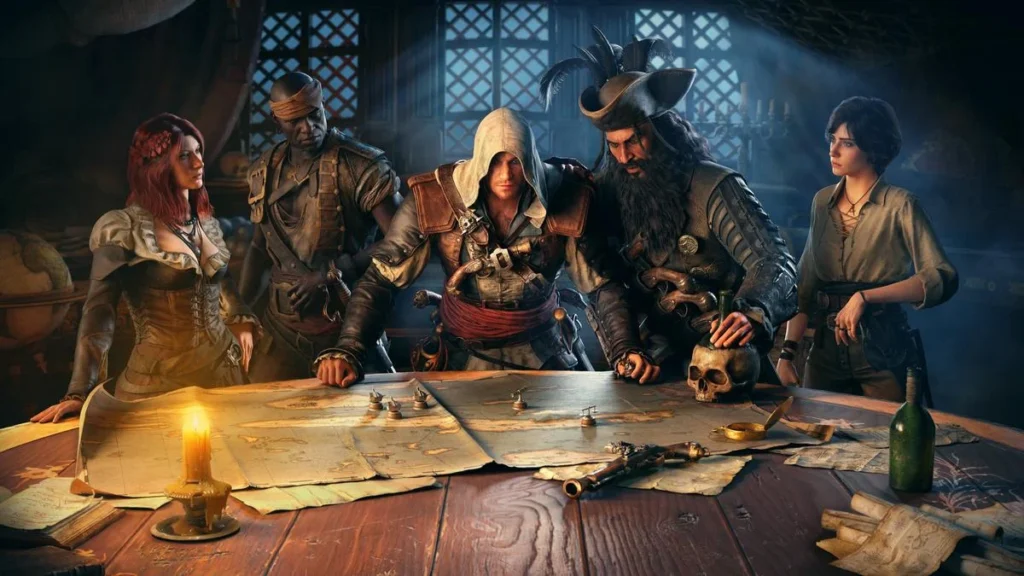
The global video game industry is preparing for one of its most competitive years on record. While much of the media’s spotlight remains firmly fixed on the colossal anticipation surrounding Rockstar Games’ Grand Theft Auto 6, a surprise contender has emerged to challenge the status quo: Assassin’s Creed: Black Flag Resynced.
Originally launched in late 2013, the original Assassin’s Creed IV: Black Flag is widely considered a high-water mark for Ubisoft’s flagship franchise. Now, rebuilt and re-crafted for modern hardware, Black Flag Resynced returns players to the sun-drenched, blood-stained waters of the 18th-century Caribbean. Helmed by the charismatic pirate-turned-Assassin Edward Kenway, the title aims to capture both nostalgic veterans and a new generation of players. Priced at ₹4,999 on PlayStation 5, PC, and Xbox platforms, this remake represents a massive technical leap, combining classic naval exploration with modern gameplay systems.
1. Main Facts: The Anatomy of a Reborn Classic
Assassin’s Creed: Black Flag Resynced is not a mere remaster with upscaled textures; it is a comprehensive overhaul designed to align a decade-old classic with the mechanical sophistication of modern entries, specifically the upcoming Assassin’s Creed Shadows.
Narrative and Setting
Set in 1715 during the Golden Age of Piracy, the game places players in the boots of Edward Kenway—a rugged, fiercely independent Welsh privateer turned pirate. Unlike traditional protagonists of the franchise, Kenway is not motivated by a grand creed or ancient philosophy at the start of his journey. Instead, he is driven by raw ambition, seeking enough gold to secure a lavish life in England with his estranged wife.
The narrative unfolds across a vast open-world Caribbean, navigating the geopolitical tensions between European superpowers—primarily the British and Spanish Empires—and the fragile, democratic pirate utopia of Nassau. Along his journey, Kenway is supported by his loyal quartermaster, Adéwalé, and crosses paths with legendary historical figures such as Edward Thatch (Blackbeard), Benjamin Hornigold, Anne Bonny, and the volatile Charles Vane.
       [1715 Caribbean: The Geopolitical Sandbox]
                         │
         ┌───────────────┼───────────────┐
         ▼               ▼               ▼
  British Empire   Pirate Republic  Spanish Empire
 (Colonial Power)     (Nassau)     (Havana Outpost)
Gameplay Innovations and Combat Overhaul
The most significant upgrades in Resynced lie in its overhauled combat engine. Ubisoft has replaced the counter-heavy, automated combat of the 2013 original with a dynamic system influenced by modern action-adventure titles.
- The Parry System: Drawing inspiration from FromSoftware’s Sekiro: Shadows Die Twice, the game introduces a timed parry and posture-breaking mechanic. Players must carefully time their deflections to open up Her Majesty’s soldiers to lethal, highly stylized finishers.
- Dual-Wielding and Agility: Edward’s signature dual cutlasses are complemented by a suite of physical maneuvers, including low sweeps, tactical kicks, and environmental interactions that make crowd control more active and fluid.
- Customizable Stealth: While traditional stealth mechanics—such as hiding in foliage and whistling to lure guards—remain intact, Resynced allows players to scale the difficulty of enemy detection. This forces a more aggressive, vertical approach to parkour, encouraging players to utilize rooftops and tree canopies for silent takedowns.
Naval Warfare and World Discovery
The core of Black Flag has always been its naval combat, and Resynced preserves this foundation while enhancing its physical feedback. Players command the Jackdaw, a highly customizable brig.
Naval battles require careful maneuvering, wind management, and tactical use of diverse armaments, including broadside cannons, mortar fire, heavy shot, and swivel guns. Once an enemy vessel is disabled, the transition to boarding is seamless: players swing across ropes, clash swords on chaotic decks, and claim enemy cargo to upgrade the Jackdaw’s hull, sails, and weaponry.
2. Chronology: The Journey from 2013 to the Present Day
The path to Black Flag Resynced is a testament to the enduring popularity of naval gameplay and the shifting strategies within Ubisoft’s global development studios.
[Oct 2013] ────────────────► [2018-2022] ──────────────► [Mid-2023] ─────────────► [2024]
Original "Black Flag"        Development of "Skull &    "Project Obsidian"        Official Reveal &
launches to critical         Bones" stalls; fan         leaks reveal a            Release of
acclaim. demands for AC4 remake. full-scale remake. "Resynced".- October 2013: Ubisoft releases Assassin’s Creed IV: Black Flag on seventh and eighth-generation consoles. It receives near-universal acclaim, selling over 15 million copies and proving that naval combat could carry an entire open-world game.
- 2018–2022: As Ubisoft attempts to develop Skull and Bones—a multiplayer-focused pirate game originally conceived as a spin-off of Black Flag—the project suffers from multiple delays and creative shifts. During this period, community demand for a direct remake of Black Flag reaches an all-time high.
- Mid-2023: Internal industry leaks reveal that Ubisoft has greenlit a full-scale remake of Black Flag, codenamed Project Obsidian. Development is reportedly led by Ubisoft Singapore (the studio behind the original game’s naval technology) alongside support from Ubisoft Montreal.
- Late 2024: Ubisoft officially announces and launches Assassin’s Creed: Black Flag Resynced, positioning it as a premium current-gen exclusive designed to showcase advanced rendering technologies like ray tracing and subsurface scattering.
3. Supporting Data: Technical Specifications and Performance
To justify its premium price tag of ₹4,999, Resynced leverages modern hardware to deliver a visual experience that rivals any contemporary AAA release. Below is a comparative look at how the remake stacks up against the original 2013 release.
| Technical Feature | Original Black Flag (2013) | Black Flag Resynced (2024) |
|---|---|---|
| Target Resolution | 1080p (PS4/Xbox One) | Native 4K / Dynamic 4K |
| Target Framerate | 30 FPS | 60 FPS (Performance Mode) / 30 FPS (Quality Mode) |
| Graphics Engine | AnvilNext | Modernized Anvil Engine (Shadows Variant) |
| Ray Tracing | None | Real-time Ray-Traced Reflections & Global Illumination |
| Water Physics | Simplified wave displacement | Dynamic fluid simulation with Subsurface Scattering |
| Audio Format | Standard 5.1 Surround | Dolby Atmos / 3D Spatial Audio |
| Platform Availability | PS3, Xbox 360, Wii U, PS4, Xbox One, PC | PlayStation 5, PlayStation 5 Pro, Xbox Series X/S, PC |
Visual Fidelity and Environmental Rendering
The visual upgrade in Resynced is anchored by two key technologies:
- Subsurface Scattering on Water: This rendering technique simulates how light penetrates and disperses through liquids. In Resynced, this creates highly realistic tropical waters. When the sun hits the crest of a wave, the water glows with a realistic emerald-blue translucency, shifting dynamically based on the angle of the camera and the time of day.
- Ray-Traced Reflections: For players on high-end PCs or the PlayStation 5 Pro, ray-traced reflections add realistic depth to wet ship decks, metallic armor, and the surface of the ocean. The dynamic day/night cycle benefits immensely from this, with cabin lights casting realistic reflections on the water as ships pass each other in the dark.
4. Official Responses and Critical Reception
Ubisoft’s decision to revisit Black Flag was met with a mix of excitement and skepticism by the gaming community. However, the development team has been vocal about their goals for the remake, emphasizing preservation alongside modernization.
Developer Insights
In a press release detailing the game’s launch, a spokesperson for Ubisoft stated:
"With Black Flag Resynced, our goal was not to change what made the original game a masterpiece, but to remove the technical limitations of the 2013 era. By integrating the advanced physics engine and combat fluidity of Assassin’s Creed Shadows, we have created an experience that feels exactly how fans remember it feeling, while meeting the rigorous visual standards of today’s hardware."
Voice Cast and Audio Preservation
A key element of the game’s positive reception is its audio design. Ubisoft chose to retain the original, celebrated voice cast while completely remastering the audio tracks for modern spatial sound systems.
- Matt Ryan (known for his role as Constantine in the DC television universe) delivers a stellar performance as Edward Kenway, capturing the character’s transition from reckless greed to mature introspection.
- Ralph Ineson (recently cast as Galactus in Marvel’s The Fantastic Four: First Steps) brings his iconic, gravelly bass voice to the historical pirate Charles Vane, adding a layer of grit to the game’s dramatic cutscenes.
        [Audio Design: Remastered Spatial Sound]
                           │
         ┌─────────────────┴─────────────────┐
         ▼                                   ▼
Voice Cast Restoration             Environmental Acoustics
• Matt Ryan (Edward Kenway)        • 3D Spatial Audio (Dolby Atmos)
• Ralph Ineson (Charles Vane)      • Dynamic Sea Shanties
                                   • Realistic Wave & Wind Impacts
Critical Critiques
Despite the praise, critics have pointed out minor friction points in the gameplay loop. The most prominent complaint involves the retention of legacy control schemes for parkour.
To sprint and free-run, players must still hold down a dedicated button (X on PlayStation, A on Xbox). When chasing floating music sheets (which unlock the game’s beloved sea shanties) across rooftops, this control scheme can make camera adjustment difficult—a mechanical issue that was successfully resolved in newer titles like Assassin’s Creed Shadows. Critics hope a post-launch patch will offer alternative control layouts to address this issue.
5. Implications: The Future of Ubisoft and the Remake Trend
The release of Assassin’s Creed: Black Flag Resynced has broader implications for both Ubisoft’s corporate strategy and the gaming industry at large.
                 [The 'Resynced' Business Model]
                                │
         ┌──────────────────────┴──────────────────────┐
         ▼                                             ▼
Franchise Preservation                        Mitigating Risk
• Safe bet for premium pricing (₹4,999)       • Reuses established IP
• Preserves classic game catalog              • Tests engine upgrades for
• Satisfies nostalgic fanbase                 • future projects (AC Shadows)
A Safe Bet in a High-Risk Market
With the escalating costs of AAA game development—often exceeding $200 million and taking upwards of six years per project—publishers are increasingly turning to remakes of established intellectual properties. Resynced represents a highly calculated, lower-risk venture for Ubisoft. By using an existing narrative, world layout, and dialogue script, the publisher can deliver a premium, highly polished title in a fraction of the time required for a brand-new IP, while still commanding a full price tag of ₹4,999.
Impact on the Pirate Genre
The success of Resynced highlights a fascinating irony within Ubisoft’s own portfolio. While the publisher spent nearly a decade struggling to define the identity of Skull and Bones, the immediate critical and commercial appeal of Black Flag Resynced proves that players still prefer a narrative-driven, single-player pirate experience over live-service multiplayer loops. The game’s unparalleled ship combat, coupled with the atmospheric immersion of a crew singing sea shanties during a sunset voyage, remains the gold standard for pirate-themed interactive entertainment.
The Roadmap for Future Remakes
If Black Flag Resynced meets its sales targets, it will likely establish a blueprint for Ubisoft’s legacy catalog. Industry analysts speculate that other fan-favorite entries, such as the Ezio Trilogy (specifically Assassin’s Creed II) or the atmospheric Assassin’s Creed Unity, could receive similar "Resynced" treatments in the future.
For now, Black Flag Resynced stands as a triumphant return to form. It successfully bridges the gap between past and present, offering a gorgeous, mechanically rich adventure that proves why Edward Kenway’s journey through the Caribbean remains one of the greatest stories ever told in digital entertainment. Whether navigating a violent storm in the Jackdaw or silently infiltrating a Spanish outpost, players will find that this classic has not just been preserved—it has been reborn.