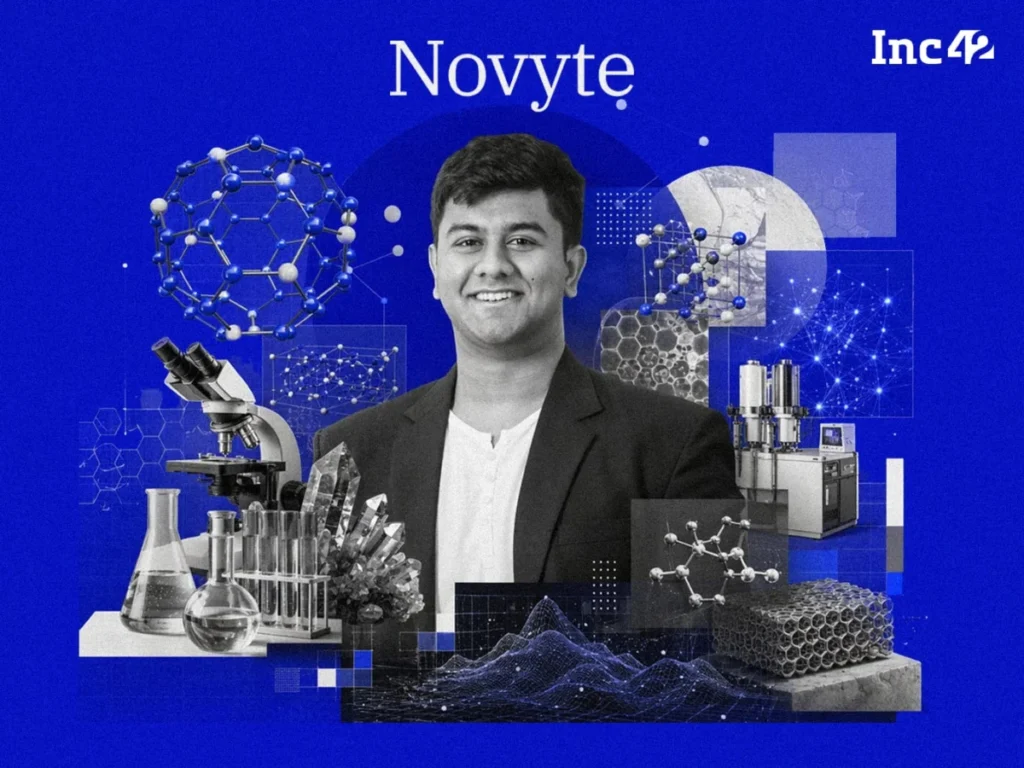
Beyond Discovery: How Novyte Materials is Re-Engineering the Industrial R&D Lifecycle with Agentic AI
In the high-stakes world of material science, the chasm between a promising laboratory discovery and a commercially viable product is often where innovation goes to die. For decades, the development of new materials—from advanced polymers to specialty chemicals—has been a grueling, iterative marathon. Scientists spend months poring over centuries of research, meticulously designing experiments, and analyzing failures, only to find that their breakthroughs cannot be manufactured economically or integrated into existing factory infrastructure.
Mumbai-based deeptech startup Novyte Materials is attempting to bridge this "valley of death" by deploying agentic AI. While much of the global hype cycle focuses on the generative capability of AI to "dream up" new materials, Novyte is pivoting toward a more pragmatic reality: the automation of the industrial R&D lifecycle. By focusing on formulation optimization and synthesisability, the startup aims to compress years of industrial research into mere months.
The Industrial Bottleneck: Why Discovery Isn’t Enough
The traditional process of material development is notoriously inefficient. It is a cycle of trial-and-error that is frequently derailed by variables outside of a scientist’s control. Even when a brilliant mind identifies a material with superior properties, the "real-world" constraints—thermal behavior, corrosion resistance, and, most importantly, the ability to synthesize the material at scale—often render the discovery useless.
"Most chemical manufacturers spend years refining existing formulations—changing ingredient concentrations, replacing hazardous chemicals, or adapting to different production environments," explains Ajaz Khan, founder of Novyte Materials. "This isn’t just about discovery; it’s about the drudgery of optimization. It’s about repeated literature reviews and resource-heavy testing."
According to Khan, the industry’s obsession with "generating" new structures is misplaced. Many current AI models can output millions of theoretically stable structures that lack a plausible chemical route to production. "Synthesisability is mostly ignored," he notes. "Models hand you beautiful structures with no path to reality, and property prediction remains shallow, failing to feed experimental failures back into the loop."

Chronology and Evolution: From ICT Mumbai to the Industry Frontline
Founded in 2025 and incubated at the Institute of Chemical Technology (ICT) in Mumbai, Novyte Materials emerged with a clear mission: to create a "synthesis layer" for the chemical industry.
- 2025 (Foundation): Ajaz Khan, a chemical engineer, establishes Novyte, focusing on the intersection of deep learning and industrial chemistry.
- Late 2025 (Seed Funding): The startup secures a ₹4.5 Cr pre-seed round led by Thiea Ventures, with participation from industry veterans including Sandesh Paturi (Venwiz) and Niharika Jain (Chemvera).
- Early 2026 (Infrastructure): Novyte joins NVIDIA’s Inception program, gaining access to critical GPU infrastructure and technical support to train its proprietary models.
- Mid-2026 (Commercial Traction): The company signs a landmark royalty agreement with Chemvera Specialty Chemicals to develop and commercialize a high-value chemical for the polymer industry.
- Present Day: The company reports a high-single-digit base of paying customers, with many expanding their R&D deployments significantly within the first year of implementation.
The Technology: Inside the "Novyte Q" Platform
Novyte’s primary engine, Novyte Q, is designed to act as an AI-powered scientific partner. Unlike general-purpose LLMs, Novyte’s models are "chemistry-aware," trained to understand complex reaction pathways and material properties.
How the Platform Works
- Literature Synthesis: The AI agent reviews between 500 and 1,000 scientific sources per iteration, identifying trends that might take a human researcher weeks to compile.
- Physics-Informed Validation: The system utilizes reinforcement learning paired with Density Functional Theory (DFT)—an industry-standard quantum chemistry technique—to evaluate the chemical stability of proposed formulations.
- Reverse Engineering: Perhaps most disruptively, the platform can reverse-engineer competitor materials and specialty chemicals using only Technical Data Sheets (TDS) and fundamental material properties.
- Deployment: To protect proprietary intellectual property, Novyte does not rely on a public cloud. The software is deployed on-premise using the client’s own GPU hardware, ensuring sensitive research data never leaves the facility.
The results have been tangible. In one case study, a specialty chemicals manufacturer utilized Novyte Q to replace a hazardous additive. The platform helped the team hit their target specification in just 40 trials—a significant improvement over their historical baseline of 200 trials—resulting in a 58% reduction in both laboratory workload and project timelines.
Market Landscape: A $5.5 Billion Opportunity
The global appetite for AI in materials discovery is surging. According to data from Market.us, the sector is expected to balloon from $536 million in 2024 to approximately $5.5 billion by 2034, representing a robust CAGR of 26.4%.
However, the field is becoming increasingly crowded. Globally, companies like CuspAI, Orbital Materials, and Citrine Informatics are raising hundreds of millions of dollars to build the next generation of industrial R&D tools. In India, while the competitive landscape is thinner, startups like Whizzo (focused on engineered textiles) and RF Nanocomposites (defense-grade materials) highlight a growing national interest in deeptech.

Yet, Novyte maintains a distinct strategy. While competitors focus on the "generation" phase, Novyte is positioning itself as the "synthesis layer"—the entity that turns an AI-generated candidate into a tangible, manufacturable product. As Khan succinctly puts it, "We compress the search and the drudgery, not the scientist’s judgment."
Implications: The Future of Industrial R&D
The integration of agentic AI into materials science is not without its skeptics. Bryce Meredig, founder of Citrine Informatics, has previously questioned how businesses built on generalized AI discovery can consistently deliver venture-scale returns.
Novyte’s response to this challenge is a deliberate architectural choice. By building a three-layer stack—Discovery, Physics Validation, and Synthesis Workflow—the startup is attempting to ensure that every AI suggestion is backed by a concrete, actionable plan for manufacturing.
Key Takeaways for the Industry:
- Human-in-the-Loop: Novyte emphasizes that AI is not a replacement for scientists. Humans retain control over defining constraints and making the final "go/no-go" decisions, keeping the scientist in the seat of judgment.
- Royalty-Based Models: By signing royalty agreements (such as the deal with Chemvera), Novyte is aligning its success with the commercial success of its clients, rather than relying solely on software-as-a-service (SaaS) fees.
- Infrastructure Sensitivity: The trend toward on-premise AI deployments is likely to accelerate, as chemical and manufacturing giants become increasingly protective of their proprietary formulations in the era of large-scale AI models.
Conclusion
Novyte Materials represents a shift in the deeptech narrative: moving away from the "magic" of AI generation and toward the gritty reality of industrial optimization. By focusing on the "synthesisability" of materials, the Mumbai-based firm is solving the most painful bottleneck in the chemical sector.
As the company continues to scale its roster of enterprise clients—including names like Manipal Specialty Chemicals and Primacy Industries—the true test will be whether its "synthesis layer" can consistently produce the high-value, manufacturable materials that the global market demands. If Novyte succeeds, it may well prove that the future of materials science lies not just in finding new elements, but in perfecting the process of making them.