Architecting Intelligence: A Comprehensive Guide to Choosing the Right AI Agent Memory Strategy
In the rapidly evolving landscape of agentic AI, memory is frequently treated as an afterthought—a "bolt-on" feature rather than a core architectural pillar. Developers often find themselves in a precarious middle ground: either building agents that suffer from chronic amnesia, failing to recall vital user context, or conversely, over-engineering complex, latent-heavy infrastructure that provides little tangible value to the agent’s reasoning process.
The fundamental design challenge is not merely deciding where to store data, but answering the more critical question: How long should specific categories of information live, and what is the optimal retrieval mechanism for each?
To build robust, production-grade agents, we must move beyond monolithic storage solutions and embrace a multi-layered approach to memory. By utilizing a deliberate, decision-tree-based methodology, practitioners can categorize information types and map them to the appropriate memory architecture.
The Core Philosophy: Why Memory Classification Matters
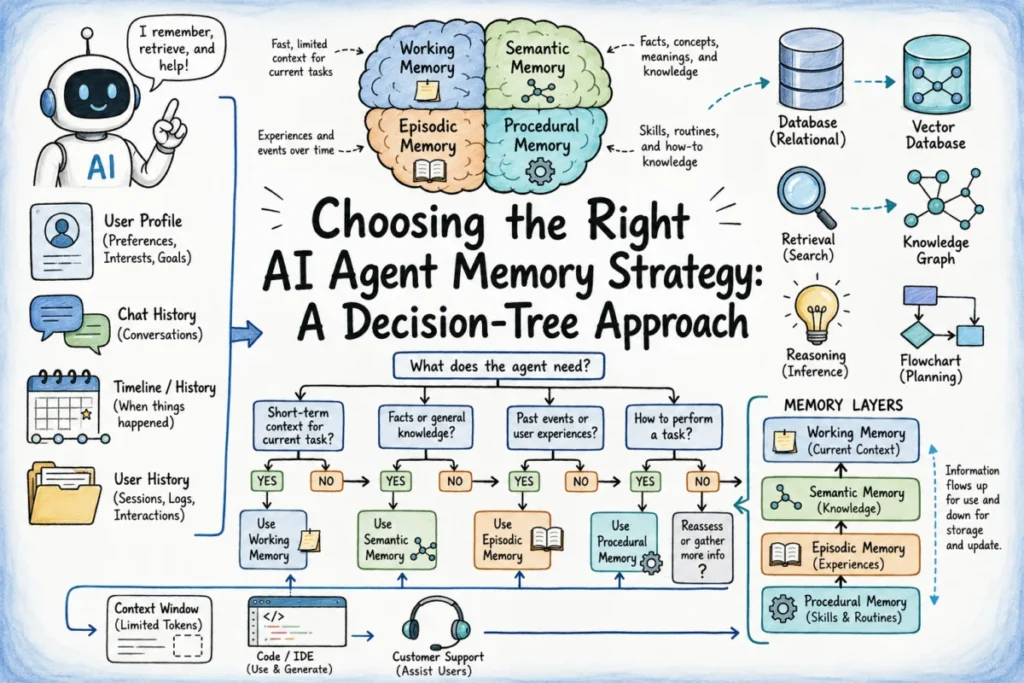
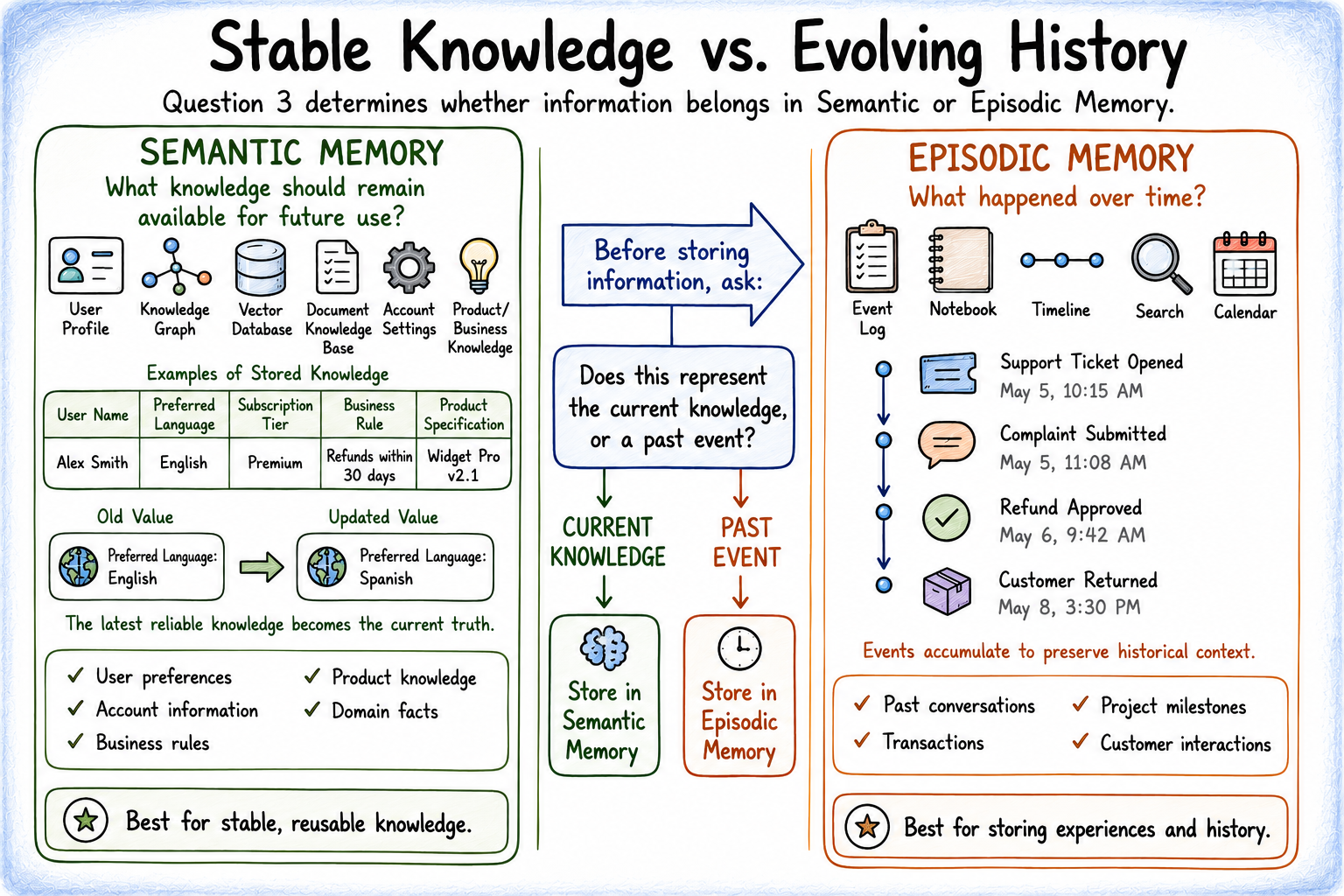
Before diving into the decision tree, it is essential to understand the functional taxonomy of agent memory. Much like human cognition, which bifurcates into distinct memory systems, AI agents benefit from specialized storage layers.
The Four Pillars of Agent Memory
- Working Memory: The "mental scratchpad" used for the immediate, active conversation. It is high-speed, volatile, and context-dependent.
- Semantic Memory: The repository of stable facts, user preferences, and generalized domain knowledge. It is the agent’s "encyclopedia."
- Episodic Memory: A historical log of past interactions and events. This provides the agent with a narrative sense of "what happened" in previous sessions.
- Procedural Memory: The learned "how-to" knowledge—the distilled routines and workflows that allow an agent to become more efficient over time.
Problems invariably arise when these layers are conflated. For instance, storing transient session state in a vector database introduces unnecessary latency and noise, while relying on a simple conversation buffer to hold critical, long-term user preferences will lead to "memory drift," where the agent eventually forgets core identity markers.
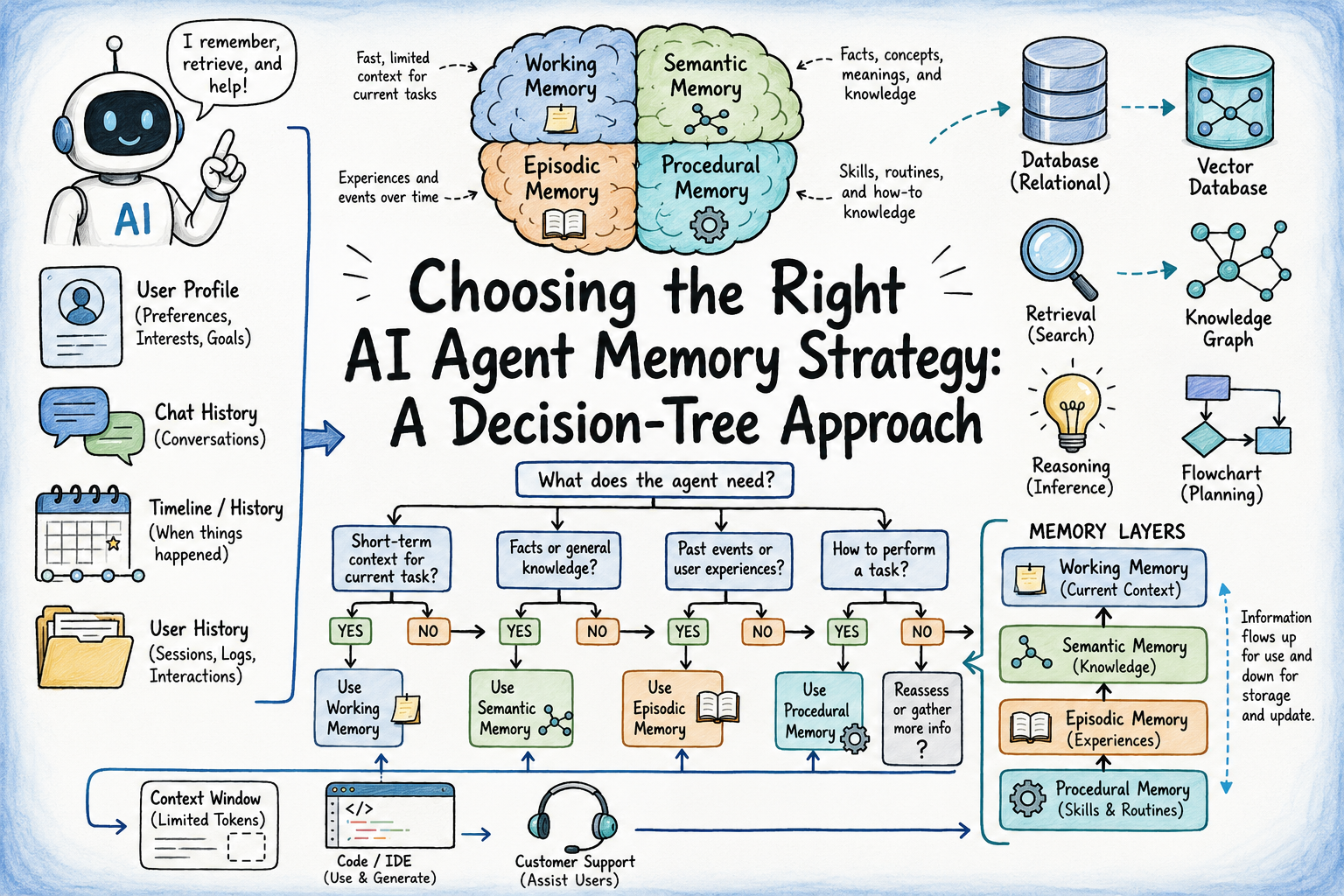
A Decision-Tree Approach: Categorizing Information
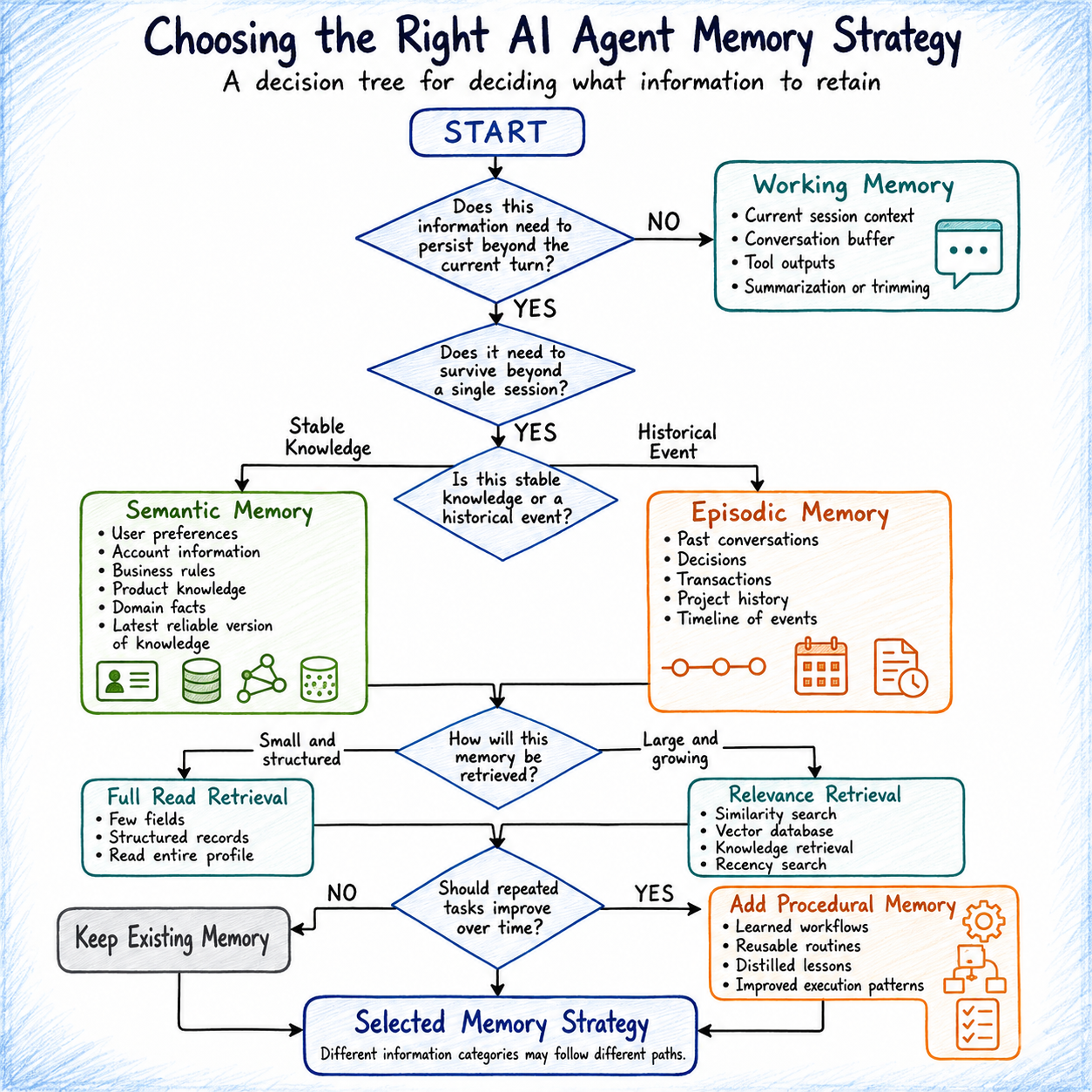
To determine the correct strategy, we must apply a rigorous five-step decision tree to every distinct category of information the agent handles. Do not attempt to apply one strategy to the entire agent; instead, treat each data point as a unique candidate for a specific memory layer.
1. Persistence: Beyond the Current Turn
The first question is simple: Does this information need to persist beyond the current turn?
If the information is self-contained—such as a specific question about a current document—the standard context window is sufficient. There is no need for architectural overhead. If the information must carry forward to future exchanges, proceed to the next step.
2. Session Durability: Working vs. Long-Term
Does it need to survive beyond a single session?
If the answer is no, you are looking at Working Memory. This is typically implemented via a conversation buffer, often combined with intelligent summarization to keep the token count manageable while maintaining the thread of the dialogue. If the information must outlive the session, it moves into the realm of durable storage.
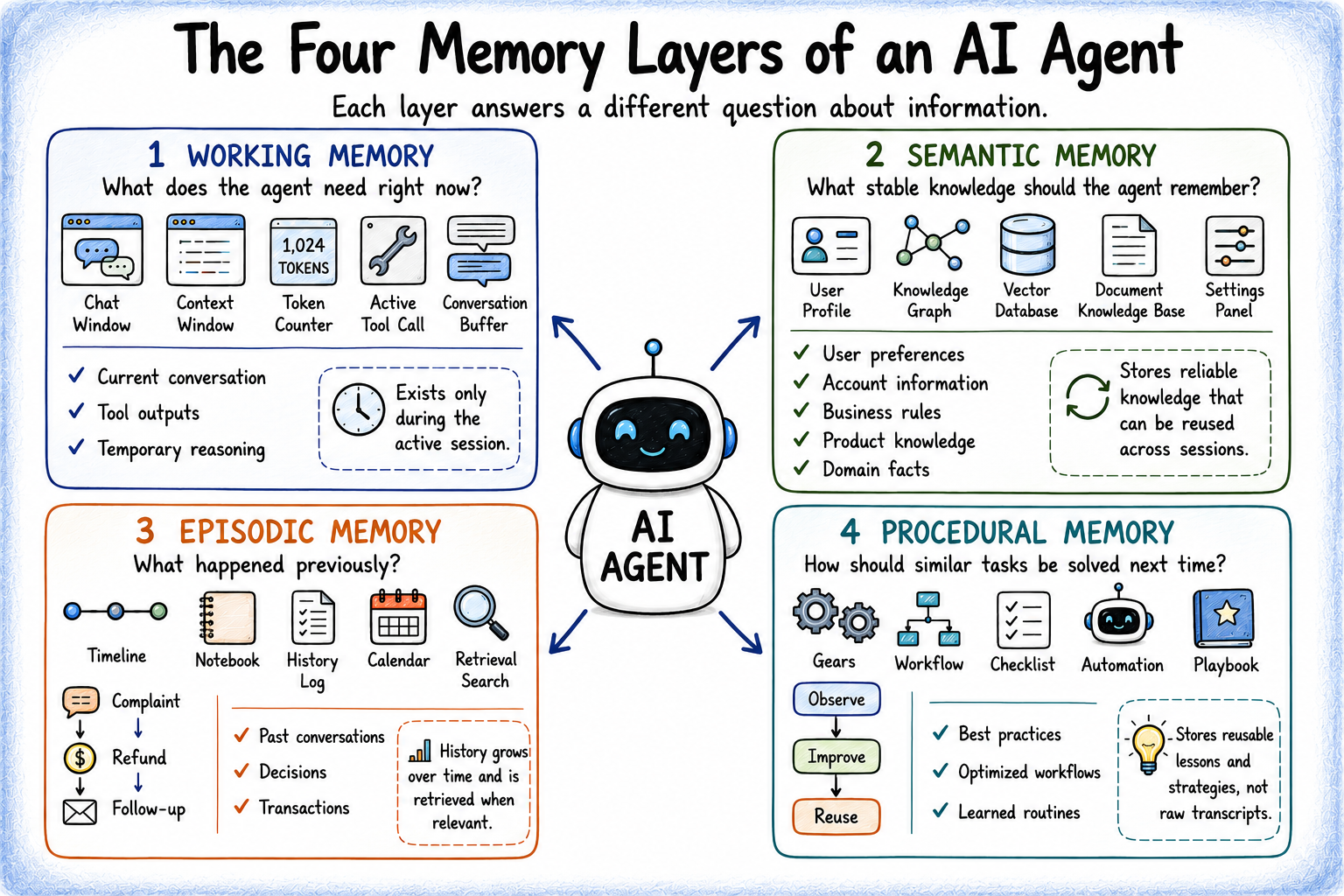
3. Stability: Facts vs. Events
This is the most common point of failure in current agent design. Is this a stable fact, or is it an evolving event?
- Stable Facts: These are user attributes, subscription tiers, or established ground truths. They belong in Semantic Memory, often housed in structured records or knowledge graphs.
- Evolving Events: These are historical logs, past complaints, or interaction timestamps. These belong in Episodic Memory.
Using a vector store for a static user preference—such as "User prefers Python over C++"—is inefficient. A simple key-value store or a structured profile is faster and more reliable.
4. Retrieval Mechanics: Scaling the Access
How will this memory be retrieved?
Retrieval strategy must match the scale of the data. For small, high-value datasets (like a user profile), a "full-read" approach—where the agent pulls the entire record into the context window—is superior to vector search. Conversely, for vast episodic logs, similarity search (vector retrieval) is necessary to surface relevant context without overwhelming the context window.
5. Procedural Improvement: The Learning Loop
Finally, does the agent need to learn reusable procedures?
This is the domain of Procedural Memory. It does not replace the other layers; it acts as an overlay. By distilling successful past actions into reusable "recipes," the agent can bypass the trial-and-error phase in future tasks.
Chronology of Memory Design
In the early stages of agent development, engineers often rely on "Naive RAG" (Retrieval-Augmented Generation), dumping all history into a single vector database. This leads to a degradation in performance as the database grows, with the agent struggling to differentiate between high-level facts and low-level noise.
The progression of a mature agent architecture follows a predictable path:
- Phase 1 (The Stateless Era): The agent relies purely on the prompt’s context.
- Phase 2 (The Buffer Era): The introduction of simple message history for session-based continuity.
- Phase 3 (The Specialized Store Era): Segregating facts (semantic) from history (episodic).
- Phase 4 (The Agentic Learning Era): Implementing procedural layers that allow the agent to optimize its own workflows based on historical success.
Supporting Data and Performance Implications
Evidence from current production environments suggests that context-window optimization is the primary driver of agent cost and latency. By offloading static information to a structured database and keeping only high-entropy, session-relevant information in the active context, latency can be reduced by up to 40% in complex workflows.
Furthermore, "context pollution"—where irrelevant or stale information is retrieved—is the leading cause of hallucination. By using the proposed decision tree, developers can ensure that only the most pertinent information is injected into the prompt, significantly increasing the reliability and accuracy of the agent’s output.
Implications for Future AI Development
The shift toward deliberate memory architecture signals a maturing industry. We are moving away from the era of "General Purpose Chatbots" toward "Task-Oriented Agents" that exhibit genuine, long-term competence.
For developers, the implication is clear: stop treating memory as a black box. Start treating it as a tiered database problem. The agents of the future will not necessarily be "smarter" in terms of model weights, but they will be significantly more effective because they possess a superior infrastructure for recalling what matters and discarding what does not.
Summary Table of Memory Layers
| Layer | Primary Utility | Recommended Implementation |
|---|---|---|
| None | Immediate context only | Prompt injection only |
| Working | Intra-session continuity | Rolling buffer + summarization |
| Semantic | Stable facts/preferences | Knowledge graphs / Structured DBs |
| Episodic | Historical narrative | Vector DBs / Chronological logs |
| Procedural | Workflow optimization | Distilled "recipe" store |
Common Pitfalls and Mitigation Strategies
Even with a clear strategy, implementation errors persist.
- The "All-Vector" Trap: Storing everything in a vector database is a lazy design choice that creates retrieval noise. Use structured storage for facts whenever possible.
- The "Indigestion" Problem: Agents often try to "learn" from raw logs. This fails because raw logs are messy. Fix: Implement a "Distillation Layer" that summarizes logs into actionable lessons before committing them to procedural memory.
- The "Stale Fact" Paradox: Over time, semantic memory becomes outdated. Fix: Implement a versioning system or a "validity window" for facts, ensuring the agent prioritizes the most recent information.
Conclusion
Memory is the bridge between a simple chat interface and a functional, autonomous agent. By applying the five-step decision tree, you can strip away the unnecessary complexity of your current infrastructure and replace it with a tiered, efficient system that serves the agent’s specific needs.
The future of AI agent development lies not in bigger models, but in better context management. By categorizing information by persistence, stability, and utility, you provide your agents with the cognitive structure they need to excel in complex, real-world environments. The next step is to evaluate current memory frameworks—such as Zep, MemGPT, or LangGraph—with this refined understanding of your specific application requirements.