The Architecture of Intelligence: Mastering Context and Memory Engineering in Agentic AI
As AI agents transition from simple chatbots to autonomous systems capable of executing complex, multi-session workflows, developers are encountering a recurring set of performance bottlenecks. These include critical instructions being dropped mid-task, irrelevant information resurfacing during sensitive operations, and historical data "bleeding" into current reasoning chains. While these errors appear to be hallucinations or logic failures, they are often symptoms of a more fundamental structural problem.
The underlying challenge lies in the conflation of two distinct but deeply interrelated disciplines: Context Engineering and Memory Engineering. To build agentic systems that scale across real-world workloads, developers must treat these as separate, specialized layers of the intelligence stack.
The Core Distinction: Ephemeral vs. Persistent Intelligence
At the highest level, the difference between these two disciplines is one of temporal scope.
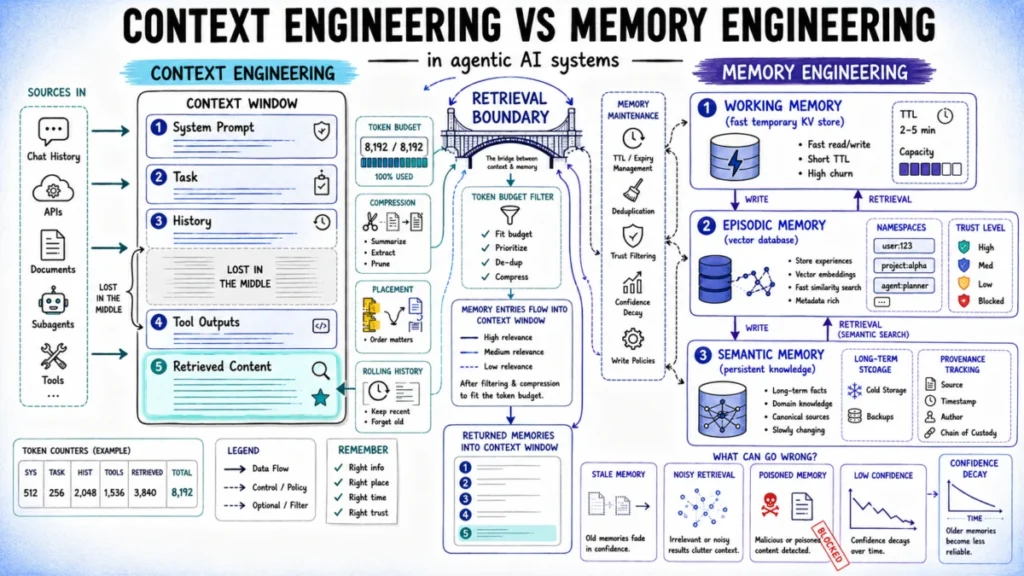
Context Engineering is the art of the "now." It covers the design of a single inference call—the ephemeral window of information that a Large Language Model (LLM) considers before generating a response. Everything within this window is transient; once the inference is complete, the window is wiped clean.
Memory Engineering, by contrast, is the science of the "forever." It focuses on the infrastructure required to store, govern, update, and retrieve information across sessions. If an agent recalls a user preference from last month, coordinates with a sub-agent, or applies a lesson learned from a previous failure, it is functioning via its memory architecture, not its context window.
Comparative Framework
| Aspect | Context Engineering | Memory Engineering |
|---|---|---|
| Scope | Single inference call | Across calls, sessions, and agents |
| Primary Goal | Optimization of the "Active Window" | Long-term reliability and persistence |
| Fails When | Noise overwhelms signal; token limits breached | Retrieval misses; staleness; data poisoning |
| Key Surface | Prompt structure; token budgeting | Schema design; retrieval/write policies |
Context Engineering: Designing the Optimal Reasoning Space
For an agent running a complex workflow, the context window is a limited resource. Every inference call acts as a "stage" where system prompts, task descriptions, conversation history, and retrieved documents compete for the model’s attention.
The Challenge of Selective Inclusion
The most common mistake in context engineering is the "everything-in-the-kitchen-sink" approach. Developers often pass entire database dumps or raw logs into the prompt. This creates two problems: it exhausts the token budget and introduces noise that degrades the model’s reasoning capabilities. Effective context engineering requires a strict policy of selective inclusion:
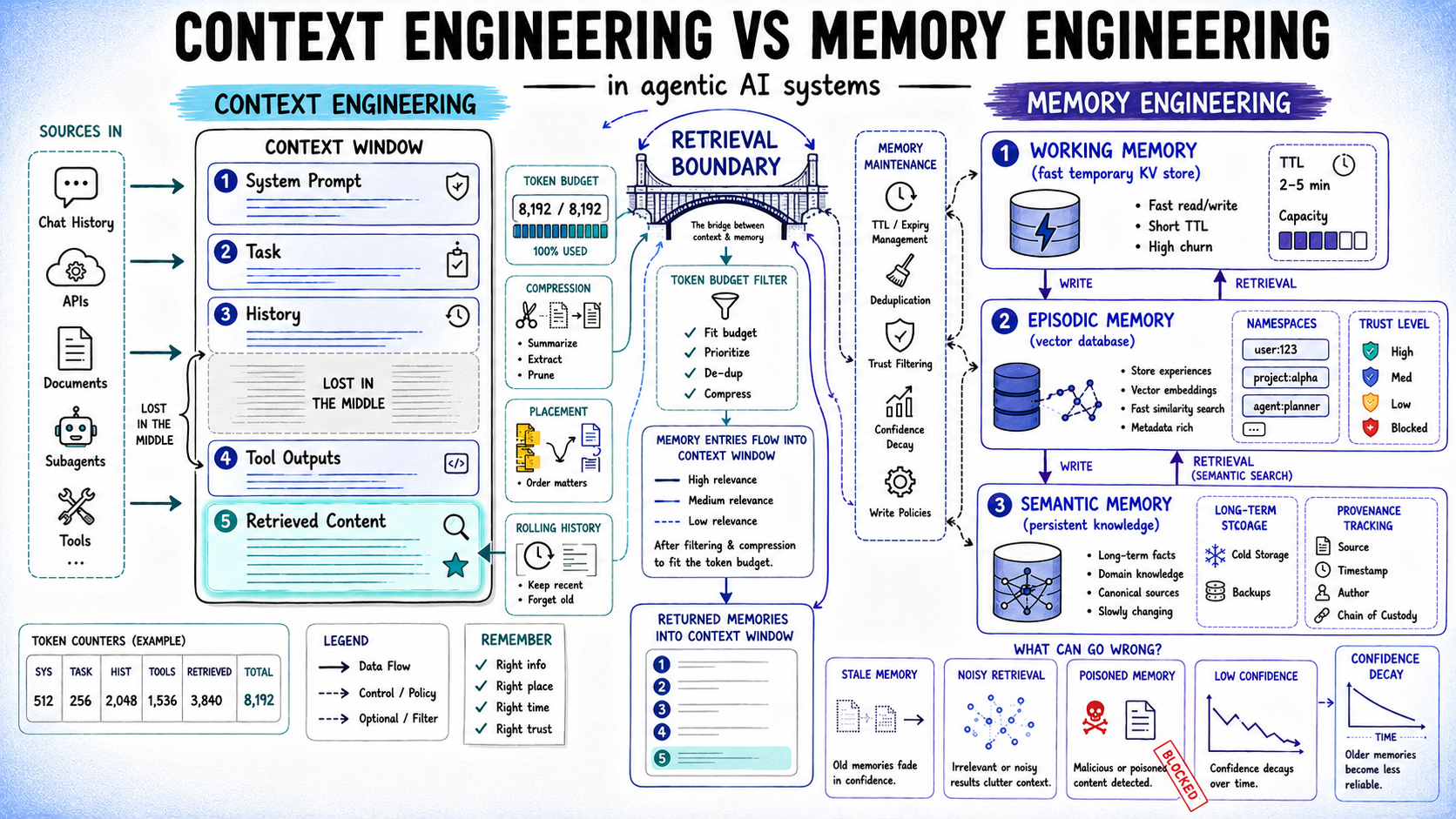
- Summarization: Raw data (like 3,000-token API logs) must be compressed before entering the context window.
- Extraction: Rather than passing full documents, extract only the specific entities or facts relevant to the current objective.
Navigating the "Lost in the Middle" Phenomenon
Research into transformer architectures has confirmed the "lost in the middle" effect: models pay the most attention to information at the very beginning and very end of their input.
- The Strategy: Place hard constraints and core system instructions at the absolute beginning. Place retrieved data—the "evidence"—immediately preceding the final user query. This ensures that the model’s reasoning process is directly anchored by the most relevant data points.
Dynamic Conversation Management
History grows linearly, but context windows are fixed. To prevent degradation, agents must employ hierarchical summarization. Instead of appending every turn, the system should maintain a "State Store" that periodically summarizes older interactions, keeping only the most recent few turns in the active prompt.
Memory Engineering: Building the Brain of the Agent
If context is the working memory, the memory system is the long-term repository. This layer dictates how an agent learns and evolves.
The Write Policy: A Gatekeeper for Quality
Memory quality is determined at the moment of entry. If you write everything to memory, you create a system that becomes progressively more polluted over time. A robust Write Policy acts as a filter:
- Importance Scoring: Does this piece of information provide long-term value?
- Confidence Weighting: Is this information confirmed, or is it a speculative inference?
- Provenance Tracking: Where did this come from? If an agent hallucinates a fact, knowing the source allows for system-wide corrections.
Storage Layer Architecture
Memory engineering requires selecting the right backend for the right task. A one-size-fits-all approach typically fails:
- Working Memory: Uses high-speed key-value stores (e.g., Redis) for active task states.
- Episodic Memory: Uses vector databases to store past interactions for semantic similarity search.
- Semantic Memory: Stores static, high-value facts (user preferences, system knowledge) using a hybrid approach of exact key lookups and vector search.
The Retrieval Boundary: Where Memory Meets Context
The point of intersection—the "Retrieval Boundary"—is where most complex agent systems succeed or fail. The goal is to bridge the gap between massive, unstructured storage and a constrained, structured prompt.
Failure Mode: The Budget-Blind Retrieval
A frequent failure occurs when retrieval systems function without awareness of the context budget. If a search engine returns 20 documents, but the context window only has space for three, the system must decide which are most valuable.
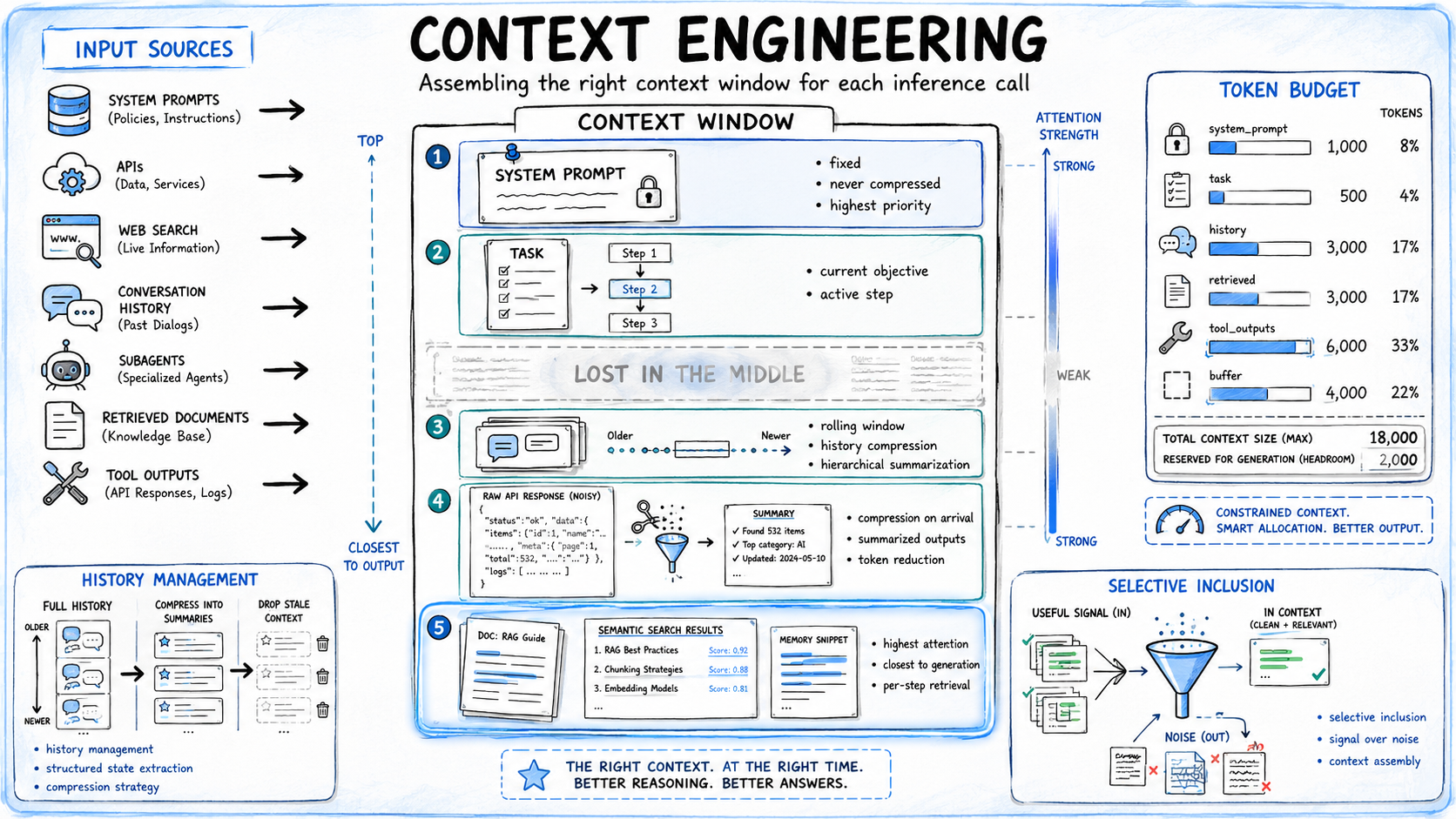
The industry is moving toward Retrieval-Aware Context Assembly. In this pattern, the context layer explicitly defines a max_tokens budget for the retrieval layer. The retrieval layer then ranks candidates not just by semantic relevance, but by a combination of relevance and token cost, ensuring the highest-density information makes it into the prompt.
Failure Mode: Poor Placement
Even if the retrieval system pulls the "perfect" documents, they can be rendered useless by poor placement. If a model is tasked with answering a question, and the answer is buried in the middle of a 10,000-token retrieved document, the model will likely miss it.
Architectural Recommendation: Retrieved information should be treated as "contextual support." It should be processed through a re-ranking stage that identifies the most salient snippets and positions them near the end of the context window, directly adjacent to the model’s response generation point.
Implications and Future Outlook
The evolution of AI agents is shifting from "how to prompt" to "how to architect." As we look toward the future, the integration of these two disciplines suggests three key industry shifts:
- Self-Optimizing Memory: We are seeing the rise of "maintenance agents"—secondary processes that audit the primary agent’s memory. These processes perform deduplication, decay stale facts, and compress episodic memories during system downtime, ensuring the memory store doesn’t degrade.
- Standardized Schemas: The industry is converging on structured
MemoryEntryobjects. By forcing data into schemas—includingtrust_level,confidence, andimportance—developers can build more predictable systems that handle uncertainty gracefully. - Context-Awareness in Models: We expect future LLMs to have "native" memory slots or better attention mechanisms for multi-turn contexts, which will alleviate some of the manual heavy lifting currently required in context engineering. However, the fundamental need for a disciplined, external memory strategy will remain.
Conclusion
Context engineering and memory engineering are two sides of the same coin. Context engineering ensures the model is "in the moment," while memory engineering ensures it is "informed by the past."
When handled separately, they lead to fragmented, unreliable agents. When integrated into a unified retrieval-to-context pipeline, they create a robust foundation for intelligence. By enforcing strict budget constraints, prioritizing placement, and maintaining rigorous write policies, developers can move beyond the current limitations of AI and build agents that are truly capable of multi-session reasoning, learning, and sustained performance.
The future of agentic AI will not be won by the smartest model, but by the most resilient architecture—one that knows exactly what to remember, and exactly how to use it.