Navigating the Spectrum: Agentic Workflows vs. Autonomous Agents in Enterprise AI
As generative AI transitions from experimental playgrounds to the backbone of corporate operations, a critical architectural divide has emerged. Deloitte projects that by 2027, up to 50% of organizations utilizing generative AI will have deployed agentic pilots. Yet, amidst this gold rush, a pervasive terminological drift has occurred. The term "agentic" is now frequently applied to everything from a simple prompt-chained script to a self-directing system of multiple agents.
This semantic ambiguity creates significant operational risk. Conflating a rigid, predictable pipeline with an open-ended autonomous system leads to two failure modes: over-engineering simple tasks with unnecessary complexity, or under-engineering mission-critical problems by forcing them into brittle, linear structures. To build resilient AI, engineers must understand that the fundamental divide is not "AI vs. No AI," but rather Predictability vs. Autonomy.
The Core Distinction: Who Owns the Control Flow?
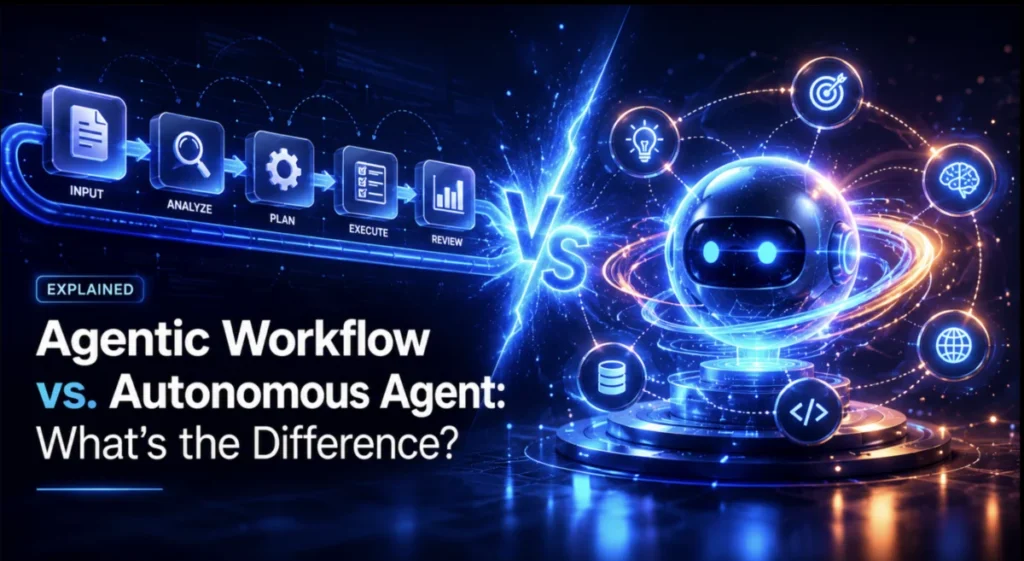
The foundational line, as articulated by Anthropic in their "Building Effective Agents" framework, rests on one factor: control flow ownership. In a workflow, the path is predefined by a human via code. In an agentic system, the model dynamically directs its own process, tool usage, and trajectory at runtime.
The Axis of Predictability
Before selecting an architecture, architects must ask two diagnostic questions:
- Does this process require strict auditability, repeatability, and step-by-step explainability?
- Is the correct path to a solution known in advance, or must the system discover it dynamically?
A system can be heavily powered by an LLM yet remain entirely deterministic. Conversely, an agent can be "agentic" but strictly constrained by a limited action space and hard step limits. The presence of an LLM call is merely a feature; the location of the decision-making logic is the architectural signal.
Chronology of Architectural Evolution
The development of agentic systems has evolved through four distinct stages, each reflecting a different balance between human control and machine autonomy.
1. Deterministic Workflows: The Baseline
Deterministic workflows represent the status quo of modern software engineering. Here, a human programmer defines the sequence of operations at design time. While an LLM may be invoked for specific tasks—such as classification or text summarization—the model acts as a subroutine within a fixed pipe.
In this model, the output of the LLM is treated as data, not as a decision-making directive. Regardless of what the LLM generates, the next function in the code sequence is predetermined. This is the gold standard for compliance and regulatory environments where every branch of logic must be testable and auditable.
2. Orchestrated Workflows: The Dynamic Middle Ground
Often misidentified as "agentic," orchestrated systems represent the most common pattern in current enterprise deployments. In these systems, a human defines a set of potential paths or "branches" in advance, but the selection of the path is delegated to the LLM at runtime.
The LLM acts as a router, selecting a branch from a predefined "menu" (e.g., ROUTE_MAP). While the system feels dynamic, it cannot invent a new category of action. It is constrained by the guardrails explicitly set by the developer.
3. Reactive Agents: The ReAct Threshold
Real autonomy begins with the ReAct (Reasoning + Acting) loop. Popularized by Yao et al. in 2022, this pattern empowers the model to determine its own trajectory based on the observation of its previous actions. There is no predefined if-then sequence. Instead, the agent iterates through a cycle of thought, action, and observation until an exit condition is reached. The sequence length, the tool selection, and the number of steps are all emergent properties of the runtime environment.
4. Autonomous Multi-Agent Systems
The apex of this spectrum involves nesting ReAct loops. In these systems, an orchestrator agent delegates tasks to specialized sub-agents. These sub-agents run their own independent reasoning loops. The "swarm" pattern, as categorized by Google Cloud, removes the central orchestrator, allowing agents to collaborate autonomously. While this offers the potential for creative problem-solving, it also introduces significant unpredictability and high compute costs.
Supporting Data and Technical Realities
The transition from deterministic workflows to autonomous agents is not merely a technical upgrade; it is a trade-off of guarantees.
| Architecture | Predictability | Auditability | Flexibility |
|---|---|---|---|
| Deterministic | Absolute | High | Low |
| Orchestrated | High | Medium | Medium |
| Reactive Agent | Low | Low | High |
| Multi-Agent Swarm | Very Low | Very Low | Very High |
In production environments, data indicates that the "Hybrid Model" is winning. Mature systems often employ a high-level agent for goal-setting while anchoring critical, sensitive computations in deterministic modules. For instance, a financial AI might use an agent to analyze market sentiment (high-flexibility/low-predictability) but force the final transaction execution through a hardcoded, deterministic validation pipeline (low-flexibility/high-predictability).
Official Perspectives and Industry Implications
Industry leaders, including Google Cloud and Anthropic, have emphasized that these architectures should not be viewed as a ranking from "primitive" to "advanced." Instead, they are distinct tools for different categories of risk and ambiguity.
The Compliance Paradox
For industries like healthcare, law, and finance, the "black box" nature of autonomous agents remains a barrier to adoption. If a system cannot explain its step-by-step reasoning, it cannot be audited for bias or error. Consequently, most production systems in 2025 remain firmly in the "Orchestrated Workflow" territory. These systems provide the "illusion" of intelligence through dynamic routing, while keeping the critical business logic under the strict control of the human-authored code.
The Cost of Autonomy
Beyond compliance, there is the issue of "compute drift." In an autonomous loop, an agent might enter an infinite cycle of tool-calling or produce hundreds of unnecessary reasoning tokens. Without strict human-set boundaries—such as max-step limits or token-budget caps—autonomous agents can become prohibitively expensive, consuming compute resources far beyond their value-add.
Conclusion: Designing for the Right Level of Autonomy
The current hype surrounding autonomous agents often obscures the reality that most business problems are better solved by well-orchestrated workflows.
"Agentic" is not a synonym for "better." It is a synonym for "less predictable."
To build successful systems, developers must resist the urge to automate autonomy where it is not required. By placing each piece of the application at the appropriate point on the spectrum—using deterministic pipelines for repeatable tasks and reserving agentic reasoning for truly ambiguous problems—organizations can build systems that are both powerful and reliable. The future of enterprise AI does not belong to the most autonomous agent, but to the most intelligently orchestrated hybrid system.