The Ethics of Authority: Navigating the Complex World of Big Media Product Recommendations
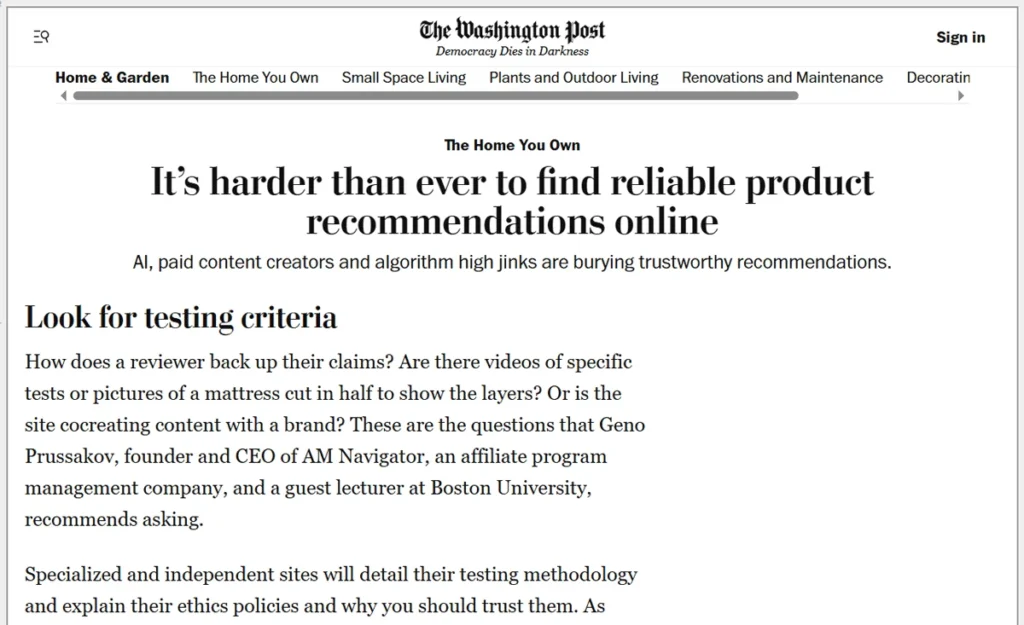
In the modern digital landscape, the line between editorial independence and commercial enterprise has become increasingly blurred. When a legacy news organization—a pillar of journalism—recommends a vacuum cleaner, a mattress, or a specific brand of noise-canceling headphones, consumers naturally view that endorsement through the lens of trust. However, behind every “Best of” list lies a sophisticated ecosystem of affiliate marketing, data-driven SEO, and monetization strategies that are fundamentally changing the nature of online advice.
Earlier this year, The Washington Post invited me to weigh in on this shifting paradigm. While my contribution to their piece was concise, the nuances of the industry require a deeper, more rigorous examination. This analysis explores how big media leverages its hard-earned authority, the mechanisms of trust, and the essential strategies consumers must employ to navigate an era where every click is a transaction.
The Evolution of Media Monetization: From Subscriptions to Affiliate Revenue
For decades, the business model of major media outlets was straightforward: print subscriptions, display advertising, and classifieds. The arrival of the internet decimated these revenue streams, forcing publishers to look for new ways to keep their newsrooms funded. The result was the rise of the “Affiliate Model.”
The Mechanism of Authority
Big media players possess a rare, high-value asset: "Search Authority." Because their domains have been indexed for decades, they carry significant weight with search engines like Google. When a major newspaper publishes a product review, it almost immediately ranks at the top of search results. This is not merely an editorial achievement; it is a search engine optimization (SEO) powerhouse.
By creating content that ranks for high-intent search terms—such as "best laptop for students" or "best home security system"—publishers can insert affiliate links. When a reader clicks a link and makes a purchase, the publisher earns a commission. This is not inherently malicious; it is a survival strategy. However, it creates an inevitable tension: Is the recommendation made because the product is truly the best, or because the partnership is the most profitable?
Chronology: The Shift Toward Commercial Content
To understand how we arrived at this moment, we must look at the timeline of digital transformation in newsrooms:
- 2010–2014: The Experimental Phase. Early adopters began testing the waters of affiliate links, often burying them in technology-focused articles.
- 2015–2018: The Rise of Dedicated Review Vertical. Publications like Wirecutter (acquired by the New York Times) demonstrated that high-quality, long-form product testing could be a primary revenue driver, not just a side project.
- 2019–2022: The "Gold Rush." Recognizing the profitability, nearly every major legacy media outlet launched dedicated commerce desks. These teams were explicitly tasked with creating SEO-friendly content designed to capture consumer spending.
- 2023–Present: The Era of Transparency and Skepticism. As search algorithms evolve and AI-generated content floods the web, consumers have become more cynical. Media outlets are now under pressure to prove that their reviews are still grounded in genuine, human-verified testing.
Supporting Data: The Trust Gap
Research indicates that while consumers rely heavily on digital reviews, their trust is fragile. According to industry studies, over 70% of shoppers consider editorial content from major news sites to be more trustworthy than standard influencer reviews. However, the internal mechanisms of these partnerships are often opaque.
At AM Navigator, our work managing affiliate programs for merchants has provided a front-row seat to how these deals are struck. It is a misconception that these outlets are simply "selling out." Most reputable publishers have implemented rigorous internal safeguards. Their "homework" generally consists of four primary pillars:
- Editorial/Commercial Separation: Many organizations maintain a strict firewall between the commerce team (who identifies products and negotiates deals) and the editorial team (who writes the reviews).
- Product Testing Standards: Reputable outlets often purchase products anonymously, perform blind testing, and utilize independent labs to ensure that the "best" product is determined by performance, not by who offers the highest commission.
- Conflict of Interest Disclosures: Ethical journalism mandates the inclusion of clear, visible disclaimers. If a link is an affiliate link, the reader is informed, allowing them to account for potential bias.
- Data-Driven Revisions: High-performing commerce teams don’t just "set and forget" their reviews. They regularly revisit product rankings based on updated testing, return rates, and customer feedback to maintain their search authority.
The Financial "Thumb on the Scale"
Despite these safeguards, the system is not infallible. The influence of money can manifest in ways that are subtle but significant. As an industry veteran, I have observed that product rankings can occasionally be nudged by financial incentives. These include:
- Placement Fees: A merchant pays a flat fee for a guaranteed "top three" spot in a roundup, regardless of whether they objectively outperform competitors.
- Inflated Commission Rates: Publishers may prioritize merchants who offer a 15% commission over those offering 5%, effectively incentivizing the promotion of products that yield higher margins for the publisher.
- EPC (Earnings Per Click) Guarantees: A merchant may guarantee a certain amount of revenue per click to ensure they remain the featured choice in a high-traffic article.
When a consumer reads a review, they are rarely privy to these negotiations. This is the "hidden architecture" of modern commerce.

Navigating the Marketplace: A Consumer’s Guide
If the landscape is inherently biased by financial interests, how can you make an informed purchase? You must adopt the mindset of an investigator. Here are four steps to ensure your buying decisions remain your own:
1. Look for the "Methodology" Section
Legitimate reviews are backed by a transparent process. Does the author explain how they tested the product? Did they use it for a week? A month? Did they test it against a control group? If a review lacks a detailed methodology section, treat it as a sales pitch rather than a critique.
2. Verify Across Multiple Sources
Never rely on a single "Best Of" list. If a product appears as the #1 choice on three different major media sites, look for the reasoning. If the reasoning is consistent (e.g., "fastest processing speed," "longest battery life"), it is likely a quality product. If the reasoning varies wildly, you are likely looking at the results of varying affiliate negotiations.
3. Check the "Last Updated" Date
The internet moves fast. A "Best Running Shoes of 2022" list is useless in 2025. Ensure the content is fresh. If an article hasn’t been updated in over a year, the recommendations are likely obsolete or maintained only to collect passive, outdated commission revenue.
4. Consult User-Generated Sentiment
Cross-reference the polished editorial review with user reviews on platforms like Amazon, Reddit, or independent forums. While user reviews have their own issues (e.g., fake reviews), the aggregate sentiment of hundreds of real-world users can provide a vital reality check against a singular, professional review.
Implications: The Future of Trust
The long-term implication of this monetization model is a potential erosion of brand equity. If big media outlets prioritize short-term affiliate revenue over long-term editorial integrity, they will eventually lose the very "authority" that makes their commerce content valuable in the first place.
For the affiliate marketing industry, the trend is moving toward greater transparency. Merchants, publishers, and regulators are increasingly aligned on the idea that deceptive practices are a losing game. The future of online product recommendations lies in authentic utility. If a reader feels that their time was saved and their purchase was improved by a recommendation, they will continue to trust the outlet. If they feel manipulated, the brand suffers.
As consumers, we have the ultimate power: our attention and our wallets. By demanding higher standards of transparency and staying skeptical of "guaranteed" top rankings, we can force the industry to prioritize the consumer experience over the commission check.
What do you think? Have you ever felt misled by a major media outlet’s product review? Or do you believe these partnerships provide a net benefit to the consumer? The comments section is open—I look forward to hearing your perspective and continuing this vital conversation.